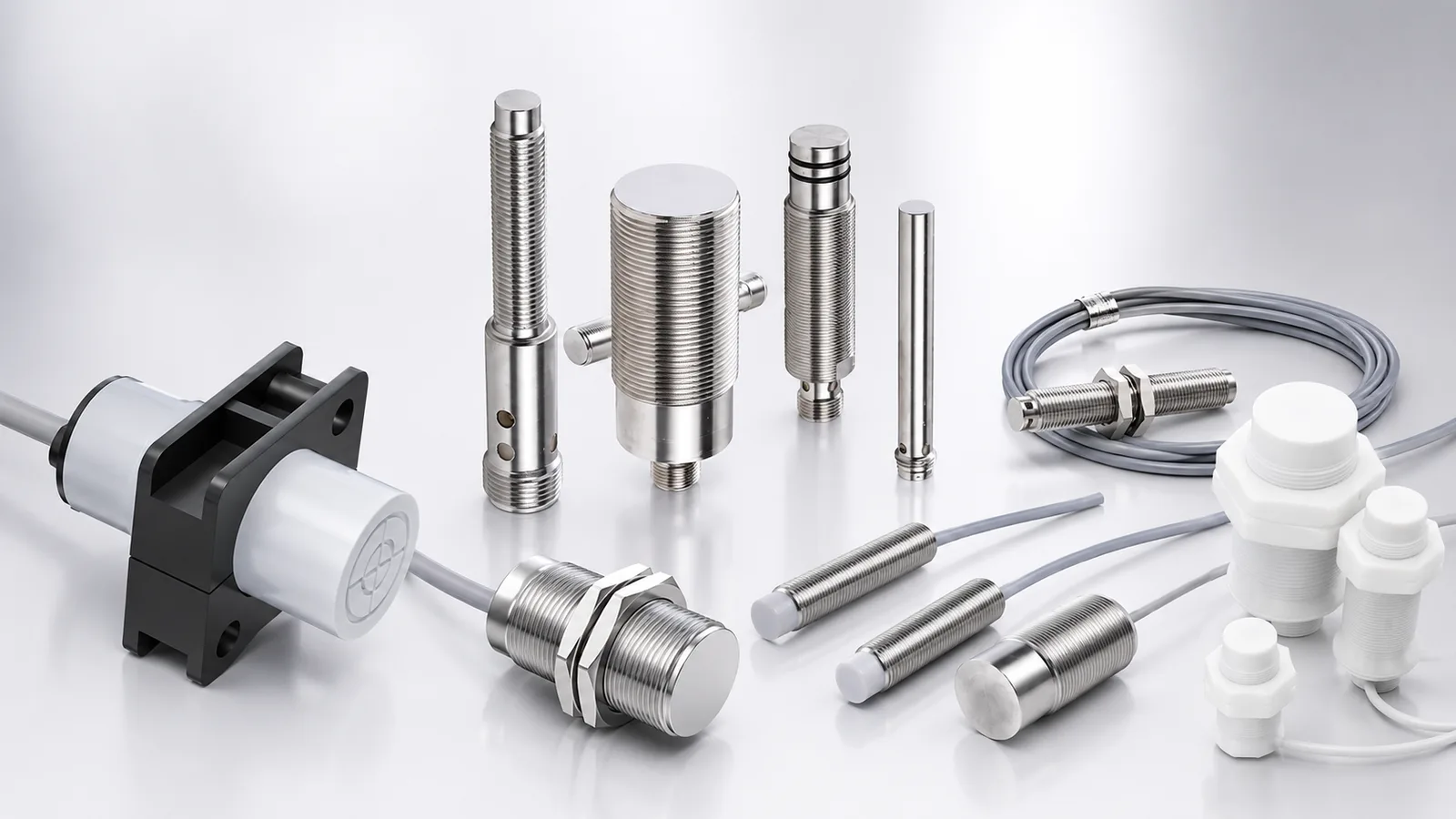
The five types of proximity sensors are inductive, capacitive, photoelectric, ultrasonic and magnetic. Use an inductive sensor for metal targets at a few millimetres, a capacitive sensor for non-metal targets or level through a plastic wall, a photoelectric sensor for longer distances, an ultrasonic sensor for transparent or liquid surfaces, and a magnetic sensor when a magnet can be fitted to the moving part.
What are the five types of proximity sensors?
Proximity sensors are grouped by the physical effect they use to notice a target. The international standard for proximity switches, IEC 60947-5-2 ↗, applies to the same five families: inductive and capacitive switches that sense metallic and non-metallic objects, ultrasonic switches that sense sound-reflecting targets, photoelectric switches that sense objects optically, and magnetic switches that sense through a magnetic field without moving mechanical parts.
| Type | Sensing principle | Detects | Typical distance | Main limits |
|---|---|---|---|---|
| Inductive | High-frequency magnetic field; eddy currents in the target damp the oscillator | Metals only (steel best; aluminium, copper, brass at shorter range) | 1–50 mm rated Sn (SGI-GP, 6.5 mm to M30) | Short range; non-ferrous metals reduce distance |
| Capacitive | Electric field; the target changes the capacitance at the sensing face | Metals and non-metals: plastic, glass, wood, liquids, powders, granules | Adjustable 1–6 mm (M12), 2–15 mm (M18), 2–30 mm (M30) on SGC-HT | Sensitive to moisture, build-up and the target's dielectric constant |
| Photoelectric | Light beam: target blocks or reflects light to a receiver | Almost any solid material; polarised retro-reflective models detect clear PET bottles | 5–50 mm slot, up to 6 m diffuse, 30 m retro-reflective, 40 m through-beam | Dirty lenses, mist and dark or glossy targets reduce margin |
| Ultrasonic | Sound pulse; distance from the echo time of flight | Sound-reflecting targets: liquids, transparent objects, bulk solids | Longer than inductive or capacitive; set by the transducer (per datasheet) | Dead zone close to the face; foam and soft materials absorb sound |
| Magnetic | Reed contact or Hall/magnetoresistive element switched by a magnet | A permanent magnet fixed to the target (e.g. a cylinder piston) | Set by magnet strength; can sense through non-ferrous walls | Needs a magnet on the target; stray magnetic fields interfere |
Distances for the inductive, capacitive and photoelectric rows are rated values from the SEGMENsensor inductive proximity sensor, capacitive proximity sensor and photoelectric sensor pages. Ultrasonic and magnetic ranges depend on the transducer and the magnet, so take them from the datasheet of the device you choose.
How does each type of proximity sensor work?
Inductive proximity sensors
An oscillator drives a coil on a ferrite core and creates an alternating magnetic field in front of the sensing face. A metal target entering the field carries eddy currents that draw energy from it; when the oscillation amplitude falls below a threshold, the output switches. Because only conductive material carries eddy currents, plastic, wood and liquid are ignored — useful when metal parts must be detected through a plastic guard or among non-metal products.
Capacitive proximity sensors
The sensing face is one plate of an open capacitor. Any material with a dielectric constant higher than air, or any conductive object, changes the capacitance and switches the output. Sensitivity is set with a potentiometer, so a capacitive sensor can see granules in a hopper or liquid through a plastic tank wall while ignoring the wall itself. Principle and range are compared in detail in inductive vs capacitive proximity sensors.
Photoelectric proximity sensors
An emitter sends light and a receiver measures how much arrives. In through-beam mode the target interrupts a beam between two separate units; in retro-reflective mode it interrupts the beam returning from a reflector; in diffuse mode light scattered from the target itself switches the output; a slot (fork) sensor holds emitter and receiver in one rigid body across a fixed gap.
Ultrasonic proximity sensors
A transducer sends a short sound pulse and times the echo. Distance follows from d = c × t ÷ 2, where c is the speed of sound in air and t the round-trip time. Because c changes with air temperature, ultrasonic sensors usually compensate for it. Colour and transparency do not matter, which is why ultrasonic sensing suits clear bottles, liquid surfaces and bulk material.
Magnetic proximity sensors
A reed contact, Hall element or magnetoresistive element changes state when a permanent magnet approaches. The magnet is part of the target — for example the piston magnet in a pneumatic cylinder — so the sensor can work through aluminium or stainless walls that would block an inductive field.
Which type of proximity sensor should I use?
Start from the target material, then the distance, then the environment at the mounting point. The flow below covers most machine-building and process cases.
- Metal parts on machines (end of stroke, gear teeth, cam position, part present): inductive. It ignores oil, coolant and most dirt, and has no optics to clean.
- Bulk material, liquids and non-metal parts: capacitive at short range, ultrasonic or photoelectric at longer range.
- Conveyors, packaging and counting: photoelectric — choose the mode by distance and whether a reflector or receiver can be mounted opposite.
- Cylinder piston position through the barrel: magnetic, with a magnet on the piston.
How far can a proximity sensor detect, and what reduces the distance?
Each type has a different range, and the datasheet value is a laboratory figure. For inductive sensors IEC 60947-5-2 defines the rated distance Sn on a mild steel (Fe 360) reference target, and an assured operating distance Sa of no more than 81% of Sn. Other metals switch closer, by a reduction factor. All results below are calculated values.
Worked example: M18 flush inductive sensor, Sn = 8 mm
| Target metal | Typical reduction factor | Formula | Assured distance (calculated) |
|---|---|---|---|
| Mild steel Fe 360 | 1.00 | 0.81 × 8 × 1.00 | ≤ 6.5 mm |
| Stainless steel 304 | 0.65 | 0.81 × 8 × 0.65 | ≤ 4.2 mm |
| Aluminium | 0.45 | 0.81 × 8 × 0.45 | ≤ 2.9 mm |
| Copper | 0.30 | 0.81 × 8 × 0.30 | ≤ 1.9 mm |
If the aluminium target sits 4 mm from the face, this sensor is not enough: the minimum rated distance is Sn ≥ 4 ÷ (0.81 × 0.45) = 11.0 mm, so a non-flush M18 (rated 16 mm) or the all-metal SGI-FM series made for non-ferrous targets is the better choice. Sa, Sr and Su, mounting clearances and temperature effects are explained in proximity sensor sensing distance.
For the other types, the main range killers are: moisture and build-up on the face (capacitive), dirty lenses and dark targets (photoelectric diffuse), soft or angled surfaces that scatter the echo (ultrasonic), and a weak or misaligned magnet (magnetic).
What other ways are proximity sensors classified?
Within one sensing type, a part number is fixed by housing, mounting, output and environment. These choices often matter more in practice than the type itself.
| Classification | Options | Why it matters |
|---|---|---|
| Housing | Cylindrical 6.5 mm, M8, M12, M18, M30; rectangular; slot | Larger faces give longer sensing distance |
| Mounting | Flush (shielded) or non-flush (unshielded) | Flush can be embedded in metal; non-flush reaches further but needs a metal-free zone |
| Switching output | NPN or PNP 3-wire, DC 2-wire, AC 2-wire, AC/DC; NO, NC or NO+NC | Must match the PLC input — see NPN vs PNP wiring |
| Analog output | 4–20 mA, 0–10 V or both (SGI-AO, up to 10 mm range) | Measures gap or runout instead of switching — see 4–20 mA vs 0–10 V |
| Environment | High pressure (500 bar M8/M12, up to 1000 bar M18), high temperature (+150 °C inductive, +200 °C capacitive split type), weld field (150 mT) | A general-purpose sensor fails early at these mounting points |
Pressure-rated and hot-oil applications are covered in hydraulic cylinder proximity sensors and the high-temperature proximity sensor selection guide. Protection ratings such as IP67 and IP69K are defined by IEC 60529 ↗.
SEGMENsensor proximity sensor types: key data
| Series | Type | Key data |
|---|---|---|
| SGI-GP | Inductive, general purpose | 6.5 mm to M30, flush or non-flush; Sn 1–50 mm; NPN/PNP 3-wire, DC 2-wire, AC 2-wire, AC/DC; 4,060 part numbers |
| SGI-FM | Inductive, all-metal | For aluminium, stainless steel and copper targets; 469 part numbers |
| SGC-HT | Capacitive, high temperature | +120 / +150 / +180 °C, M30 split type to +200 °C; adjustable up to 30 mm; PTFE head; IP67 |
| SGI-HP | Inductive, high pressure | 500 bar (M8/M12), M18 hydraulic-cylinder type 250–1000 bar; ceramic face; IP67 / IP69K |
| SGI-HT | Inductive, high temperature | +120 °C or +150 °C; sensing 1–25 mm; 155 part numbers |
| SGI-WR | Inductive, weld-field immune | Constant and alternating fields up to 150 mT; PTFE-coated brass; M8 to M30 |
| SGI-AO | Inductive, analog | 4–20 mA / 0–10 V; range up to 10 mm (M12); repeatability 0.02 mm |
| Photoelectric | Optical, 4 modes | Slot 5–50 mm, diffuse to 6 m, retro-reflective to 30 m, through-beam to 40 m; 10–30 V DC |
| Samples | Samples 1–5 pcs for qualification; volume per project | |
All series and environments are compared on the special-environment proximity sensors page.
Not sure which proximity sensor type fits your machine?
Send the target material, sensing distance, mounting (flush or not), the input on your controller and the conditions at the sensor (pressure, temperature, welding). Our engineers will propose the type and part number. Qualification samples 1–5 pcs in 5–7 working days · FOB China · reply within 24 hours.
Frequently Asked Questions
In industrial automation the three most used are inductive (metal targets), capacitive (metal and non-metal targets) and photoelectric (light beam, longest range). Ultrasonic and magnetic sensors complete the five types covered by IEC 60947-5-2.
A capacitive sensor at short range, or a photoelectric or ultrasonic sensor at longer range. An inductive sensor cannot detect non-metals. For clear plastic bottles use an ultrasonic sensor or a retro-reflective photoelectric sensor with a polarising filter.
Yes. IEC 60947-5-2 treats photoelectric switches as proximity switches because they detect an object without contact. In everyday use, "proximity sensor" often means an inductive sensor, so state the type when you order.
It is the output stage, not the sensing type. A PNP output switches the load to +V (sourcing); an NPN output switches it to 0 V (sinking). Use PNP for sinking PLC inputs and NPN for sourcing inputs. Inductive, capacitive and photoelectric sensors are all offered in both.
A pressure-rated inductive sensor whose sensing face sits in the oil and detects the steel piston or cushion spear. SEGMENsensor SGI-HP models are rated 500 bar in M8 and M12, and the M18 hydraulic-cylinder type is offered in grades up to 1000 bar.