Inductive distance measurement
Analog Inductive Proximity Sensors 4–20 mA · 0–10 V
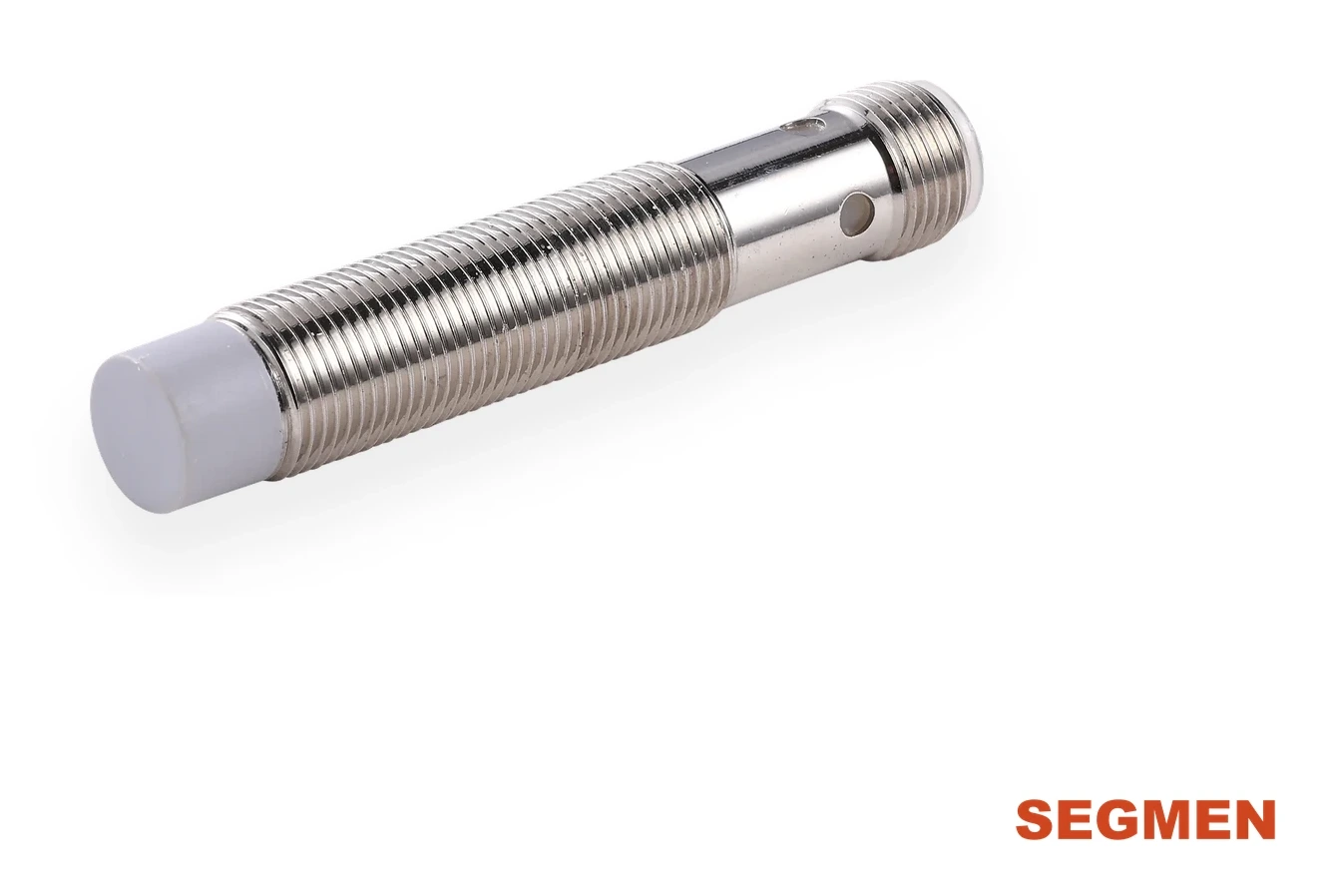
These sensors report how far away a metal target is, not only whether it is there. The output rises or falls continuously across the measuring range, so a PLC can read gap, position or runout directly.
- Outputs
- 4–20 mA / 0–10 V / dual
- Repeatability
- 0.02 mm
- Measuring range
- up to 10 mm
- Housings
- D6.5 · M8 · M12
Quick answer
What is an analog inductive proximity sensor?
An analog inductive proximity sensor measures the distance to a metal target without contact and outputs it as a continuous signal. SEGMENsensor analog models give 4–20 mA, 0–10 V, or both, over measuring ranges up to 10 mm, with 0.02 mm repeatability, in D6.5, M8 and M12 housings.
Model finder
Choose by housing, output and connection
The measuring range column shows the linear range of each model. The last letter before the connection code is the output: I = 4–20 mA, V = 0–10 V, M = dual.
| Part number | Housing | Mounting | Measuring range | Output | Connection | Frequency |
|---|
All models: 18–30 VDC, IP67, nickel-plated brass housing, PBT sensing face. Ranges refer to a standard steel target.
How it works
Distance in, analog signal out
- The sensor sets up a magnetic field at its face. A metal target in front of it changes the field.
- Inside the linear measuring range the output follows the distance continuously.
- A PLC analog input reads the signal. Use 4–20 mA for long cable runs and 0–10 V where the input expects voltage.
Typical uses for analog inductive sensors.
Part number guide
Reading a SEGMENsensor part number
Specifications
Technical data, AO series
| Measuring range | D6.5 / M8: up to 6 mm; M12: up to 10 mm (see model table) |
| Supply voltage | 18–30 VDC |
| Current output | 4–20 mA, load ≤ 400 Ω |
| Voltage output | 0–10 V, load ≥ 2 kΩ |
| Dual output | 0–10 V (≥ 2 kΩ) and 0–20 mA (≤ 400 Ω) |
| Repeatability | 0.02 mm |
| Linearity | < 5 % |
| Temperature drift | < 5 % Sr |
| Max. frequency | 1000–1500 Hz by model |
| No-load current | 35 mA |
| Operating temperature | -25 °C to +70 °C |
| Protection | IP67 |
| Reverse polarity protection | Yes |
| Housing / sensing face | Nickel-plated brass / PBT |
| Connection | 2 m oil-resistant PVC cable, M8 or M12 connector |
| EMC | RFI > 3 V/m, EFT > 1 kV, ESD > 4 kV (contact) |
| Shock / vibration | IEC 60947-5-2, 7.4.1 |
| Approvals | CE, RoHS |
Datasheets and dimension drawings are sent by email on request.
Standards: IEC 60947-5-2 (proximity switches) · IEC 60529 IP ratings
Comparison
Analog vs. switching inductive sensor
| Feature | Switching (on/off) | SEGMENsensor AO |
|---|---|---|
| Output | On or off at one set point | Continuous 4–20 mA or 0–10 V |
| What you learn | Target present or not | Exact gap within the range |
| Changing the set point | Move the sensor | Change the threshold in the PLC |
| Wiring options | One output | Current, voltage or both in one sensor |
Comparison with a typical switching inductive sensor, not a specific product.
Ordering
Samples, MOQ and OEM
MOQ 1 piece. Sample and production lead times are confirmed with your quotation.
Contact us about OEM and private-label options.
FAQ
Common questions
What is the difference between 4–20 mA and 0–10 V?
4–20 mA is a current signal that is less affected by cable length and electrical noise, and a reading of 0 mA shows a broken wire. 0–10 V is simpler to wire and suits short runs to a voltage input.
What does the dual-output version give me?
The M models provide a 0–10 V and a 0–20 mA signal at the same time, so one part number covers both input types.
Which metals can it measure?
Any metal target, including steel, stainless steel, brass and aluminum. Ranges in the table refer to standard steel; non-ferrous metals give a shorter range, so calibrate on your actual target.
How accurate is it?
Repeatability is 0.02 mm and linearity is better than 5 %. For best results, calibrate the signal against your target in the PLC.
What does D6.5 mean?
D6.5 is a smooth 6.5 mm diameter barrel without thread, for tight spaces where an M8 thread will not fit.
Are the sensors CE and RoHS compliant?
Yes. The AO series carries CE and RoHS documentation. It is available on request with your quote.
What is an analog distance sensor?
An analog distance sensor outputs a signal that changes continuously with the distance to the target, typically 4–20 mA or 0–10 V. SEGMENsensor SGI-AO models do this inductively for metal targets over ranges up to 10 mm.
How can I tell if a proximity sensor is analog or digital?
Check the output in the datasheet. A digital (switching) sensor lists NPN or PNP and NO or NC. An analog sensor lists a current or voltage range such as 4–20 mA or 0–10 V. In SEGMENsensor part numbers, I, V or M before the connection code marks an analog model.
What are the main types of proximity sensors?
The most common are inductive sensors for metal targets, capacitive sensors for metal and non-metal targets, and photoelectric sensors that use a light beam. Analog output is available on SEGMENsensor inductive models.