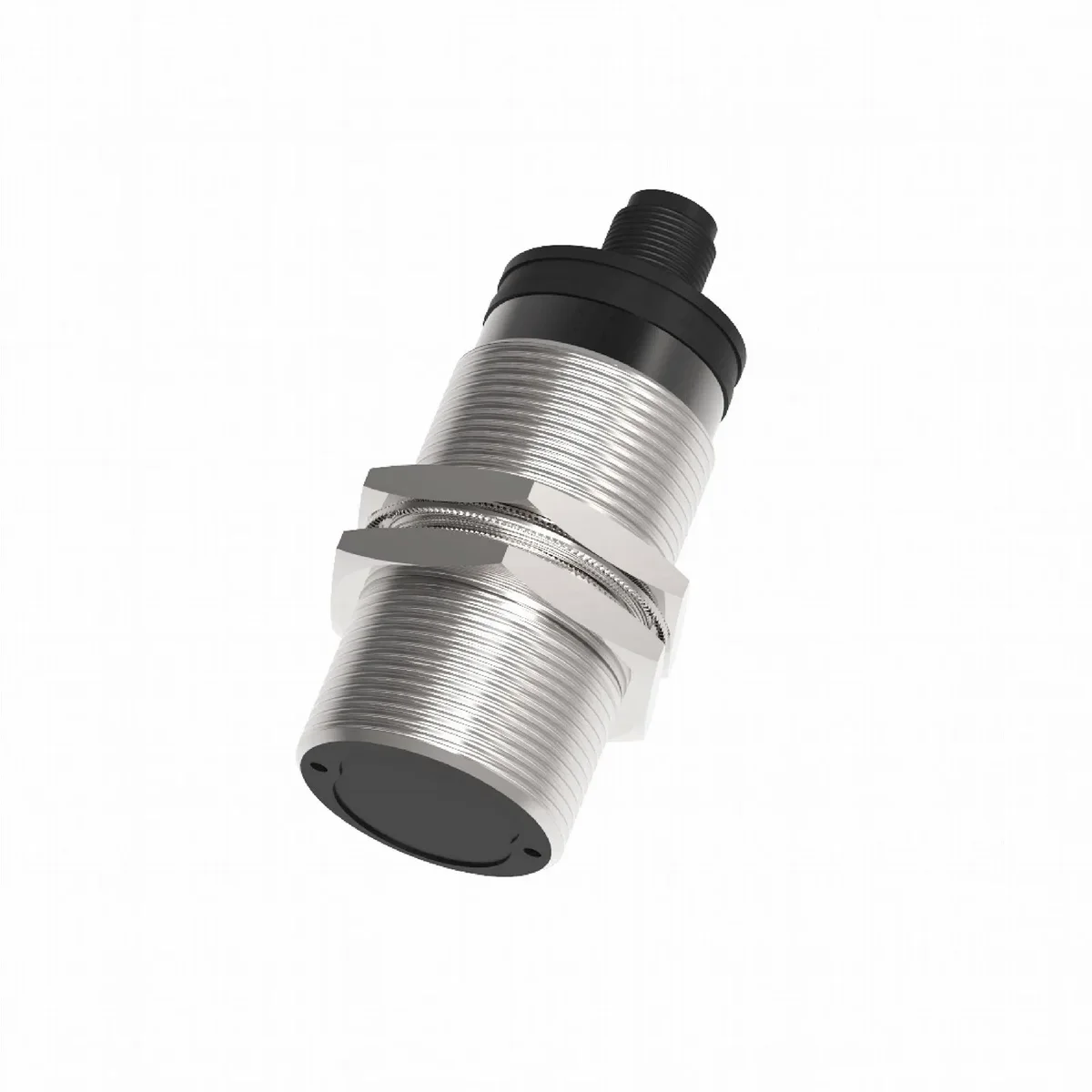
Photoelectric sensors detect objects optically, so they work on cardboard, glass, plastic, liquid, metal and fabric alike — at ranges from a 5 mm slot to 40 m across a loading bay. SEGMENsensor builds four sensing modes in M12, M18, M30, rectangular and slot housings, with NPN or PNP outputs, 10–30 V DC supply on the standard DC series and IP67 protection on the barrel and rectangular housings (slot types are IP50). OEM and private-label supply from Shenzhen, MOQ 10 pcs.
10–30 V DC (5 mm slot series 5–24 V DC; AC/DC types available)
Protection
IP67 (slot types IP50)
Housings
M12 / M18 / M30 / rectangular / slot
Reviewed by the SEGMENsensor applications engineering team · Shenzhen, ChinaSpecifications taken from current production selection tablesLast updated:
What is a photoelectric sensor?
A photoelectric sensor detects the presence, absence or distance of an object by transmitting a
beam of light and monitoring how much of it returns to a receiver. When the target interrupts or
reflects that beam, the sensor switches a solid-state output that a PLC or controller reads as a
digital signal.
Because detection is optical rather than magnetic, photoelectric sensors work on almost any
material — cardboard, glass, plastic, liquid, metal or fabric — and at ranges from a few
millimetres to 40 m. That range advantage is the main reason they replace inductive proximity
switches once the sensing gap exceeds roughly 20 mm or the target is not metallic.
What are the four sensing modes and when do you use each?
Through-beam: separate emitter and receiver give the highest signal margin and the longest range.
Through-beam
Emitter and receiver in separate housings. The target breaks the beam. Highest excess gain,
longest range, least affected by target colour, dust or spray. Needs cabling and power on both sides.
Sensor and reflector. Light travels out and back, so wiring is on one side only while the range
stays long. Polarising-filter versions detect clear bottles, film and shiny parts.
A single housing; the target itself reflects light back. Simplest to install and the cheapest
to run, but range depends on target colour and finish — dark or matt surfaces cut it sharply.
Emitter and receiver factory-aligned in one U-shaped body. Nothing to set up, immune to
alignment drift, ideal for small-part counting, label edges and index marks.
Work through five questions in order. Each one removes options, so the answer usually falls out
before you reach a part number.
#
Question
What it decides
1
How far is the target, and can you mount on both sides?
Sensing mode. Beyond 2 m with one-sided access, retro-reflective. Beyond 6 m or in dust, through-beam.
2
What is the target made of and what colour is it?
Rules diffuse in or out. Matt black cardboard can cut diffuse range by more than half against a white reference.
3
Is the background close behind the target?
Whether you need a fixed-distance optic rather than plain diffuse.
4
How much space is there, and what thread?
M12, M18, M30 barrel or a rectangular body. Slot types where the part passes through a fixed gap.
5
What does the controller input expect?
NPN or PNP, light-on or dark-on, cable or M8/M12 connector.
What do the model codes mean?
Every model code follows the same pattern, so you can read a configuration without a lookup table.
Segment
Example
Meaning
Series
SEGP18
Housing family and size: P = plastic, B = nickel-plated brass, S = stainless, Q = rectangular, U = slot. The number is the thread or body size in millimetres.
Mode + range
-T015M
T = through-beam, D = diffuse, L = retro-reflective, followed by the rated distance.
Output
N / P
NPN or PNP switching output.
Suffix
-SI4U2, /F
Connection and optics. /F denotes a polarising filter for clear-object detection.
Representative models across the range
The full catalogue holds 309 configurations across the four sensing modes — 116 through-beam, 89 retro-reflective, 82 diffuse and 22 slot. The table below is a cross-section; ask for the
complete selection table if you need a specific distance, output or housing combination.
Model
Series / form
Sensing distance
Output
Supply
Connection
Housing
Light source
SEGB12-D0200N-SI4U2-JP
B12 · M12
200 mm
NPN light-on / dark-on
10-30 V DC
2 m PVC cable
Nickel-plated brass
Infrared
SEGB12-D0200P-SI4U2
B12 · M12
200 mm
PNP light-on / dark-on
10-30 V DC
2 m PVC cable
Nickel-plated brass
Infrared
SEGB12-L1000N-SR4U2/F
B12 · M12
1 m
NPN light-on / dark-on
10-30 V DC
2 m PVC cable
Nickel-plated brass
Red light
SEGB12-L1000P-SR4U2/F
B12 · M12
1 m
PNP light-on / dark-on
10-30 V DC
2 m PVC cable
Nickel-plated brass
Red light
SEGB12-L2000N-SI4U2
B12 · M12
2 m
NPN light-on / dark-on
10-30 V DC
2 m PVC cable
Nickel-plated brass
Infrared
SEGB12-L2000P-SI4U2
B12 · M12
2 m
PNP light-on / dark-on
10-30 V DC
2 m PVC cable
Nickel-plated brass
Infrared
SEGB12-T5200D-EI3L2
B12 · M12
5.2 m
NPN light-on
10-30 V DC
2 m PVC cable
Nickel-plated brass
Infrared
SEGB12-T5200P-DI3U2
B12 · M12
5.2 m
PNP dark-on
10-30 V DC
2 m PVC cable
Nickel-plated brass
Infrared
SEGB18-D0150A-DIEL4
B18 · M18
150 mm
Dark-on
24-240 V AC
M12 connector
Nickel-plated brass
Infrared
SEGB18-D0150A-LIEL4
B18 · M18
150 mm
Light-on
24-240 V AC
M12 connector
Stainless steel / nickel-plated brass
Infrared
SEGB18-D0500N-SIEU4
B18 · M18
500 mm
NPN light-on / dark-on
10-30 V DC
M12 connector
Nickel-plated brass
Infrared
SEGB18-D0500P-SIEU4
B18 · M18
500 mm
PNP light-on / dark-on
10-30 V DC
M12 connector
Nickel-plated brass
Infrared
SEGB18-L1000A-DREL4/F
B18 · M18
1 m
Dark-on
24-240 V AC
M12 connector
Nickel-plated brass
Red light, polarising filter
SEGB18-L1000A-LREL4/F
B18 · M18
1 m
Light-on
24-240 V AC
M12 connector
Nickel-plated brass
Red light, polarising filter
SEGB18-L1000N-SREU4/F
B18 · M18
1 m
NPN light-on / dark-on
10-30 V DC
M12 connector
Nickel-plated brass
Red light, polarising filter
SEGB18-L1000P-SREU4/F
B18 · M18
1 m
PNP light-on / dark-on
10-30 V DC
M12 connector
Nickel-plated brass
Red light, polarising filter
SEGB18-L3000A-DIEL4
B18 · M18
3 m
Dark-on
24-240 V AC
M12 connector
Nickel-plated brass
Infrared
SEGB18-L3000A-LIEL4
B18 · M18
3 m
Light-on
24-240 V AC
M12 connector
Nickel-plated brass
Infrared
How do you wire a photoelectric sensor to a PLC?
Photoelectric sensor wire colour and connector pin assignment
Function
Cable colour (IEC 60947-5-2)
M12 pin
M8 pin
Notes
Supply +
Brown
1
1
10–30 V DC on standard DC models
Supply −
Blue
3
3
0 V / common
Output (NPN or PNP)
Black
4
4
Main switching output
Second output / mode select
White
2
2
Present on 4-wire NO + NC and selectable models
Emitter (through-beam)
Brown + blue only
1, 3
1, 3
Emitters carry no switching output
An NPN output sinks current to 0 V; a PNP output sources current from the supply. Match the sensor
output to the input card of the controller — wiring a PNP sensor to a sinking input (or the reverse) leaves the
input permanently off. Confirm the pin assignment on the datasheet before wiring a specific model.
Troubleshooting: symptom, cause, check
Symptom
Likely cause
What to check
Output never switches
Output type does not match the controller input
NPN vs PNP; sinking vs sourcing input card
Output chatters at the switching point
Insufficient excess gain, or target at the edge of range
Move the target closer, or step up to a longer-range model
Dark targets are missed
Diffuse mode reflectivity too low
Switch to retro-reflective or through-beam
Shiny or mirrored targets are missed
Specular reflection steered away from the receiver
Tilt the sensor 10–20° away from perpendicular to the surface, or use through-beam
Clear bottles or film not detected
Standard optics pass straight through the target
Use a polarising-filter retro-reflective model
Random switching near other sensors
Optical crosstalk between adjacent units
Alternate emitter/receiver orientation, or increase spacing
Detection drifts through the shift
Lens contamination in dust or spray
Clean the lens; move to through-beam for a higher signal margin
Fast parts on a conveyor are skipped
Response time too slow for the line speed
Calculate dwell time from part length and belt speed, then compare with response time
Output inverted versus expectation
Light-on / dark-on set the wrong way
Select the opposite model variant, or switch mode if the model supports it
Where are photoelectric sensors used?
Packaging and bottling lines use retro-reflective sensors with polarising filters to count clear
containers. Material-handling conveyors use through-beam pairs across the belt because dust and
vibration are constant. Assembly cells use compact diffuse or slot sensors where the gap is short
and space is tight. Warehouse and door-control applications use long-range through-beam pairs for
presence detection at gates and shutters.
Frequently asked questions
What is the difference between a photoelectric sensor and a proximity sensor?
A photoelectric sensor detects objects optically and works on nearly any material at ranges up to tens of metres. An inductive proximity sensor detects only metal and typically at 1–15 mm. Use inductive for short-range metal detection, photoelectric when the target is non-metallic or the gap exceeds about 20 mm.
Which sensing mode gives the longest range?
Through-beam. Because light travels once from a dedicated emitter to a dedicated receiver, the signal margin is the highest of any mode. In this catalogue, through-beam models reach 40 m, retro-reflective 30 m and diffuse 6 m.
How do I detect clear plastic bottles or transparent film?
Use a retro-reflective sensor with a polarising filter. The filter blocks the light that reflects off the shiny surface of the target and only accepts light returned by the reflector, so the small attenuation caused by clear material is enough to trigger the output reliably.
What is the difference between light-on and dark-on?
Light-on switches the output when the receiver sees light. Dark-on switches when light is blocked. On a through-beam pair guarding a conveyor gap, dark-on gives an output when a part passes; light-on gives an output when the gap is clear. Choose whichever matches the controller logic.
Should I choose NPN or PNP?
It depends on the controller input, not on the sensor. PNP sourcing outputs are standard in Europe and most modern PLC input cards; NPN sinking outputs remain common in machines built to Japanese and older Chinese standards. Check the input card documentation before ordering.
What does IP67 mean for a sensor?
IP67 under IEC 60529 means the housing is dust-tight and withstands temporary immersion in water to 1 m for 30 minutes. It is suitable for washdown-adjacent areas and outdoor-sheltered mounting, but it is not a rating for high-pressure jets, which requires IP69K.
How close together can two sensors be mounted?
Close spacing risks optical crosstalk, where one emitter is seen by the neighbouring receiver. The practical fix is to alternate the orientation of adjacent pairs so emitters do not face receivers, or to increase spacing. Confirm the minimum distance for a specific model before finalising the layout.
Can a photoelectric sensor drive a relay or contactor directly?
Only within the rated output current of the model, and only with a flyback diode across an inductive coil. Most DC transistor outputs are rated for a few hundred milliamps. For larger loads, switch an interposing relay from the sensor output rather than the load itself.
Do you supply photoelectric sensors as an OEM manufacturer?
Yes. SEGMENsensor builds photoelectric sensors in Shenzhen for OEM and private-label customers, with a minimum order of 10 pieces per configuration. Housing marking, cable length, connector type and output configuration can be changed to your specification.
What information do you need to recommend a model?
Target material and colour, sensing distance, whether you can mount on both sides, how close the background sits behind the target, available mounting space and thread, the controller input type, and the environment (dust, moisture, temperature, washdown).
OEM and private-label supply
SEGMENsensor manufactures photoelectric sensors in Shenzhen for industrial OEM customers and
distributors. Tell us the detection task rather than a part number — target material and colour,
distance, background, mounting space, environment and controller input type — and our engineers
return two or three suitable configurations with drawings.
MOQ from 10 pieces
Standard catalogue models ship from stock. Custom builds start at 10 pieces per configuration.
Private label and custom marking
Housing colour, laser marking, label artwork and packaging can be produced to your specification.
Cable and connector options
Cable length, jacket material, M8 or M12 connector and pin assignment can be changed on request.
Samples in 5–7 working days
Paid samples of catalogue models normally leave Shenzhen within five to seven working days.
Send us the detection task
Target, distance, background, environment and controller input — we reply with specifications
and a quotation within one working day.