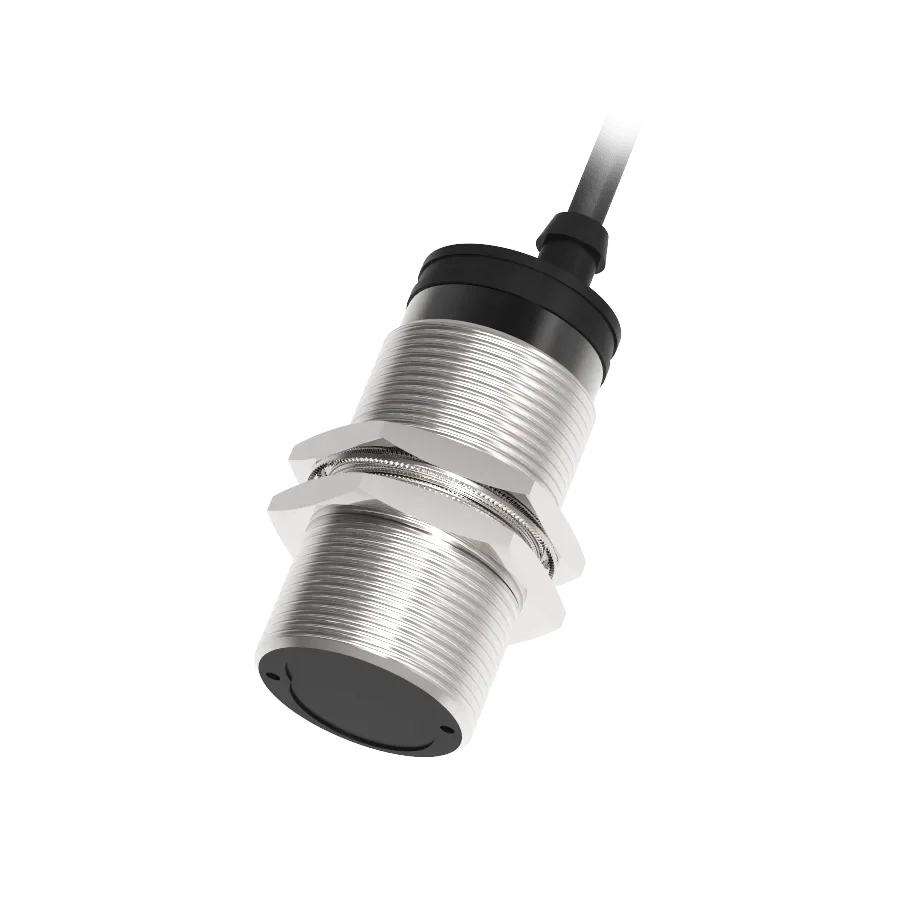
A retro-reflective sensor works against a passive reflector, so wiring stays on one side of the line while range reaches 30 m. Polarising-filter versions detect clear PET bottles, transparent film and glossy surfaces that defeat standard optics. Available in M12, M18, M30 and rectangular housings with NPN or PNP outputs and IP67 protection.
Reviewed by the SEGMENsensor applications engineering team · Shenzhen, ChinaSpecifications taken from current production selection tablesLast updated:
What is a retro-reflective photoelectric sensor?
A retro-reflective photoelectric sensor sends light to a reflector mounted opposite and watches for
that light to come back. The output switches when a target interrupts the return path. Sensor and
cable stay on one side of the line while the range stays long, which is why it is the default choice
on packaging and palletising equipment.
Light travels to a passive reflector and back. Only the sensor needs power and wiring.
Why is retro-reflective the usual choice on packaging lines?
It solves the practical problem that through-beam creates and that diffuse cannot handle. The
reflector is passive — no power, no cable, no alignment electronics — so only one side of
the conveyor needs an electrical installation. Range still reaches 30 m, and because detection
depends on interrupting a return beam rather than reflecting off the product, a dark carton and a
white one behave almost identically.
How do you detect clear bottles, film and shiny parts?
Use a polarising-filter model. A clear PET bottle passes most light straight through, and a
glossy surface can bounce light directly back to the receiver — both defeat a standard sensor.
A polarising filter accepts only the rotated light returned by a corner-cube reflector and rejects the
direct specular reflection from the target, so the small attenuation caused by the clear material is
enough to switch the output reliably.
29 models in this range carry polarising or clear-object optics, typically at
700 mm to 2 m — the working distance across a filling or labelling line.
Target
Standard retro-reflective
Polarising filter model
Matt carton, wood, fabric
Reliable
Reliable
Clear PET bottle
Unreliable — light passes through
Designed for this case
Transparent film, blister pack
Unreliable
Designed for this case
Polished metal, mirrored label
May false-trigger on specular return
Rejects specular return
Shrink-wrapped pallet
Generally reliable
Reliable
What ranges are available?
Housing
Series
Rated range
Typical application
M12 barrel
SEGP12 / SEGB12
1 m, 2 m
Compact filling and labelling stations
M18 barrel
SEGP18 / SEGB18
150 mm – 3 m
Standard conveyor and packaging lines
M30 barrel
SEGP30 / SEGB30
3 m, 5 m, 30 m
Wide bays, long transfer lines
Rectangular 31 mm
SEGQ31
700 mm – 4 m
Flat mounting, clear-object detection
Rectangular 50 mm
SEGQ50
6 m, 10 m
Palletising, wide-span presence
Selection table
89 retro-reflective configurations are available. The /F suffix denotes a polarising
filter for clear-object detection.
Model
Series / form
Sensing distance
Output
Supply
Connection
Housing
Light source
SEGB12-L1000N-SR4U2/F
B12 · M12
1 m
NPN light-on / dark-on
10-30 V DC
2 m PVC cable
Nickel-plated brass
Red light
SEGB12-L1000P-SR4U2/F
B12 · M12
1 m
PNP light-on / dark-on
10-30 V DC
2 m PVC cable
Nickel-plated brass
Red light
SEGB12-L2000N-SI4U2
B12 · M12
2 m
NPN light-on / dark-on
10-30 V DC
2 m PVC cable
Nickel-plated brass
Infrared
SEGB12-L2000P-SI4U2
B12 · M12
2 m
PNP light-on / dark-on
10-30 V DC
2 m PVC cable
Nickel-plated brass
Infrared
SEGB18-L1000A-DREL4/F
B18 · M18
1 m
Dark-on
24-240 V AC
M12 connector
Nickel-plated brass
Red light, polarising filter
SEGB18-L1000A-LREL4/F
B18 · M18
1 m
Light-on
24-240 V AC
M12 connector
Nickel-plated brass
Red light, polarising filter
SEGB18-L1000N-SREU4/F
B18 · M18
1 m
NPN light-on / dark-on
10-30 V DC
M12 connector
Nickel-plated brass
Red light, polarising filter
SEGB18-L1000P-SREU4/F
B18 · M18
1 m
PNP light-on / dark-on
10-30 V DC
M12 connector
Nickel-plated brass
Red light, polarising filter
SEGB18-L3000A-DIEL4
B18 · M18
3 m
Dark-on
24-240 V AC
M12 connector
Nickel-plated brass
Infrared
SEGB18-L3000A-LIEL4
B18 · M18
3 m
Light-on
24-240 V AC
M12 connector
Nickel-plated brass
Infrared
SEGB18-L3000N-SIEU4
B18 · M18
3 m
NPN light-on / dark-on
10-30 V DC
M12 connector
Nickel-plated brass
Infrared
SEGB18-L3000P-SIEU4
B18 · M18
3 m
PNP light-on / dark-on
10-30 V DC
M12 connector
Nickel-plated brass
Infrared
SEGB30-L3000A-DI3L2
B30 · M30
3 m
Dark-on
24-240 V AC
2 m PVC cable
Nickel-plated brass
Infrared
SEGB30-L3000A-LI3L2
B30 · M30
3 m
Light-on
24-240 V AC
2 m PVC cable
Nickel-plated brass
Infrared
SEGB30-L3000N-SI4U2
B30 · M30
3 m
NPN light-on / dark-on
10-30 V DC
2 m PVC cable
Nickel-plated brass
Infrared
SEGB30-L3000P-SI4U2
B30 · M30
3 m
PNP light-on / dark-on
10-30 V DC
2 m PVC cable
Nickel-plated brass
Infrared
SEGB30-L5000A-DI3L2
B30 · M30
5 m
Dark-on
24-240 V AC
2 m PVC cable
Nickel-plated brass
Infrared
SEGB30-L5000A-LI3L2
B30 · M30
5 m
Light-on
24-240 V AC
2 m PVC cable
Nickel-plated brass
Infrared
SEGB30-L5000N-SI4U2
B30 · M30
5 m
NPN light-on / dark-on
10-30 V DC
2 m PVC cable
Nickel-plated brass
Infrared
SEGB30-L5000P-SI4U2
B30 · M30
5 m
PNP light-on / dark-on
10-30 V DC
2 m PVC cable
Nickel-plated brass
Infrared
How do you wire a retro-reflective sensor?
Photoelectric sensor wire colour and connector pin assignment
Function
Cable colour (IEC 60947-5-2)
M12 pin
M8 pin
Notes
Supply +
Brown
1
1
10–30 V DC on standard DC models
Supply −
Blue
3
3
0 V / common
Output (NPN or PNP)
Black
4
4
Main switching output
Second output / mode select
White
2
2
Present on 4-wire NO + NC and selectable models
Emitter (through-beam)
Brown + blue only
1, 3
1, 3
Emitters carry no switching output
An NPN output sinks current to 0 V; a PNP output sources current from the supply. Match the sensor
output to the input card of the controller — wiring a PNP sensor to a sinking input (or the reverse) leaves the
input permanently off. Confirm the pin assignment on the datasheet before wiring a specific model.
Troubleshooting retro-reflective installations
Symptom
Likely cause
What to check
Output never switches
Output type does not match the controller input
NPN vs PNP; sinking vs sourcing input card
Output chatters at the switching point
Insufficient excess gain, or target at the edge of range
Move the target closer, or step up to a longer-range model
Output drops out intermittently
Reflector undersized, dirty, or not square to the sensor
Fit a larger reflector, clean it, and align it perpendicular to the beam
Shiny targets are not registered
The target returns light the same way the reflector does
Specify the polarising-filter variant; check that the target is not depolarising
Clear bottles or film not detected
Standard optics pass straight through the target
Fit the polarising-filter variant and set the sensitivity for the reduced return signal
Random switching near other sensors
Optical crosstalk between adjacent units
Alternate emitter/receiver orientation, or increase spacing
Detection drifts through the shift
Lens contamination in dust or spray
Clean the lens and the reflector; shorten the span for more excess gain
Fast parts on a conveyor are skipped
Response time too slow for the line speed
Calculate dwell time from part length and belt speed, then compare with response time
Output inverted versus expectation
Light-on / dark-on set the wrong way
Select the opposite model variant, or switch mode if the model supports it
Related products
Photoelectric sensing is one of six sensor families we build in Shenzhen. Where an optical
solution is not the right fit, these alternatives cover the same detection tasks:
A retro-reflective photoelectric sensor emits light towards a passive reflector mounted opposite and monitors the returning beam. When a target interrupts that beam the output switches. Sensor, power and wiring stay on one side of the line, while range remains long — up to 30 m in this catalogue.
How do I detect clear plastic bottles?
Use a retro-reflective model with a polarising filter. The filter rejects light reflected directly off the shiny bottle surface and accepts only the polarisation-rotated light returned by a corner-cube reflector, so the slight attenuation caused by clear PET is enough to switch the output reliably.
What is the difference between retro-reflective and through-beam?
Through-beam uses a powered receiver opposite the emitter and gives the highest signal margin. Retro-reflective replaces that receiver with a passive reflector, so only one side needs wiring. Through-beam tolerates dust better; retro-reflective is far quicker to install and still reaches 30 m.
Does target colour affect a retro-reflective sensor?
Very little. Detection depends on the target blocking the return beam, not on how much light it reflects, so a matt black carton and a white one behave almost the same. This is the main advantage over diffuse sensing, where colour changes the effective range substantially.
What kind of reflector do I need?
A corner-cube (prismatic) reflector returns light along the incoming path and is required for polarising-filter models. Reflector size affects the achievable range: a small reflector at long distance reduces the signal margin. Tell us the installed distance and we will specify a suitable reflector.
Why does the sensor false-trigger on a shiny product?
A polished surface can reflect light straight back to the receiver, which the sensor reads as an unbroken beam even though the product is present. A polarising-filter model rejects that direct specular return. Mounting the sensor at a slight angle to the product surface also helps.
Can dust or condensation on the reflector cause faults?
Yes. Light makes a return trip, so contamination on either the lens or the reflector reduces the signal twice over. Specify extra range headroom in dusty areas, schedule lens cleaning, or move to through-beam where contamination is continuous.
What supply voltage and outputs are available?
Standard models take 10–30 V DC with NPN or PNP transistor outputs in light-on or dark-on versions. Rectangular series models are also available in AC and universal AC/DC variants for installations without a DC control supply.
Do you supply retro-reflective sensors as an OEM manufacturer?
Yes. Minimum order is 10 pieces per configuration, with custom cable length, M8 or M12 connector, housing marking and output configuration available. Paid samples of catalogue models normally leave Shenzhen within five to seven working days.
What should I tell you to get the right model?
The distance from sensor to reflector, the target material (especially if it is clear or shiny), the available mounting space and thread, whether the environment is dusty or wet, and the controller input type. A photograph of the mounting position speeds up the recommendation.
OEM and private-label supply
SEGMENsensor manufactures photoelectric sensors in Shenzhen for industrial OEM customers and
distributors. Tell us the detection task rather than a part number — target material and colour,
distance, background, mounting space, environment and controller input type — and our engineers
return two or three suitable configurations with drawings.
MOQ from 10 pieces
Standard catalogue models ship from stock. Custom builds start at 10 pieces per configuration.
Private label and custom marking
Housing colour, laser marking, label artwork and packaging can be produced to your specification.
Cable and connector options
Cable length, jacket material, M8 or M12 connector and pin assignment can be changed on request.
Samples in 5–7 working days
Paid samples of catalogue models normally leave Shenzhen within five to seven working days.
Send us the detection task
Target, distance, background, environment and controller input — we reply with specifications
and a quotation within one working day.