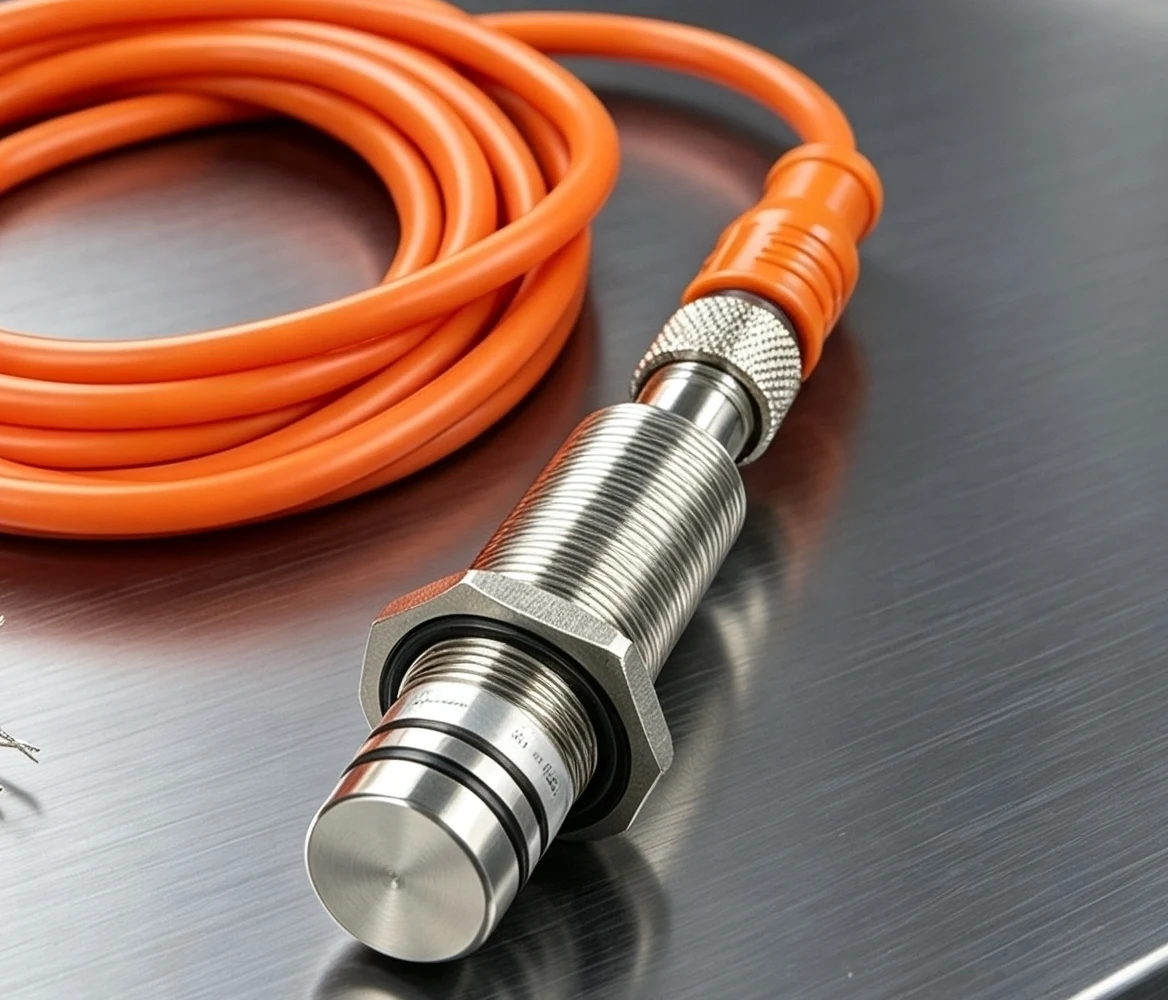
Choose a hydraulic cylinder proximity sensor in two checks. First, pressure: if the sensing face touches the oil, use a pressure-rated sensor, 500 bar SGI-HP in M8/M12 or the M18 type up to 1000 bar. Second, temperature: measure the oil at the end cap; SGI-HP M8/M12 are listed to +70 °C, and hotter applications are evaluated per project.
Product series: SEGMENsensor high-pressure inductive proximity sensors (SGI-HP 500 bar, M18 up to 1000 bar) and high-temperature inductive proximity sensors (SGI-HT T120 / T150).
Hydraulic cylinder makers, construction-machinery OEMs and builders of fire-fighting equipment use inductive proximity sensors in the end caps to confirm that the piston has fully retracted or extended. Two loads act on that sensor at the same time: system pressure on the sensing face, and the temperature of the hydraulic oil around it. Most selection mistakes come from checking only one of them. This guide shows how to read both requirements, which SEGMENsensor series covers which case, and what to send so an engineer can confirm the part number.
The guide adds one thing the series pages do not: a single decision table that maps each pressure and temperature combination to a series, and marks honestly where the published data stops and a project evaluation starts.
Where Does the Sensor Sit: In the Oil or Outside It?
The mounting position decides which rating matters. A sensor screwed through the end cap so that its face is flush with the inner wall sees the full system pressure, including pressure peaks when the cylinder hits the end of stroke. A sensor mounted outside the cylinder, on a bracket that detects a cam, a flag or the rod eye, sees no hydraulic pressure but may sit in hot air near the pump, the engine or the oil tank.
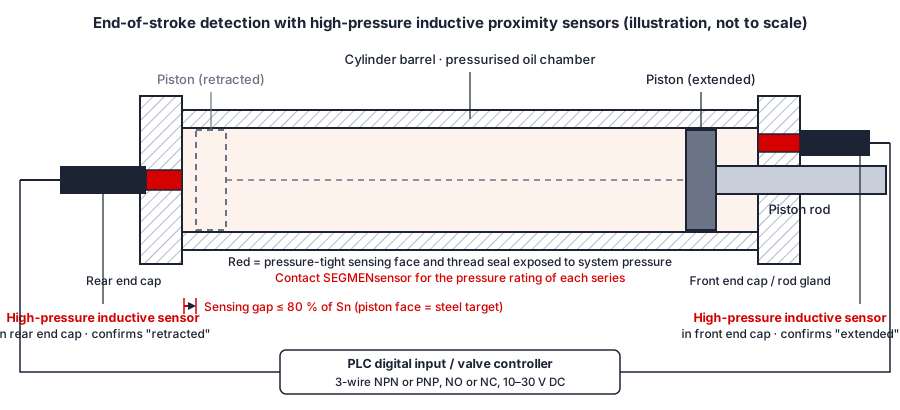
- Face in the oil (end cap, valve block, pump housing): pressure rating first, then oil temperature.
- Face in air (external bracket): ambient temperature first; a pressure rating is not needed.
- Both pressure and heat at the face: confirm per project before the design is frozen.
Which Pressure Rating Do I Need?
Use the highest pressure at the sensing face, including peaks, not only the nominal working pressure of the circuit. SEGMENsensor publishes two pressure-rated options: SGI-HP models in M8, M12 and M12×1.5 rated 500 bar, and an M18 hydraulic-cylinder type ordered by pressure grade, 250, 350, 500, 800 or 1000 bar. Pick the grade that covers your peak pressure, and machine the mounting bore and seal seat to the dimension drawing; the mounting hole and sealing guide walks through the bore, O-rings, torque and pressure test.
How Hot Is the Oil at the End Cap?
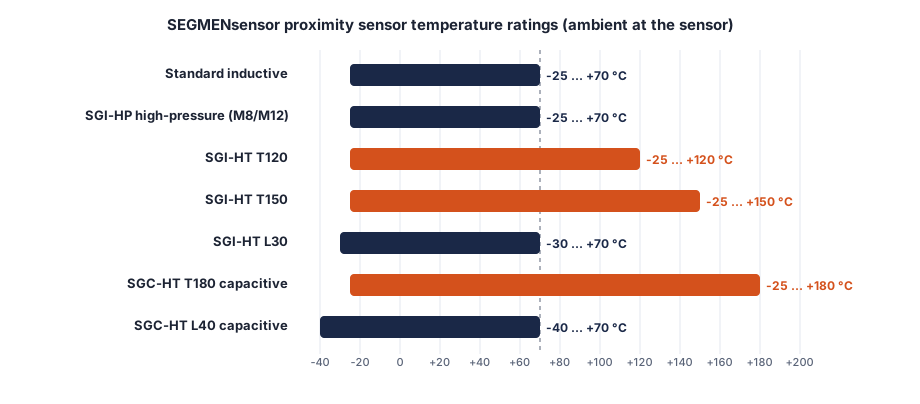
The temperature that counts is the oil and housing temperature at the sensor position during the hardest duty cycle, not the tank thermostat setting. Measure it at the end cap after a full shift under load, in summer if the machine works outdoors. Then compare it with the published ratings:
- SGI-HP M8 and M12 (500 bar): operating temperature -25 °C to +70 °C.
- M18 hydraulic-cylinder type (up to 1000 bar): temperature rating and switching frequency confirmed per project.
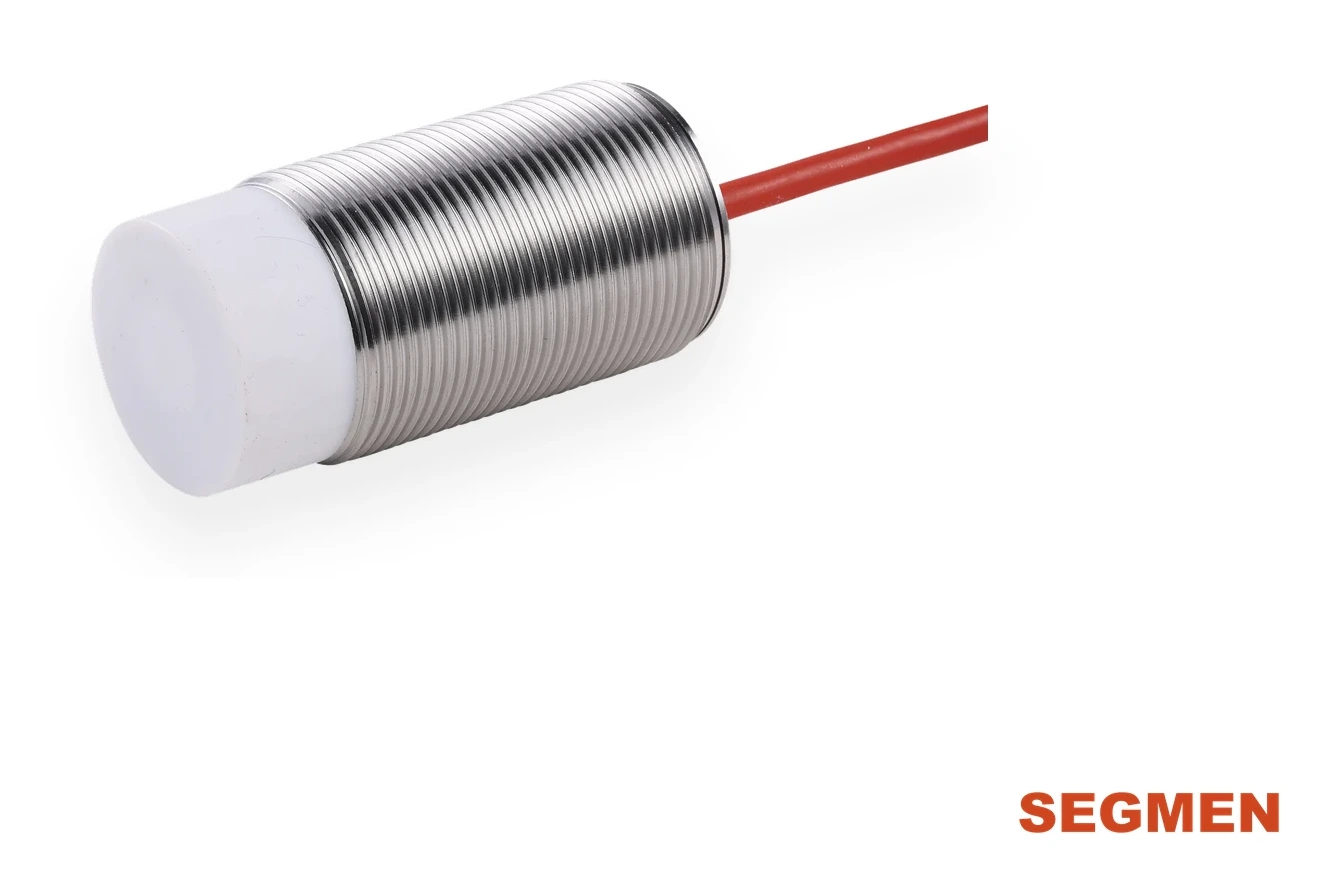
- SGI-HT T120 and T150: -25 °C to +120 °C and -25 °C to +150 °C, PTFE sensing face, silicone or PTFE cable, IP67; rated for temperature, not as a pressure-rated series.
Decision Table: Pressure and Oil Temperature
Read the row that matches your mounting position, peak pressure and temperature at the sensor:
| Sensor face sees | Temperature at the sensor | Series | Status |
|---|---|---|---|
| Oil pressure up to 500 bar | -25 °C to +70 °C | SGI-HP M8 / M12 / M12×1.5 | Catalogue model |
| Oil pressure 250–1000 bar | Within the project rating | M18 hydraulic-cylinder type, by pressure grade | Temperature confirmed per project |
| Oil pressure and oil above +70 °C | Above +70 °C | No published model combines both | Evaluated per project |
| No pressure (external bracket) | Up to +120 °C | SGI-HT T120 (M8–M30) | Catalogue model |
| No pressure (external bracket) | Up to +150 °C | SGI-HT T150 (M8–M30) | Catalogue model |
| Continuous piston position needed | Per series page | In-cylinder magnetostrictive sensor, 25–8000 mm stroke | Catalogue series |
Published Specifications Side by Side
| Parameter | SGI-HP M8 / M12 | M18 hydraulic-cylinder type | SGI-HT T120 / T150 |
|---|---|---|---|
| Pressure at the face | 500 bar (7250 psi) | 250 / 350 / 500 / 800 / 1000 bar grades | Not a pressure-rated series |
| Operating temperature | -25 °C to +70 °C | Confirmed per project | -25 °C to +120 °C / +150 °C |
| Sensing distance | 1 mm (M8), 1.5 mm (M12), 2 mm (M12×1.5), flush | 2 mm, flush | 1–25 mm by housing and mounting |
| Output / supply | NPN / PNP 10–30 V DC; DC 2-wire 10–60 V DC | NPN NO or PNP NO, 10–30 V DC | NPN / PNP 10–30 V DC; 2-wire 10–60 V DC |
| Sensing face / housing | Ceramic face, stainless steel | Stainless steel, two O-rings on the sensing head | PTFE face, stainless steel M8–M30 |
| Protection / connection | IP67 / IP69K; 2 m cable or M12 connector | 2 m oil-resistant PUR cable, detachable M12 plug | IP67; silicone or PTFE cable |
| Samples | From 1 pc for qualification; volume per project | ||
Download the one-page datasheet (PDF)
The proximity sensor datasheet lists housings, sensing distances, outputs, supply voltage, protection class and the ordering code. No registration required. Pressure-grade and dimension drawings for the M18 hydraulic-cylinder type are sent on request.
Starting a Cylinder or Fire-Fighting Equipment Project?
Send peak pressure, oil temperature at the end cap, thread size and output. We confirm the series and part number within 24 hours. Qualification samples 1–5 pcs in 5–7 working days; production planned around annual volume.
How Should I Set the Sensing Gap in the End Cap?
Set the gap between sensing face and piston inside the assured operating distance Sa, which IEC 60947-5-2 defines as 81% of the rated distance Sn. For the published distances this gives about 0.8 mm for M8 (Sn 1 mm), 1.2 mm for M12 (Sn 1.5 mm) and 1.6 mm for M12×1.5 and M18 (Sn 2 mm); these are calculated values. Heat shifts the switching point slightly, so keep the gap on the conservative side when the oil runs warm. The end-of-stroke detection guide covers target material and output wiring in more detail.
Typical Applications
Typical applications, evaluated per project: end-position detection in hydraulic cylinders for construction machinery and agricultural equipment; boom, outrigger and ladder cylinders on fire-fighting vehicles; clamping and ejector cylinders on presses and injection moulding machines; and valve-spool or pump-piston position in hydraulic power units. For hot areas outside the oil, such as near engines, ovens or die-casting cells, the SGI-HT series is the starting point; the high-temperature selection guide explains how to find the ambient temperature at the sensor.
What to Send for a Recommendation
- Peak pressure at the sensing face, including pressure spikes at end of stroke.
- Oil temperature at the end cap under the hardest duty cycle, and the lowest start-up temperature.
- Thread size (M8, M12, M12×1.5 or M18) and available length in the end cap.
- Output (NPN or PNP, NO or NC, DC 2-wire) and supply voltage.
- Connection (cable length and material, or M12 connector) and the cable route temperature.
- Annual volume and target start of production.
Standards Referenced
- IEC 60947-5-2: Proximity switches — defines rated and assured operating distance (Sn, Sa).
- IEC 60529: IP ratings — the IP67 and IP69K protection codes used above.
- ISO 6149-1: Hydraulic fluid power ports — port and stud-end design for hydraulic components.
Frequently Asked Questions
It is an inductive sensor that detects the steel piston or cushion spear at the end of stroke through the cylinder end cap. SEGMENsensor SGI-HP M8 and M12 models are rated 500 bar, and the M18 hydraulic-cylinder type is offered in 250, 350, 500, 800 and 1000 bar grades.
Only outside the pressurised volume. A standard sensor is not rated for pressure at the sensing face; when the face sits in the oil, use a pressure-rated sensor such as the SGI-HP series (500 bar) or the M18 type (up to 1000 bar).
SGI-HP M8 and M12 models are listed for an operating temperature of -25 °C to +70 °C. For the M18 hydraulic-cylinder type, the temperature rating is confirmed per project, so send the maximum oil temperature at the end cap with your enquiry.
No published SEGMENsensor model combines both. The SGI-HT series is rated +120 °C (T120) or +150 °C (T150) but is not a pressure-rated series; a combined pressure and temperature requirement is evaluated per project.
Set the piston gap within the assured operating distance, 81% of the rated distance Sn under IEC 60947-5-2. With Sn = 2 mm on the M18 type, that is about 1.6 mm (calculated value); with Sn = 1.5 mm on M12, about 1.2 mm.
Qualification samples of 1–5 pieces ship in 5–7 working days for catalogue models, and production volume is planned around your annual demand. Every enquiry receives a written reply within 24 hours.
Related reading: High-pressure inductive proximity sensors · High-temperature inductive proximity sensors · Hydraulic cylinder end-position detection · Mounting hole and sealing · High-temperature proximity sensor selection
Last updated: 15 October 2026 · SEGMENsensor Engineering Team. Specifications reflect the SEGMENsensor product pages at the date of publication; datasheets and dimension drawings are sent on request.