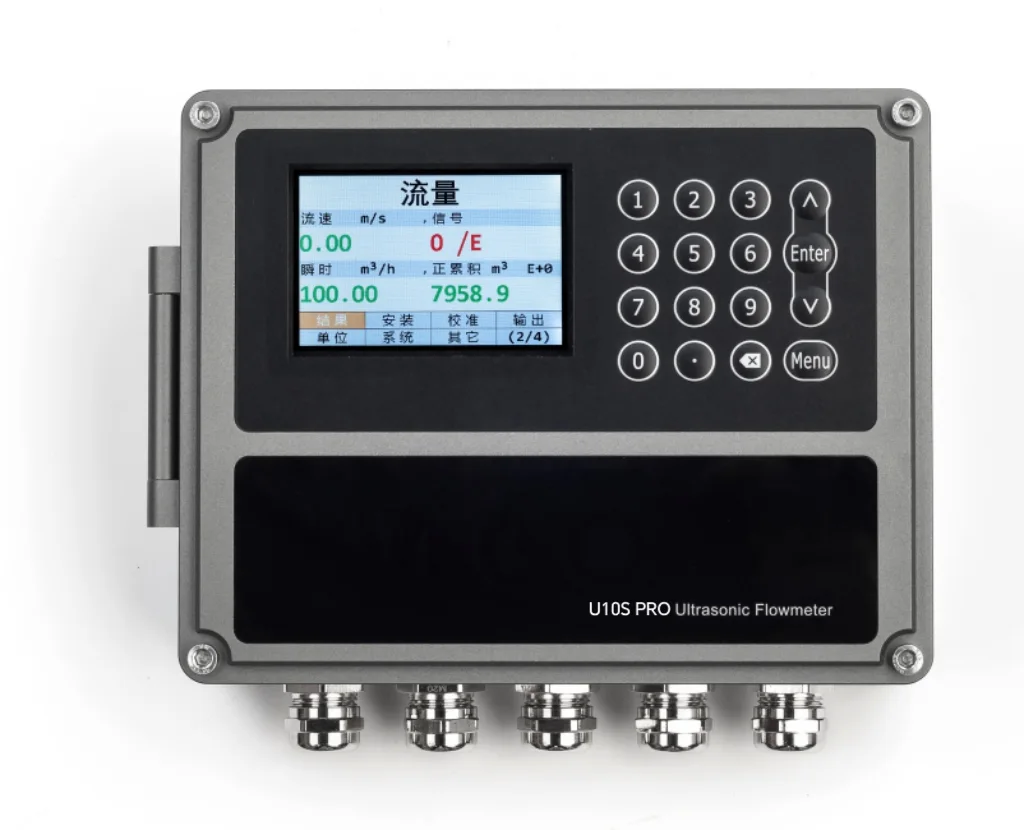
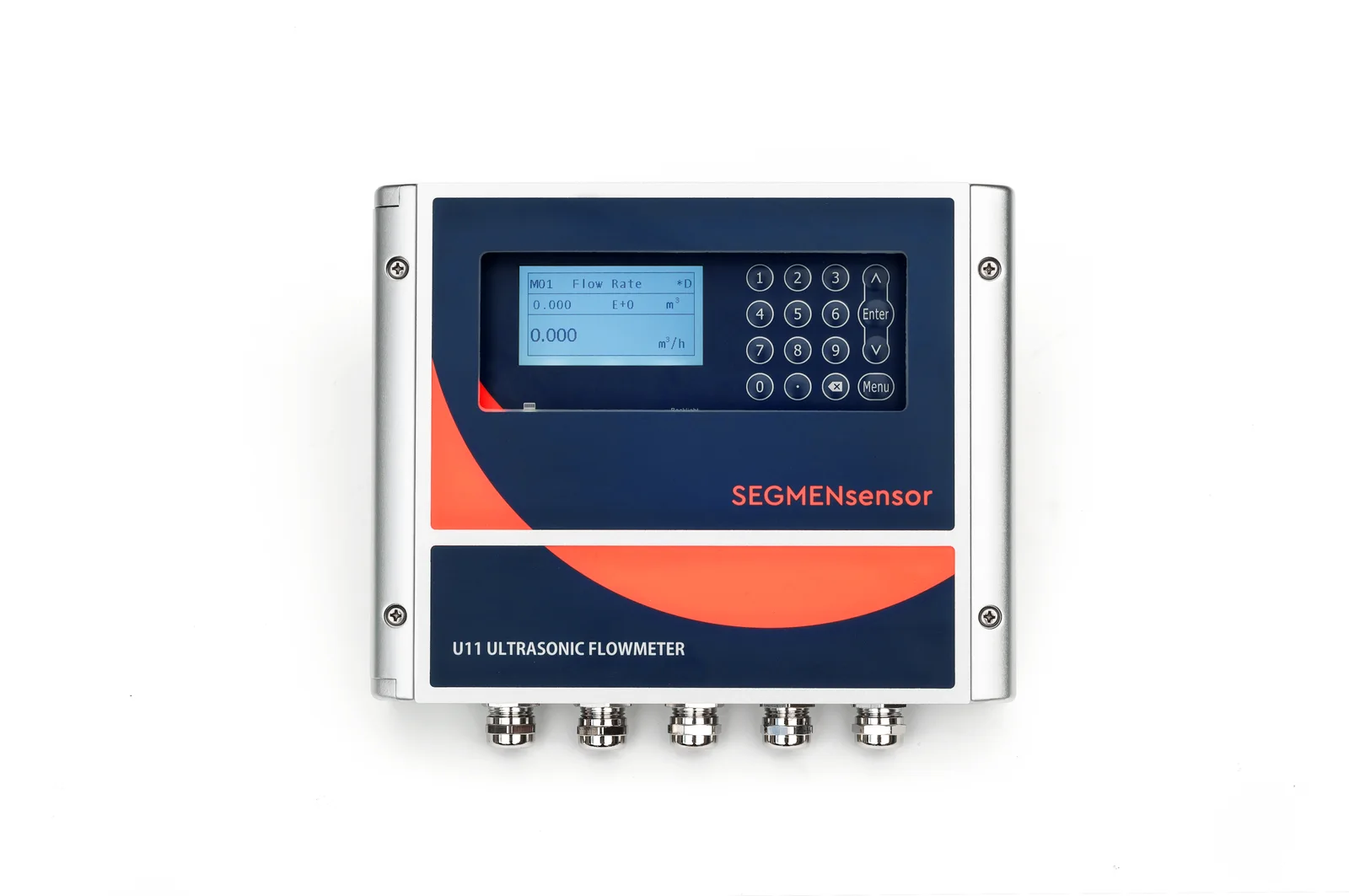
Use a U11 (15–5000 mm, ±0.5%) on the mill water or fresh water main, U10S PRO (±1%) on supply lines to each paper machine or dyeing machine range, and H1A sensors (to +130 °C) on dyehouse hot water. Trial clear filtrate and recycled water with the U20 portable meter first. Pulp stock, white water to the fan pump, dye liquor recirculation and raw effluent with fibre or lint are not suitable for a transit-time clamp-on meter.
Where Does a Clamp-On Meter Fit in a Paper Mill or Dyehouse?
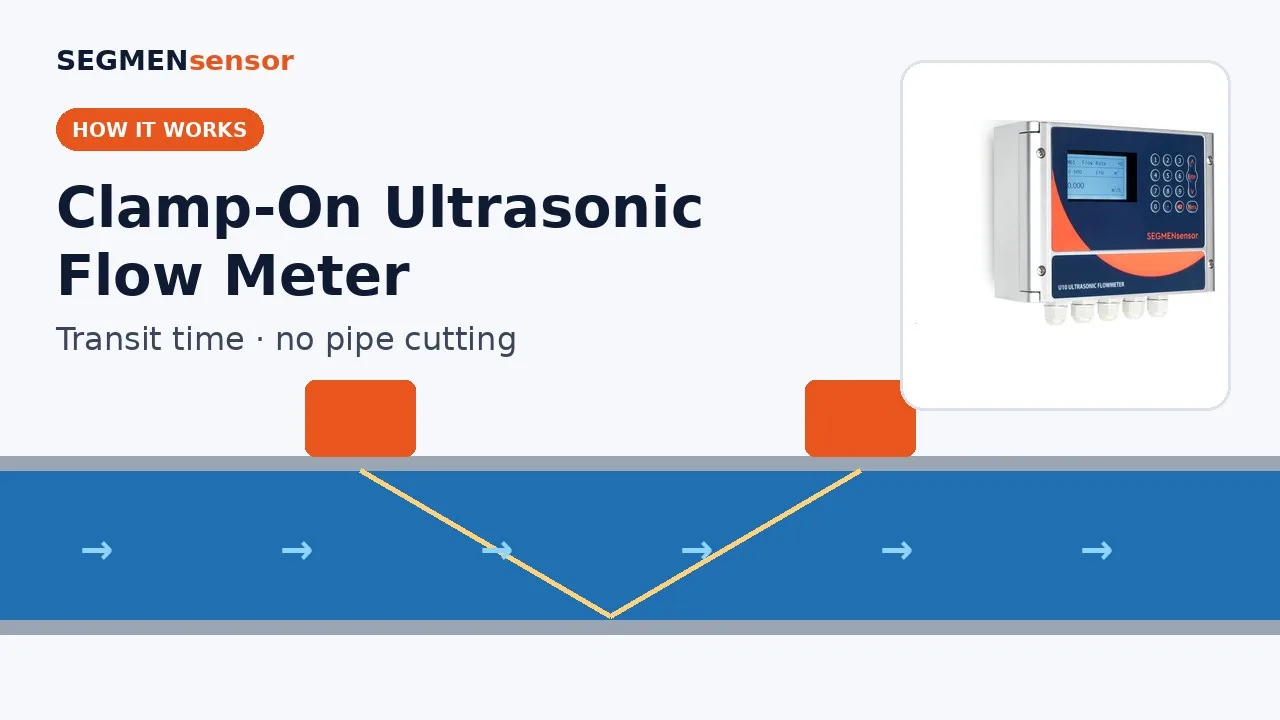
On the water that goes into the process and the water that cools it, not on the fibre-laden streams that come out. A clamp-on ultrasonic flow meter times ultrasonic pulses sent with and against the flow through the pipe wall; the transit-time difference gives velocity, and the pipe's inner area gives volume flow. The method for liquids in closed conduits is described in ISO 12242 — Measurement of fluid flow in closed conduits: ultrasonic transit-time meters for liquid. Every fibre, filler particle, lint strand and air bubble in the path scatters part of the pulse, so the question at each line is what the water carries.
That splits both industries the same way. In a paper or board mill, the fresh water intake, the mill water header, shower and dilution water from fresh sources, vacuum pump seal water and cooling water are clean and full-pipe — good clamp-on points. Clear and super-clear filtrate from the save-all or disc filter is in between and needs a trial. Pulp stock at any consistency and the short-circulation white water returning to the fan pump are not measurable this way. In textile dyeing and finishing, softened water, hot water, process cooling water and boiler feed make-up are good points; recycled treated water needs a trial; dye liquor circulating inside a machine and the raw effluent with lint are not suitable.
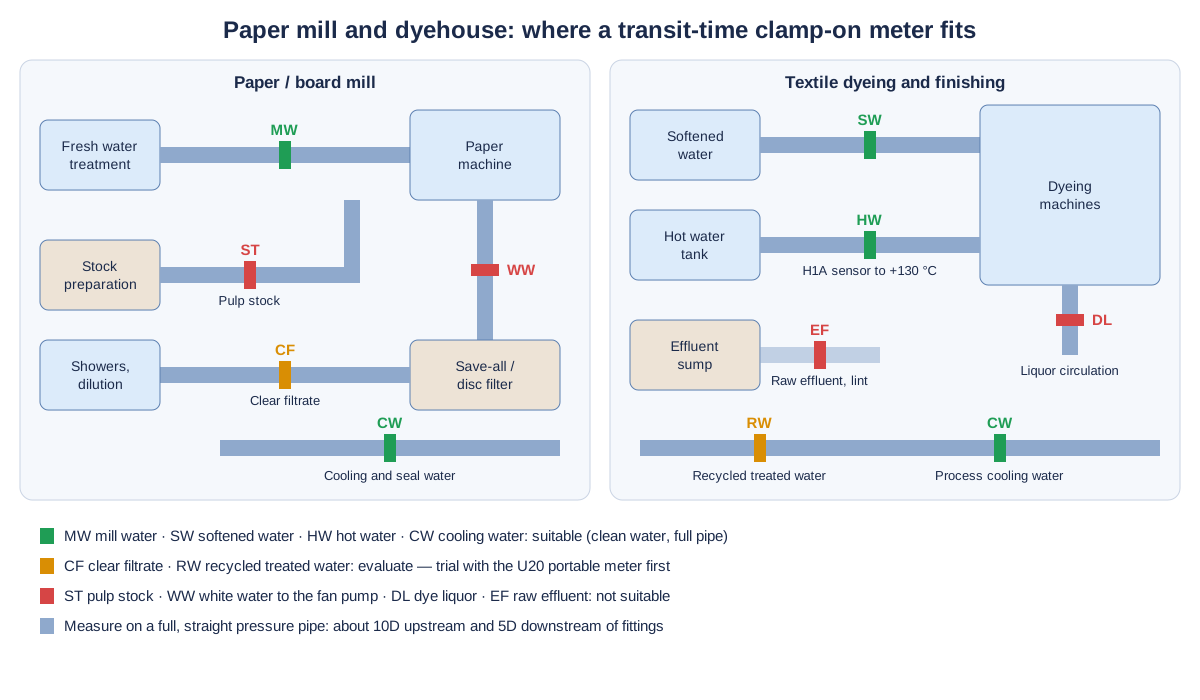
Typical Measuring Points in Paper Mills and Dyehouses
The table lists the lines where mills and dyehouses most often ask for a clamp-on meter. Pipe sizes are typical values for orientation only; model data are from the SEGMENsensor product page and datasheets. We confirm the model from your pipe and water data.
| Measuring point | Typical pipe | Medium · temperature | Suggested model | Confirm before ordering |
|---|---|---|---|---|
| Fresh water intake / mill water header (paper mill) | Carbon steel, stainless or ductile iron, DN200–DN1000 | Treated river or well water, ambient | U11 (15–5000 mm, ±0.5%); Z-mode on large pipes | Straight run away from pumps and branch tees; lining; output to the DCS |
| Water supply to each paper machine (showers, dilution, chemical make-down) | Stainless or carbon steel, DN50–DN300 | Fresh or warm water | U10S PRO (±1%), A2 sensors (−40 to +80 °C) | Vibration near pumps and refiners; machine-hall humidity; reverse flow on interconnections |
| Vacuum pump seal water and machine cooling water | Carbon steel or stainless, DN25–DN150 | Clean water, ambient to warm | U10S PRO (from 15 mm); U12 (DN15–DN65, ±2%) for indication | Lowest flow per pump; whether a totaliser is needed for the water balance |
| Clear / super-clear filtrate from the save-all or disc filter | Stainless or PVC, DN100–DN400 | Clarified white water with residual fines | Trial with the U20 portable meter first, then U10S PRO or U11 | Signal quality over a full shift including grade changes and filter washing |
| Softened water header to dyeing machines (dyehouse) | PP, PVC-U or stainless, DN50–DN250 | Softened water, ambient | U10S PRO (±1%); U11 where totals are allocated per department | Pipe material and measured wall; start–stop demand; signal on thick PP pipe |
| Hot water to dyeing and washing ranges | Stainless or carbon steel, insulated, DN40–DN200 | Hot water, often above +80 °C | U10S PRO / U11 with H1A sensors (to +130 °C) or H2A (to +180 °C) | Maximum water temperature; insulation opening at the sensor; no flashing at the measuring point |
| Small lines on machines (dosing water, cooling of a single machine) | Stainless, copper or PVC, DN15–DN40 | Clean water | U13 (DN15–DN40) or U12 (DN15–DN65) | Outer diameter; space between fittings on the machine |
| Water survey across machines (audit, water-saving project) | Any of the above, 25–1200 mm | Clean water, hot lines with P2H | U20 portable (±1%; P2 to +80 °C, P2H to +130 °C) | Logging interval and duration; access to bare pipe on each machine |
Installation Difficulties in Mills and Dyehouses and How to Handle Them
Hot, insulated lines in the dyehouse
Dyehouse hot water and wash-range supply lines often run above the +80 °C limit of standard A2 sensors. Specify H1A (to +130 °C) or H2A (to +180 °C), open the insulation only where the sensors sit and close it again over the bracket, and mount the transmitter away from the hot pipe. Do not measure where the water can flash to steam, for example just downstream of a pressure-reducing valve on a steam-heated line; two-phase flow stops a transit-time reading.
Air and foam from open tanks
Water drawn from open chests, tanks and dye machine overflows carries air, especially after a tank runs low. Mount on the pump discharge, not on the suction side, place transducers at the side of horizontal pipes (3 or 9 o'clock) and keep away from high points and air vents. The U11 rides through intermittent bubbles or impurities lasting up to 5 seconds; persistent air needs a different location.
PP and PVC pipe with thick walls
Dyehouse water networks are often PP or PVC-U. Enter the pipe material and the measured wall thickness, not the nominal one; a circumference tape gives the real outer diameter. Aim for a signal strength above 60% on the status screen, and on small, thick-walled pipes compare V-mode and W-mode, because every pass through the plastic wall weakens the pulse. Fibreglass (FRP) pipe is not in the datasheet pipe list; trial it with the U20 before ordering.
Deposits, scale and vibration in paper mills
Pitch, scale and fibre build-up on the inside of older lines reduce signal over time. Enter any lining at set-up and recheck signal quality after the first months. Mount away from refiners, screens and large pumps where possible, and fix the transmitter to a wall or column rather than the vibrating pipe. Keep about 10D of straight pipe upstream and 5D downstream of fittings; the full procedure is in the clamp-on flow meter installation guide and the installation video.
Wet, humid machine halls and washdown
Transducers are IP68 and the U10-series transmitter is IP65 (enclosure codes per IEC 60529 — Degrees of protection provided by enclosures (IP Code)). Keep the transmitter out of direct washdown spray and condensate drip, route cable glands downward, and use the long sensor cable (9 m standard, up to 274 m on order) to place the transmitter in a drier area.
Send your mill or dyehouse line data for a flow meter selection
Tell us the measuring point (mill water header, machine supply, filtrate, softened water, hot water or cooling water), pipe OD, wall thickness, material and lining, water temperature range, what the water carries (fines, lint, air), flow range including low flow, straight run, power, output to the DCS or PLC and quantity. OEM volume supply · samples 1–5 pcs in 5–7 working days · production lead time and MOQ confirmed with the quotation · quotation within 24 hours.
Can a Clamp-On Meter Measure White Water?
Only clarified white water, and only after a trial. Short-circulation white water returning from the wire pit to the fan pump carries fibre fines, fillers and air, and is not suitable for a transit-time meter. After the save-all or disc filter, the clear and super-clear filtrate sent back to showers, dilution and stock preparation is much cleaner, and many lines give a stable signal — but fines content changes with grade, furnish and filter condition.
So treat every filtrate line as a candidate, not a certainty: clamp the U20 portable meter on it for at least a full shift that includes a grade change and a filter wash, and log signal strength and quality together with flow. If the signal stays steady, a fixed U10S PRO or U11 will work at that point. If it collapses whenever fines rise, measure the water balance from the fresh-water side instead: the fresh water entering each machine and the effluent leaving the mill are usually easier points than the recycled streams in between.
How Do You Build a Water Balance Per Machine or Per Batch?
Meter the main and each consumer, and compare the sum with the main. In a paper mill that means the mill water header (U11) and the supply to each paper machine (U10S PRO); in a dyehouse, the softened water and hot water headers and the supply to each dyeing machine group. The totaliser reports cubic metres per shift, and the pulse output (OCT) can be counted by the machine PLC to record water per batch.
For scale: a DN400 mill water header at 1.2 m/s carries about 543 m³/h, and a DN80 hot water line at 1.5 m/s carries about 27 m³/h, so a 10-minute machine fill at that rate takes about 4.5 m³ (calculated values from nominal bores of 400 mm and 80 mm). Dyeing machines draw water in short bursts, so set the low-flow cut-off with care and choose the U11 (from ±0.01 m/s) where flow is often low; the U10 series measures from ±0.03 m/s. If header and machine totals drift apart over weeks, look for an unmetered take-off, a leaking valve or a meter whose signal has fallen because of deposits.
In the United States, mill discharges are regulated under the EPA's Pulp, Paper and Paperboard Effluent Guidelines (40 CFR Part 430), which are written into NPDES permits. Internal water meters support the water balance behind such permits; the permit or discharge meter itself is decided by the regulator, and SEGMENsensor flow meters carry CE and UKCA marking without any national approval for regulatory reporting.
Which Mill and Dyehouse Lines Are Not Suitable?
Pulp stock, short-circulation white water, dye liquor recirculation, raw effluent and anything two-phase or partly full are not suitable for a transit-time clamp-on meter. Specifically:
- Pulp stock at any consistency, including thick stock, machine chest and headbox feed: fibre suspensions scatter the ultrasonic pulse.
- Short-circulation white water and cloudy filtrate: high fines, fillers and entrained air.
- Rejects, sludge and coating colour: high solids or pigment content.
- Dye liquor circulating inside dyeing machines: a closed in-machine loop with foam, air and short pipe runs; measure the water entering the machine instead.
- Raw dyehouse and mill effluent: lint, fibre and partly full gravity drains; once treated and pumped, see clamp-on flow meters for treated effluent and reuse water.
- Steam, flashing condensate and gases: SEGMENsensor clamp-on meters are for single-phase liquids only.
- Hazardous (Ex) areas, such as solvent handling in some finishing or coating areas: SEGMENsensor flow meters have no explosion-protected model.
Specifications That Matter for Mill and Dyehouse Water
The values below are taken from the SEGMENsensor ultrasonic flow meter product page and datasheets. Compare every model in the U10 to U20 model comparison.
| Parameter | U10 / U10S PRO | U11 | U20 portable |
|---|---|---|---|
| Pipe size | 25–1200 mm (U10) · 15–1200 mm (U10S PRO) | 15–5000 mm | 25–1200 mm |
| Accuracy · repeatability | ±1% · 0.2% | ±0.5% · 0.1% | ±1% |
| Flow velocity | ±0.03 to ±5 m/s | ±0.01 to ±12 m/s | ±0.01 to ±12 m/s |
| Sensor temperature | A2 −40 to +80 °C · H1A −40 to +130 °C · H2A −40 to +180 °C | P2 −40 to +80 °C · P2H −40 to +130 °C | |
| Pipe materials (datasheet list) | Stainless steel, carbon steel, cast iron, copper, PVC, PP and other rigid plastics | ||
| Outputs · logging | Choose two: 4-20 mA, pulse (OCT), relay, RS232 / RS485 Modbus; HART optional · SD card up to 32 GB on the U10 series | SD card up to 32 GB, logging interval 1–99999 s | |
| Power | 10–36 V DC; 90–245 V AC optional | 10–36 V DC or 90–245 V AC | Rechargeable 3000 mAh battery, about 16 hours per charge |
| Protection · certification | Sensors IP68, U10-series transmitter IP65 · CE, UKCA (no explosion-protected model) | ||
Download the one-page datasheet (PDF)
Pipe size ranges, accuracy, transducer types and temperature ratings, outputs, power supply, enclosure ratings and ordering code for the SEGMENsensor clamp-on ultrasonic flow meter range. No registration required.
How Do You Survey Water Use Before Fixing Meters?
Move the U20 portable clamp-on flow meter from machine to machine and log each supply line over at least one full production cycle or dyeing batch. Record flow, signal strength and quality on the SD card (logging interval 1–99999 s), and fit P2H sensors on hot lines up to +130 °C. The survey shows where most water goes, which lines give a stable signal and where a fixed U10S PRO or U11 pays off; it also settles whether a filtrate or recycled water line is measurable at all. The U20 setup is shown in the U20 setup video.
Related Pages
For choosing a meter for clean water pipes in general, read the ultrasonic flow meter for water selection guide. Corrosive process liquids are covered in the chemical plant guide, cooling circuits in steel mill cooling water, and treated effluent and reuse water in the effluent and reuse guide. Why fibre-laden streams are a different measuring problem is explained in transit-time vs Doppler ultrasonic flow meters.
What Affects the Quotation?
We do not publish list prices because the configuration drives the quotation: fixed or portable, pipe size range and transducer type (standard or high-temperature), accuracy class, outputs, power supply, cable length and quantity. Quotations are FOB China and exclude international freight and import duties or taxes; payment is 100% T/T in advance, and meters carry a 12-month warranty.
Get a clamp-on flow meter for mill or dyehouse water
U11 for mill water mains, U10 series for machine and dyehouse supply lines, H1A / H2A sensors for hot water, U20 for water surveys and filtrate trials. OEM volume supply · samples 1–5 pcs in 5–7 working days · production lead time and MOQ confirmed with the quotation · quotation within 24 hours. Download the clamp-on flow meter datasheet (PDF).
Frequently Asked Questions
Only clarified white water, after a trial. Clear or super-clear filtrate from the save-all or disc filter often gives a stable signal; short-circulation white water returning to the fan pump carries fines, fillers and air and is not suitable.
No. Pulp stock at any consistency is a fibre suspension that scatters the ultrasonic pulse, so a transit-time clamp-on meter cannot measure it. Measure the fresh water and filtrate going into stock preparation instead.
Standard A2 sensors cover −40 to +80 °C. For hotter water choose H1A (to +130 °C) or H2A (to +180 °C) on the U10 series and U11, or P2H (to +130 °C) on the U20, and avoid points where the water can flash to steam.
Yes. Stainless steel, carbon steel, cast iron, copper, PVC, PP and other rigid plastics are in the datasheet pipe list. Enter the measured wall thickness; fibreglass (FRP) pipe is not listed, so trial it with the U20 first.
Yes. Fit a fixed meter on the machine supply line and read the totaliser over Modbus, or count the pulse output in the machine PLC for each batch. Choose the U11 (from ±0.01 m/s) where flow is often low.
Samples of 1–5 pcs ship in 5–7 working days. Production lead time and MOQ are confirmed with the quotation, which we send within 24 hours on working days, FOB China.