Transit-time ultrasonic flow meters measure the travel-time difference of ultrasound pulses between two transducers — they are the accurate, versatile choice for clean liquids. Doppler ultrasonic flow meters measure the frequency shift of ultrasound reflected by suspended particles or bubbles — they suit slurries and dirty liquids. SEGMENsensor manufactures only transit-time clamp-on flow meters, covering DN15–DN6000 with ±1% accuracy for clean industrial liquids.
What Is a Transit-Time Ultrasonic Flow Meter?
A transit-time ultrasonic flow meter — also called a time-of-flight flow meter — works by sending ultrasonic pulses in both directions between two transducers clamped to the outside of a pipe. When liquid is flowing, the pulse travelling in the same direction as the flow (downstream) arrives slightly earlier than the pulse travelling against the flow (upstream). This time difference, measured in nanoseconds, is directly proportional to the average flow velocity of the liquid.
The measurement principle is elegantly simple: the upstream transit time minus the downstream transit time equals a value that depends only on flow velocity and the acoustic path length through the pipe. With accurate pipe geometry inputs (outer diameter, wall thickness, pipe material), the meter converts this time difference into a precise volumetric flow rate — no moving parts, no pressure drop, no process shutdown required.
Transit-time meters work on clean, single-phase liquids — liquids that do not contain significant concentrations of suspended solids, air bubbles, or gas voids. Clean liquids allow the ultrasonic signal to travel through the fluid without excessive scattering or attenuation. Industrial applications include water supply systems, HVAC chilled water circuits, cooling water loops, chemical process lines, thermal oil systems, and food-grade liquid handling.
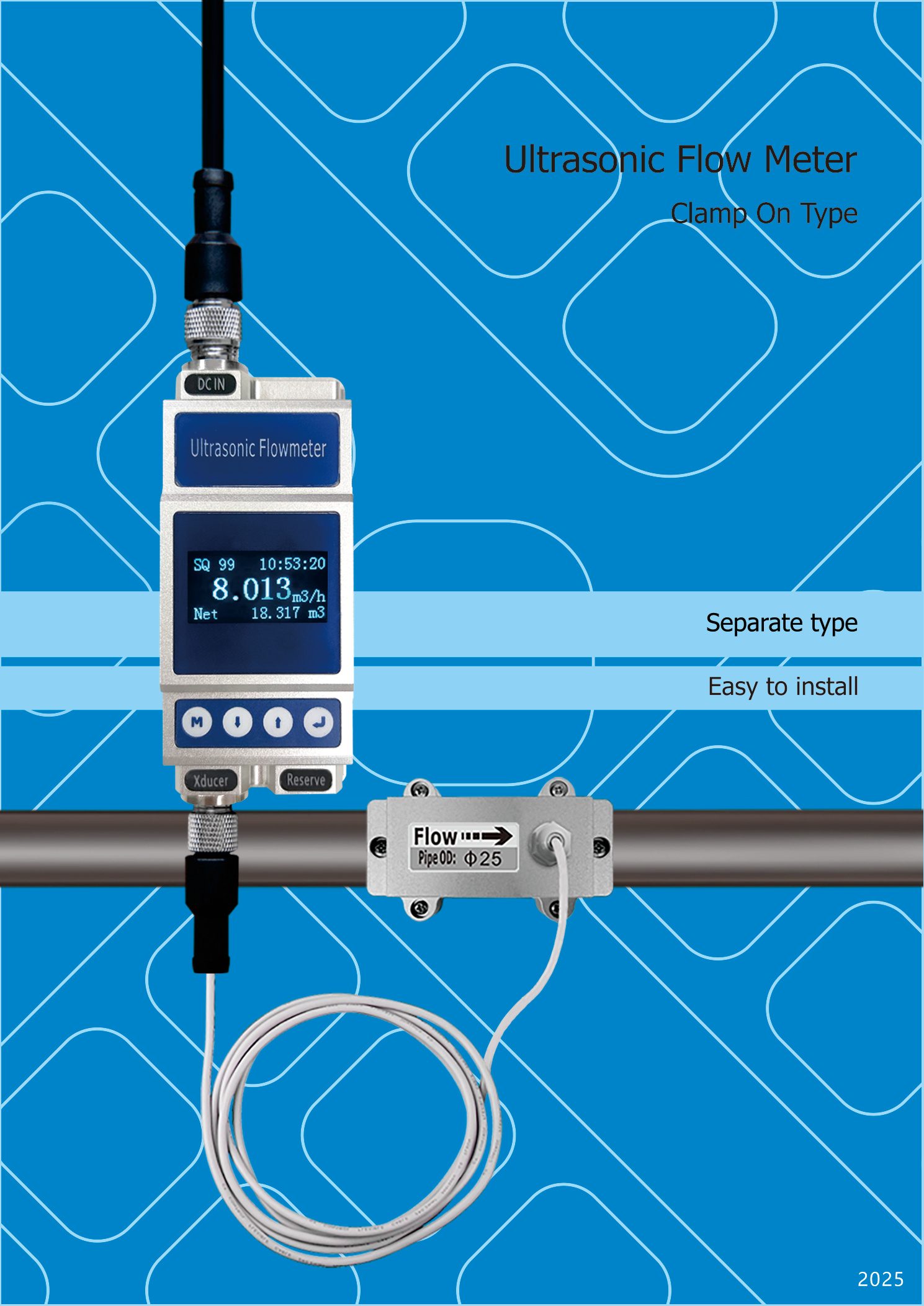
All SEGMENsensor clamp-on ultrasonic flow meters use the transit-time principle. The full product range — U series, SEGX3, SEGX3M, SEGX5, U20, and SEGEX3 — is designed exclusively for transit-time measurement, covering pipe diameters from DN15 to DN6000 with bidirectional flow velocities of ±0.01 m/s to ±15 m/s.
What Is a Doppler Ultrasonic Flow Meter?
A Doppler ultrasonic flow meter uses the Doppler effect to measure flow velocity. The meter emits a continuous ultrasonic beam into the flowing liquid. When this beam strikes moving particles — suspended solids, air bubbles, or gas voids — part of the acoustic energy is reflected back to a receiver. Because the particles are moving with the flow, the reflected signal returns at a slightly different frequency than the transmitted signal. This frequency shift (the Doppler shift) is proportional to the velocity of the particles, which is assumed to be equal to the average liquid velocity.
The critical requirement for Doppler meters is that the liquid must contain reflective particles or bubbles. Without these reflectors, there is no Doppler signal and no measurement. As a rule of thumb, Doppler meters require a minimum of 100 ppm suspended solids larger than 100 μm in diameter, or a void fraction of at least 0.5% gas bubbles. Applications where Doppler meters excel include raw sewage and wastewater, mining slurry pipelines, paper pulp and food-processing slurries, and aerated or mixed process streams.
Because the signal reflection depends on the non-uniform distribution of particles throughout the cross-section, Doppler meters are inherently less accurate than transit-time meters. Accuracy is typically stated as ±2–5% of reading, compared to ±1% for transit-time. Additionally, Doppler meters cannot measure bidirectional flow as accurately as transit-time meters, and calibration tends to drift if the particle concentration changes significantly.
SEGMENsensor does not manufacture Doppler-type ultrasonic flow meters. Our engineering focus is exclusively on transit-time (clamp-on) technology for clean industrial liquid applications.
Transit-Time vs Doppler — Head-to-Head Comparison
The table below compares the two technologies across the dimensions that matter most for industrial flow measurement selection:
| Criterion | Transit-Time | Doppler |
|---|---|---|
| Liquid requirement | Clean, single-phase liquid; low particle content; <1% gas void fraction | Must contain suspended solids (>100 ppm, >100 μm) or gas bubbles (>0.5% void fraction) |
| Pipe mounting | Two transducers clamped to outside of pipe (clamp-on); no pipe cutting | Typically one or two transducers clamped to outside of pipe; some designs use only one side |
| Accuracy | ±1% of reading under proper installation; ±0.2% repeatability | ±2–5% of reading; repeatability degrades with changing particle distribution |
| Bidirectional flow | Yes — full accuracy in both directions | Limited; accuracy typically lower for reverse flow |
| Typical applications | Cooling water, HVAC, process water, chemical solvents, thermal oil, drinking water, food-grade liquids | Wastewater, mining slurry, paper pulp, aerated liquids, activated sludge |
| Min particle content | None required — particles degrade signal | >100 ppm solids >100 μm, or >0.5% gas void fraction |
| Pipe size range | DN15–DN6000 (SEGMENsensor range) | Typically DN50–DN2000; less common on very small pipes |
| Best for | Metering, energy monitoring, process control, custody transfer on clean liquids | Flow indication (not billing-grade) on dirty or multiphase liquids |
When to Choose Transit-Time (Clean Liquids)
Transit-time ultrasonic flow meters are the correct choice for the vast majority of industrial liquid measurement applications. If your process liquid is clean and single-phase, transit-time will deliver better accuracy, better repeatability, and more reliable long-term performance than any Doppler alternative.
Applications where transit-time excels:
- Industrial process water: cooling tower make-up water, boiler feed water, raw water intake — all clean enough for transit-time at DN15 to DN6000.
- HVAC chilled water circuits: primary and secondary loops in building automation systems; energy metering for heat exchange stations requires ±1% accuracy, which only transit-time reliably achieves.
- Chemical process lines: solvents, acids, bases, and other clean chemicals where pipe penetration would create contamination or safety risks — clamp-on transit-time eliminates all wetted parts.
- Drinking water and utilities: potable water distribution, municipal supply monitoring, leak detection — transit-time is standard in waterworks metering.
- Thermal oil and heat transfer fluids: industrial heating systems where fluid purity is maintained — transit-time handles viscous clean oils across the specified temperature range.
- Semiconductor and microelectronics: ultra-pure water (UPW) systems where any wetted sensor is forbidden — clamp-on transit-time is the only non-invasive option.
- Pharmaceutical and food-grade liquids: clean CIP-compatible process streams before particulate addition — transit-time with hygienic pipe materials works without contamination risk.
The key conditions for transit-time selection are: the liquid is essentially clear (NTU turbidity below approximately 1,000), there are no large quantities of entrained gas bubbles (<1% void fraction), and the pipe is running full at the measurement point. When these conditions are met, ±1% accuracy is readily achievable with a properly installed transit-time clamp-on meter.
When to Choose Doppler (Dirty Liquids)
Doppler ultrasonic flow meters fill a specific niche: flow indication on liquids that contain too many particles or bubbles for transit-time to work. If the fluid is inherently dirty or multiphase, Doppler is typically the appropriate ultrasonic technology — though note that electromagnetic (magmeter) flow meters often outperform Doppler on dirty conductive liquids where higher accuracy is required.
Applications where Doppler is applicable:
- Wastewater and sewage: municipal wastewater treatment plants; raw sewage with high biological oxygen demand (BOD) and suspended solids content above 10,000 mg/L where transit-time signal is blocked.
- Mining slurry pipelines: ore slurries, tailings, and process slurries with solid concentrations of 5–40% by weight — ideal Doppler application with plentiful reflectors.
- Activated sludge and digester return: biological wastewater treatment processes where aeration intentionally introduces air bubbles and biological solids.
- Paper pulp and forest products: low-consistency pulp slurries (1–4% consistency) in papermaking processes.
- Food processing slurries: tomato paste, fruit pulp, vegetable mash, and similar product streams with significant fibre or particle loading.
- Doppler meters typically achieve only ±2–5% accuracy — significantly worse than transit-time ±1%. Do not use Doppler for billing-grade, energy metering, or custody-transfer applications.
- Doppler accuracy also varies with changes in particle size distribution and concentration. A reading that was calibrated at one slurry concentration will drift if the concentration changes.
- For dirty conductive liquids where higher accuracy is required, an electromagnetic flow meter (magmeter) is usually a better choice than Doppler.
Can Transit-Time Work on Slightly Dirty Liquids?
This is one of the most common questions in industrial flow meter selection, and the answer is more nuanced than the simple clean/dirty divide suggests. Transit-time meters are more tolerant of moderate contamination than the textbook description implies.
Transit-time works reliably when:
- Turbidity is below 1,000 NTU (nephelometric turbidity units) — this covers most secondary-treated effluent, lightly scaled cooling water, and process water from most industrial sources.
- Suspended solids are below approximately 1,000 mg/L by mass — fine particles at this concentration do not significantly scatter ultrasound at the frequencies used by most transit-time meters (1–2 MHz).
- Gas void fraction is below 1% — small amounts of dissolved gas or microscopic bubbles at this level are handled by the meter's signal processing algorithms.
Transit-time signal degrades when:
- Gas void fraction exceeds 5% — large gas slugs create an intermittent air column that blocks the ultrasonic path completely.
- Suspended solids exceed approximately 10,000 mg/L — the acoustic attenuation becomes too high for the signal to traverse the pipe diameter.
- Particle size is large and irregular — coarse sand, gravel, and fibre create intense forward scattering that attenuates the transit-time signal unpredictably.
In practice, transit-time meters handle approximately 95% of all industrial liquid measurement scenarios encountered in water treatment, HVAC, chemical processing, energy management, and manufacturing. The 5% of applications that genuinely require Doppler or electromagnetic technology involve highly aerated, heavily loaded slurries, or sewage with extreme suspended solids.
When in doubt, check the signal strength reading on the meter after installation. If signal strength is above 60%, the liquid is clean enough for reliable transit-time measurement. If the meter cannot achieve 60% signal even in Z-mode with clean transducer coupling, the liquid is too dirty for transit-time and an alternative technology should be considered.
SEGMENsensor Clamp-On Transit-Time Flow Meters — Full Range
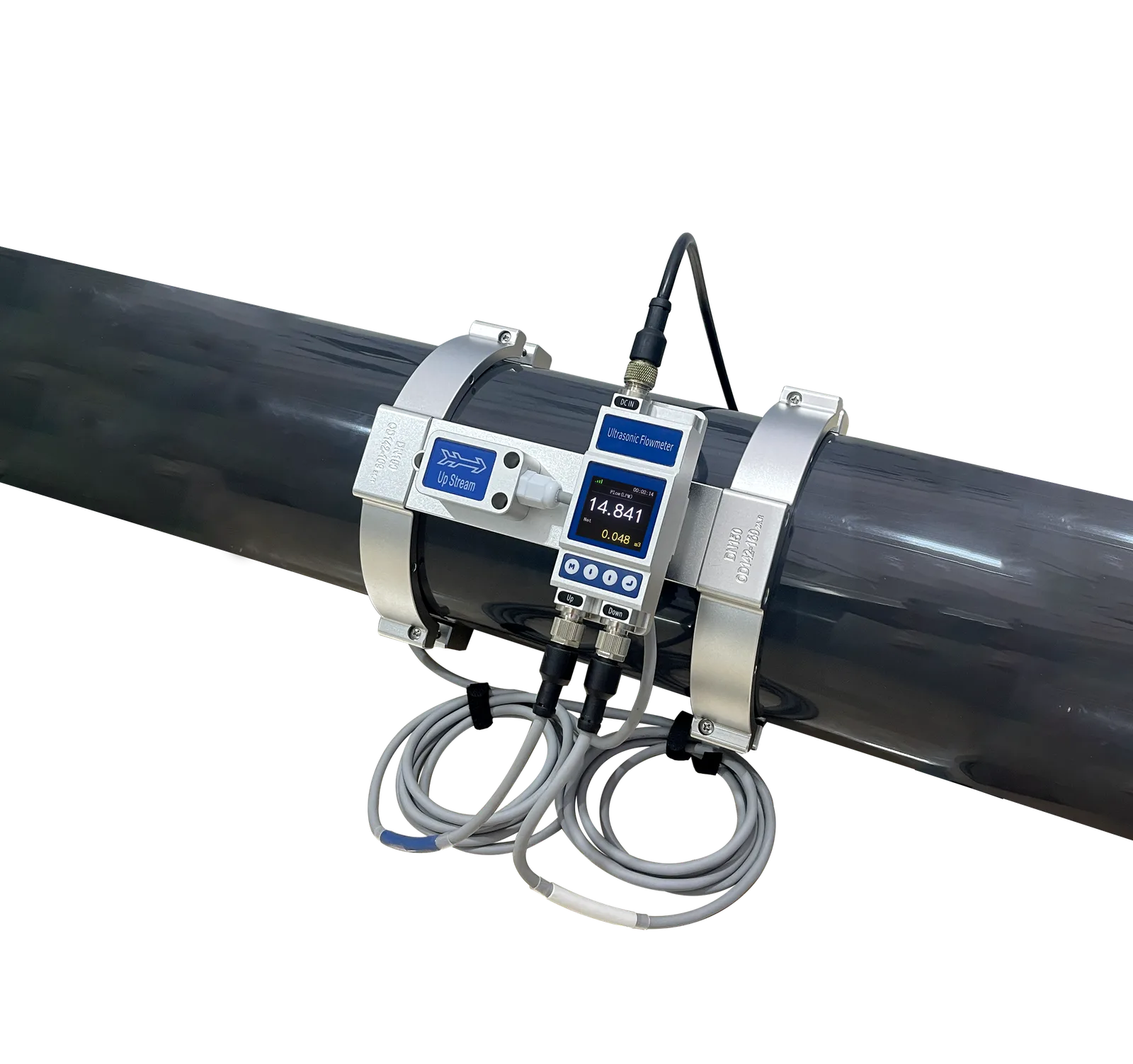
SEGMENsensor manufactures six clamp-on transit-time ultrasonic flow meter models, covering everything from small DN15 laboratory and utility lines to large DN6000 industrial mains. All models share the same transit-time operating principle, the same CE and ISO 9001 certification base, and the same fundamental ±1% accuracy specification under correct installation conditions.
| Model | Pipe Range | Display | Key Feature |
|---|---|---|---|
| U Series | DN15–DN6000 | Integrated LCD | Entry-level portable + fixed; standard general-purpose transit-time meter |
| SEGX3 | DN25–DN6000 | Integrated 4-line display | Mid-range fixed mount; 4–20 mA + Modbus RTU + pulse outputs; IP67 |
| SEGX3M | DN25–DN6000 | Remote display unit (split-type) | Split-type; transmitter separates from pipe for panel mounting; ideal for insulated or high-temperature pipes |
| SEGX5 | DN25–DN6000 | Large backlit LCD | High-performance; dual-channel energy measurement; HART output option; wider temperature range |
| U20 | DN15–DN100 | Compact integrated | Compact body for small-bore pipes; portable handheld battery operation |
| SEGEX3 | DN50–DN6000 | Integrated with ATEX housing | ATEX / IECEx certified for Zone 1 and Zone 2 hazardous areas; intrinsically safe transducers |
For a detailed model-by-model comparison including transducer options, output signal types, and temperature ratings, see the SEGMENsensor Ultrasonic Flow Meter product page and the SEGX3 vs X3M vs X5 comparison guide. Datasheets for all models are available on the Ultrasonic Flow Meter Downloads page.
- All SEGMENsensor transit-time flow meters are available for OEM from a minimum order quantity of 10 pieces.
- Custom labelling, private label packaging, and custom output signal configurations are available on request.
- CE, RoHS, ISO 9001, and ATEX (SEGEX3 model) documentation is provided as standard.
Installation Requirements for Both Technologies
While transit-time and Doppler meters both clamp to the outside of the pipe without cutting or tapping, their installation requirements differ in important ways. Understanding these requirements before site survey prevents most commissioning problems.
Transit-Time Installation Requirements
- Straight pipe run: At least 10× pipe diameter (10D) of straight, undisturbed pipe upstream and 5D downstream of the transducer location, clear of elbows, tees, reducers, control valves, and pumps. For installations close to a control valve or flow conditioner, 15D upstream is recommended.
- Pipe full at measurement point: The pipe must be 100% full of liquid. Any air pocket or gas phase at the transducer location will block the signal. On horizontal pipes, avoid the top of the pipe (air accumulation) and bottom (sediment). Mount transducers at the 3 o'clock or 9 o'clock position.
- Pipe dimensions — measured, not nominal: Outer diameter and wall thickness must be measured with calipers at the exact installation point. Nominal pipe sizes can differ by 2–5% from actual, and this directly affects accuracy. Enter the measured values into the meter, not the schedule specification.
- Pipe surface preparation: The pipe surface at each transducer location must be clean and free of scale, paint, rust, grease, and moisture. Sand smooth with 60–80 grit sandpaper, then wipe with isopropyl alcohol and allow to dry completely before applying coupling gel.
- Acoustic coupling: Apply ultrasonic couplant gel between transducer face and pipe surface. For permanent installations, use RTV silicone adhesive for a permanent acoustic bond. For pipe surfaces above 60°C, use a high-temperature couplant.
Doppler Installation Requirements
- Straight pipe run: Doppler meters are less sensitive to velocity profile distortion than transit-time, but still benefit from ≥5D upstream straight run for better accuracy. Doppler can tolerate more upstream disturbance at the cost of increased measurement uncertainty.
- Particle or bubble content: The liquid must contain a minimum of 100 ppm suspended solids (particle size >100 μm) or at least 0.5% gas void fraction. If the liquid is too clean, signal will be absent. Measure particle content before selecting Doppler technology.
- Single-sided access only: Some Doppler designs require only one side of the pipe to be accessible, since the transducer can transmit and receive on the same face. This is advantageous in confined spaces or where only partial pipe access is possible.
- Pipe surface and coupling: Same requirements as transit-time — clean pipe surface, ultrasonic couplant gel, and accurately measured pipe dimensions for the meter's velocity calculation algorithm.
Requirements Common to Both
- Pipe OD and wall thickness must be accurately measured and entered into the meter — this is the single most common source of systematic error.
- Rubber-lined pipe with lining thickness >6 mm is problematic for both technologies — the lining attenuates ultrasound significantly. Verify signal strength at the measurement point before committing to the installation location.
- Both technologies work on the same pipe materials: carbon steel, stainless steel, copper, PVC, CPVC, HDPE, PP, and fiberglass. Concrete-lined pipe and very thick rubber-lined pipe are challenging for both.
- Signal cables must be routed away from variable frequency drives (VFDs), high-voltage power cables, and other sources of electromagnetic interference. Use shielded coaxial cable and maintain a minimum separation of 300 mm from power conductors.
Frequently Asked Questions
Transit-time meters send ultrasound between two transducers and measure how liquid slows the upstream signal vs speeds the downstream signal — this works on clean, particle-free liquids. Doppler meters measure the frequency shift of ultrasound reflected off suspended particles or bubbles — this requires the liquid to contain reflective particles or gas voids. SEGMENsensor manufactures only transit-time clamp-on flow meters, which cover the vast majority of industrial clean-liquid applications.
Transit-time flow meters are significantly more accurate. Under proper installation conditions (≥10D straight run, calibrated pipe parameters), transit-time meters achieve ±1% accuracy and ±0.2% repeatability. Doppler flow meters are inherently less precise (typically ±2–5%) because the signal reflection depends on the concentration and distribution of particles, which are never perfectly uniform. For most billing-grade, process control, or energy metering applications, transit-time is the correct choice.
Standard transit-time flow meters are not suitable for heavily aerated wastewater or sewage with high suspended-solid content (>10,000 mg/L) because the particles and air scatter the ultrasonic signal. However, transit-time meters work reliably on clean process water, cooling water, drinking water, and treated effluent with low turbidity. For raw sewage, aerated activated sludge, or slurry pipelines, a Doppler-type or electromagnetic (magmeter) flow meter is the appropriate choice.
All SEGMENsensor clamp-on ultrasonic flow meters — U series, SEGX3, SEGX3M, SEGX5, U20, and SEGEX3 — use the transit-time (also called time-of-flight) principle. This makes them suitable for clean, single-phase liquids: water, cooling water, chilled water, thermal oil, chemical solvents, and food-grade liquids. SEGMENsensor does not currently offer Doppler-type ultrasonic flow meters.
No. Transit-time clamp-on ultrasonic flow meters require the pipe to be 100% full of liquid at the measurement point. The ultrasonic signal must pass through a continuous liquid column between the two transducers. Partially filled pipes create an air gap that blocks the signal, resulting in an error reading or no measurement. For partially filled gravity-flow pipes (drains, culverts, open channels), use an open-channel ultrasonic level meter instead.
Both transit-time and Doppler clamp-on flow meters work on the same pipe materials: carbon steel, stainless steel, copper, PVC, CPVC, HDPE, PP, and fiberglass. The key requirement is that the pipe wall must transmit ultrasound without excessive attenuation. Heavily corroded steel pipe (irregular wall), thick rubber-lined pipe (>6 mm lining), and concrete pipe are challenging for both technologies. Cast iron pipe can be difficult for Doppler due to its irregular grain structure attenuating the signal.
SEGMENsensor transit-time clamp-on flow meters measure bidirectional flow velocities from ±0.01 m/s to ±15 m/s (with the full specified accuracy range of ±0.2 m/s to ±12 m/s for ±1% accuracy). The optimal accuracy range is 0.5–8 m/s, which covers most pump-driven industrial pipelines. For very low flow velocities (below 0.2 m/s), transit-time accuracy degrades because the time difference becomes too small to resolve reliably.
Yes. The signal quality indicator (displayed as signal strength percentage or S/N ratio on SEGMENsensor meters) must read at least 60% for reliable measurement. Below 60%, the meter may display readings but accuracy is significantly compromised. Signal strength depends on pipe surface cleanliness, couplant quality, transducer mounting precision, and pipe material. If V-mode gives <60% signal, switch to Z-mode (transducers on opposite sides of the pipe). For heavy pipe scale or coatings, mechanical descaling at the measurement point improves signal strength.