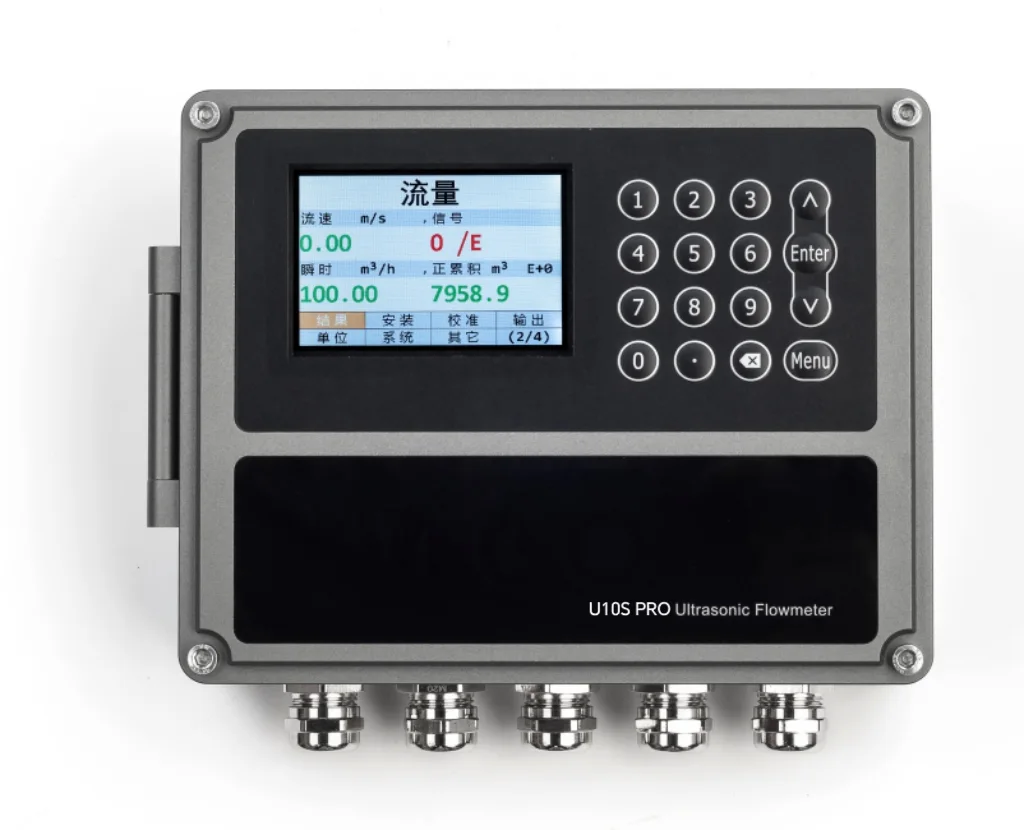
In a chemical plant, use a transit-time clamp-on ultrasonic flow meter on full pipes of a single, clean liquid: cooling water, chilled brine or glycol, demineralized water, condensate, heat-transfer liquids within the sensor rating, and many solvents, acids and alkalis. The transducers stay outside the pipe, so no wetted part has to resist the chemical. Do not use our meters in hazardous (Ex) areas, on slurries or on two-phase flow.
Why Do Chemical Plants Use Clamp-On Ultrasonic Flow Meters?
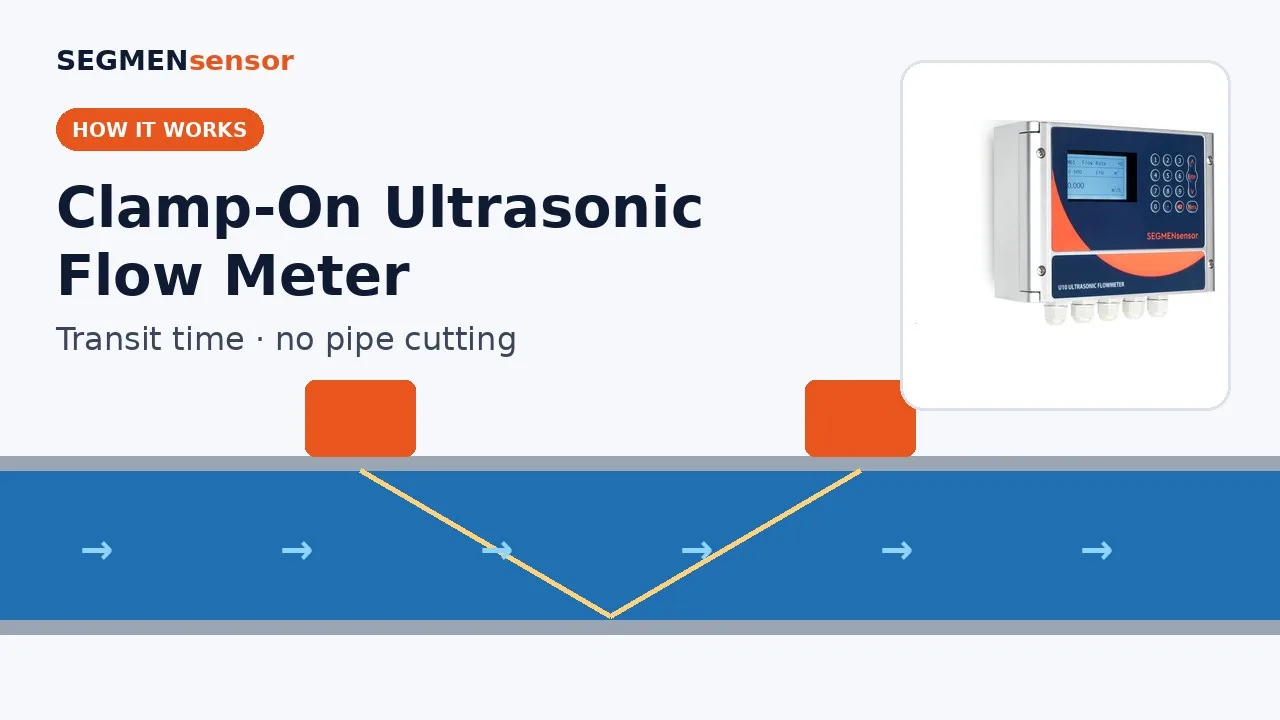
Because nothing has to touch the chemical and nothing has to be cut. A clamp-on ultrasonic flow meter times ultrasonic pulses sent with and against the flow between two transducers strapped to the pipe wall; the transit-time difference gives velocity, and the pipe inner area gives volume flow. The method for liquids in closed conduits is described in ISO 12242 — Measurement of fluid flow in closed conduits: ultrasonic transit-time meters for liquid.
That matters more in a chemical plant than almost anywhere else. An inline meter on an acid or solvent line needs wetted materials matched to the medium, gaskets that hold, and a line break to install — each line break means draining, purging and a permit. Where a plant handles highly hazardous chemicals, changes to process equipment also fall under management-of-change procedures; in the United States these are set by OSHA 29 CFR 1910.119 — Process safety management of highly hazardous chemicals. A clamp-on meter adds no flange, no seal and no pressure drop to the line, so the process boundary stays as it was.
Typical Measuring Points in a Chemical or Petrochemical Plant
The table lists the lines where we are most often asked for a clamp-on meter in chemical plants. Pipe sizes and media are typical values for orientation; model data are from the SEGMENsensor product page and datasheets. Every chemical medium is checked against its sound speed, viscosity and temperature before we confirm a model.
| Measuring point | Typical pipe | Medium and temperature | Suggested SEGMENsensor model | Confirm before ordering |
|---|---|---|---|---|
| Process cooling water to reactor jackets and heat exchangers | Carbon steel, DN80–DN600 | Treated cooling water, usually within +80 °C | U10 or U10S (±1%); U11 (±0.5%) for headers or larger mains | Scale and corrosion on old pipes; straight run after pumps and control valves |
| Chilled water, brine and glycol loops | Steel or stainless, DN50–DN300, insulated | Water-glycol or brine, below ambient | U10 series or U11 with A2 sensors (−40 to +80 °C); E type with PT1000 for cooling energy | Glycol concentration (sound speed changes with it); condensation and ice at the sensor spot |
| Demineralized and process water | Stainless steel or PVC / PP, DN25–DN150 | Clean water near ambient temperature | U10S or U11 (from 15 mm); U12 (DN15–DN65) for skid lines | Plastic pipe material and wall; pulse output for batch totalizing |
| Steam condensate return | Carbon steel, insulated | Hot water; check the maximum temperature | U10 series or U11 with H1A sensors (to +130 °C) | Measure on a full, pumped section, away from flashing |
| Thermal oil and hot heat-transfer liquids | Carbon steel, insulated | Single-phase liquid, only up to +180 °C at the pipe wall | U10 series or U11 with H2A sensors (to +180 °C) | Sound speed and viscosity of the oil at operating temperature; above +180 °C is not suitable |
| Solvent and alcohol transfer (for example methanol, ethanol) | Stainless steel, DN25–DN100 | Single clean liquid near ambient temperature | U10S, U11, or U12 on small lines | Hazardous-area classification first: our meters have no Ex rating |
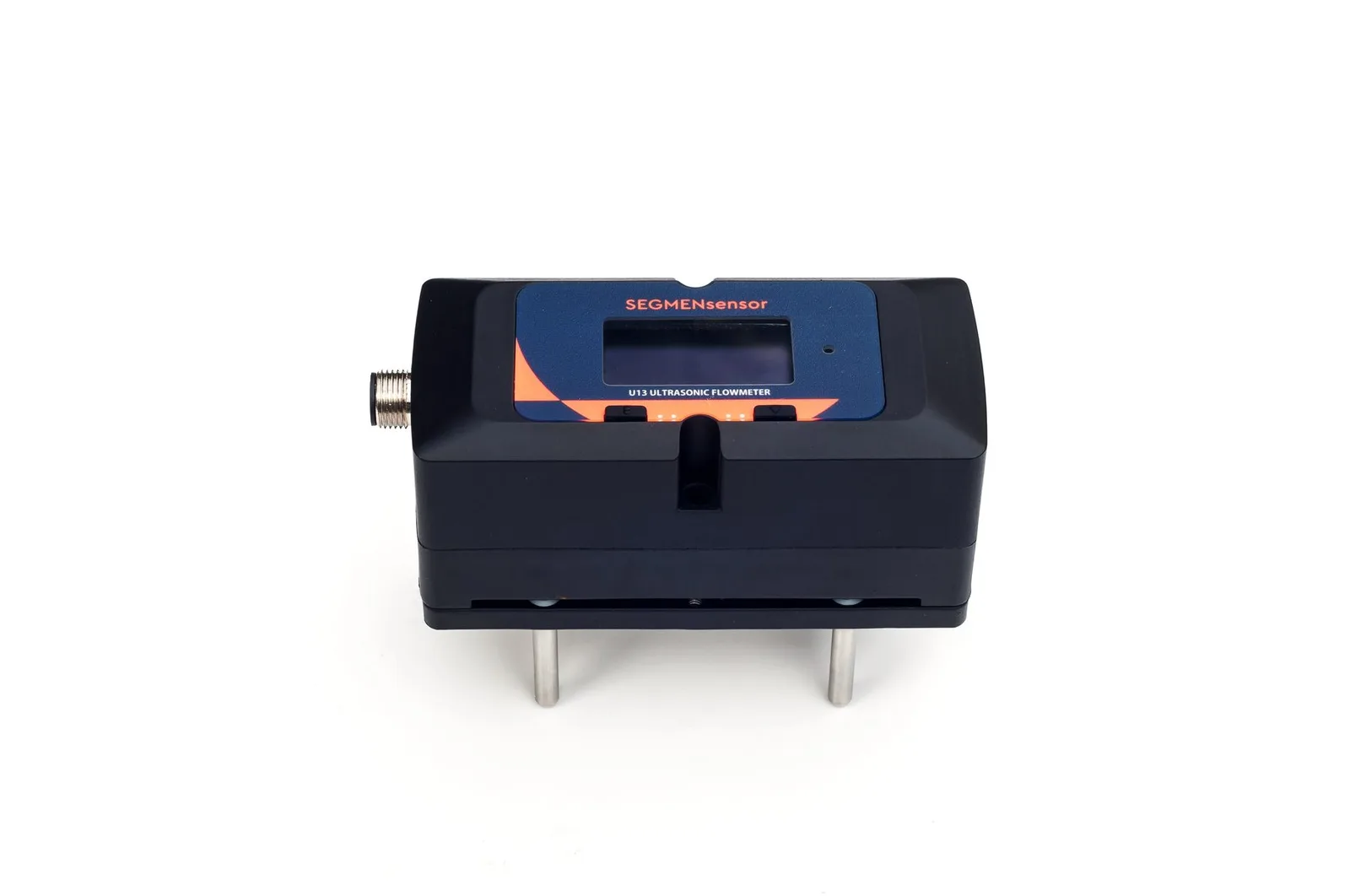
| Dilute acid and alkali dosing and transfer | PVDF, PP, PVC, PFA or lined steel, DN10–DN65 | Clean, single-phase solution | U13 (DN10–DN40, PP glass-fibre acid- and alkali-resistant housing) or U12 (DN15–DN65) | Pipe material and liner; crystallization or gas release; splash exposure of the transmitter |
| Checking existing meters and water balance surveys | Any of the above, 25–1200 mm | Clean liquid | U20 portable (P2 to +80 °C, P2H to +130 °C) | Transducer pair supplied for the pipe range; non-hazardous location |
Installation Difficulties in Chemical Plants and How to Handle Them
Liquids other than water
The meter needs the sound speed of the liquid at operating temperature to calculate transducer spacing and flow. Select the liquid in the set-up menu or enter its sound speed, then check the measured sound speed on the status page against the expected value. The datasheets list pure water, seawater, diesel, gasoline, methanol, ethanol and chemical mixtures as measurable liquids; for anything else, send the medium data with the inquiry.
Lined and plastic pipes
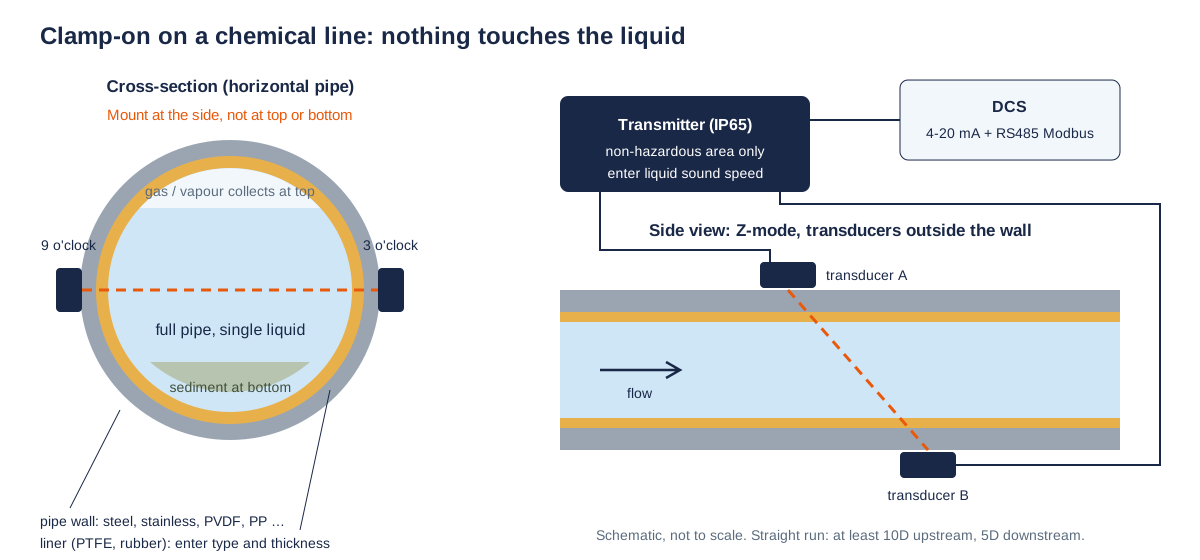
Chemical lines are often PTFE- or rubber-lined steel, or PVDF, PP, PVC and PFA. The datasheets list stainless steel, carbon steel, copper, PVC, PVDF, PPR and PPH (U12, U13), plus PFA for the U13. Enter the liner material and thickness; a thick or loosely bonded liner can block the signal, so measure on an unlined spool or on a plastic section of the same line where one exists.
Gas release and sediment
Dissolved gas comes out of solution after pressure drops, and some solutions settle or crystallize. Mount the transducers at the side of a horizontal pipe, never at the top or bottom; prefer a vertical pipe with upward flow; measure on the pump discharge side, away from control valves. The U11 tolerates intermittent bubbles or impurities lasting up to 5 seconds, not continuous gas.
Corrosive atmosphere and wash-down
Transducers are IP68 and the U10-series transmitter is IP65. Place the transmitter away from splash zones and acid vapour, keep the cable entries facing down,. On small acid and alkali lines the U13 has an acid- and alkali-resistant PP glass-fibre housing.
Hot and insulated lines
Condensate and heat-transfer lines are insulated. Open the insulation only at the measuring section, choose H1A (+130 °C) or H2A (+180 °C) sensors by the highest wall temperature, including start-up and upset conditions, and use couplant rated for that temperature.
The full mounting procedure, including V-, Z- and W-mode spacing, is in the clamp-on flow meter installation guide and the installation video with chapters. For the principle in one minute, see the transit-time video.
Send your process line data for a flow meter selection
Tell us the medium and concentration, operating temperature, pipe OD, wall thickness, pipe and liner material, available straight run, area classification, output to the DCS and quantity. OEM volume supply · samples 1–5 pcs in 5–7 working days · production lead time and MOQ confirmed with the quotation · quotation within 24 hours.
Which Chemical Plant Applications Are Not Suitable?
Hazardous (Ex) areas, slurries, two-phase flow, partly full pipes and lines above +180 °C are not suitable. Specifically:
- Hazardous areas. SEGMENsensor flow meters have no explosion-protected (Ex) model. Do not install them in zones classified for flammable gas, vapour or dust; equipment for those areas must be certified to the IEC 60079 series — Explosive atmospheres, Part 0: Equipment — General requirements or the local equivalent.
- Slurries and suspensions such as catalyst slurry, pigment or lime milk: high solids scatter the ultrasonic signal.
- Two-phase flow: flashing liquids near their boiling point, liquids with continuous gas, steam and gas lines. Transit-time meters measure single-phase liquids only.
- Partly full pipes: gravity drains, tank overflows and vent lines.
- Lines above the sensor rating: wall temperatures above +180 °C (H2A).
- Liquids that crystallize or polymerize on the wall, and very viscous media: assess first with the medium data.
If you are unsure whether a medium carries too much gas or solids, read transit-time vs Doppler ultrasonic flow meters and describe the medium in your inquiry.
Specifications That Matter for Chemical Process Lines
The values below are taken from the SEGMENsensor ultrasonic flow meter product page and datasheets. Compare every model in the U10 to U20 model comparison.
| Parameter | U10 / U10S / U10S PRO | U11 | U12 / U13 one-piece |
|---|---|---|---|
| Pipe size | 25–1200 mm (U10) · 15–1200 mm (U10S, U10S PRO) | 15–5000 mm | U12 DN15–DN65 · U13 DN10–DN40 |
| Accuracy | ±1% | ±0.5% | U12 ±2% (±1% after calibration) · U13 <3% FS (<1.5% FS after calibration) |
| Liquid | U10: water (a small amount of bubbles allowed) · U10S / U10S PRO: single, acoustically conductive liquid | Single, acoustically conductive liquid; tolerates intermittent bubbles or impurities up to 5 s | Water and other clean single-phase liquids (no solids) |
| Temperature | A2 −40 to +80 °C · H1A to +130 °C · H2A to +180 °C | Same sensors as the U10 series | U12 0–65 °C (0–115 °C option) · U13 −10–65 °C (−10–105 °C option) |
| Pipe materials listed | Stainless steel, carbon steel, cast iron, copper, PVC, PP and other rigid plastics | Stainless, carbon steel, copper, PVC, PVDF, PPR, PPH; U13 also PFA | |
| Outputs | Choose two: 4-20 mA, pulse (OCT), relay, RS232 / RS485 Modbus; HART optional | U12: any two of 4-20 mA, RS485 Modbus RTU, OCT, relay · U13: 4-20 mA and RS485 Modbus RTU, optional OCT or relay | |
| Housing / protection | Transmitter IP65, sensors IP68 | Sensors IP68 | U12 IP65 · U13 PP glass-fibre, acid- and alkali-resistant |
| Certification | CE, UKCA (no explosion-protected model) | ||
Download the one-page datasheet (PDF)
Pipe size ranges, accuracy, transducer types and temperature ratings, outputs, power supply, enclosure ratings and ordering code for the SEGMENsensor clamp-on ultrasonic flow meter range. No registration required.
Portable Checks: Existing Meters and Water Balance
Chemical plants often need a flow figure for a few days rather than permanently: checking an inline meter that drifts, a cooling water balance between units, or a survey before deciding where a fixed meter belongs. The U20 portable clamp-on flow meter covers 25–1200 mm at ±1%, runs on a rechargeable battery for about 16 hours and logs to an SD card. Use it only in non-hazardous locations.
How Do You Connect the Meter to the DCS?
Use 4-20 mA for the flow value to a DCS analogue input and RS485 Modbus for flow, totalizer and diagnostics. On the U10 series and U11 you choose two outputs from 4-20 mA, pulse (OCT), relay and RS232 / RS485 Modbus, with HART as an option. A pulse output feeds a batch totalizer for dosing or transfer, and a relay can raise a low-flow alarm on a reactor cooling water line. The same connection logic is shown for plant utilities in our power plant cooling water guide.
What Affects the Quotation?
We do not publish list prices because the configuration drives the quotation: pipe size range and transducer type, temperature rating, accuracy class, outputs, housing, any project certification and quantity. Quotations are FOB China and exclude international freight and import duties or taxes; payment is 100% T/T in advance, and meters carry a 12-month warranty.
Get a clamp-on flow meter for your process line
U10 series and U11 for utility and process lines, U12 and U13 for small chemical lines, U20 for checks. OEM volume supply · samples 1–5 pcs in 5–7 working days · production lead time and MOQ confirmed with the quotation · quotation within 24 hours. Download the clamp-on flow meter datasheet (PDF).
Frequently Asked Questions
Yes, if the solution is a single, clean liquid in a full pipe. The transducers sit outside the pipe, so no wetted material has to resist the chemical. Send the medium, concentration and temperature so we can check its sound speed; slurries, crystallizing solutions and liquids releasing gas are not suitable.
Plastic pipes such as PVC, PP and PVDF are listed in the datasheets, and the U13 also lists PFA. On lined steel pipes, enter the liner material and thickness at set-up; a thick or poorly bonded liner can weaken the signal, so an unlined or plastic section of the same line is the better measuring point.
No. SEGMENsensor ultrasonic flow meters have no explosion-protected model, so they must not be installed in areas classified for flammable gas, vapour or dust. Use them on utility and process lines in non-hazardous locations.
Often, yes. The datasheets list methanol, ethanol, diesel, gasoline and chemical mixtures as measurable liquids. Thermal oil is possible up to +180 °C with H2A sensors. The meter needs the liquid's sound speed at operating temperature, so send the medium data for an application check.
On the U10 series and U11 you choose two of 4-20 mA, pulse (OCT), relay and RS232 / RS485 Modbus, with HART as an option. Most plants take 4-20 mA into a DCS analogue input and use RS485 Modbus for totalizer and diagnostic data.
Samples of 1–5 pcs ship in 5–7 working days. Production lead time and MOQ are confirmed with the quotation, which we send within 24 hours on working days, FOB China.