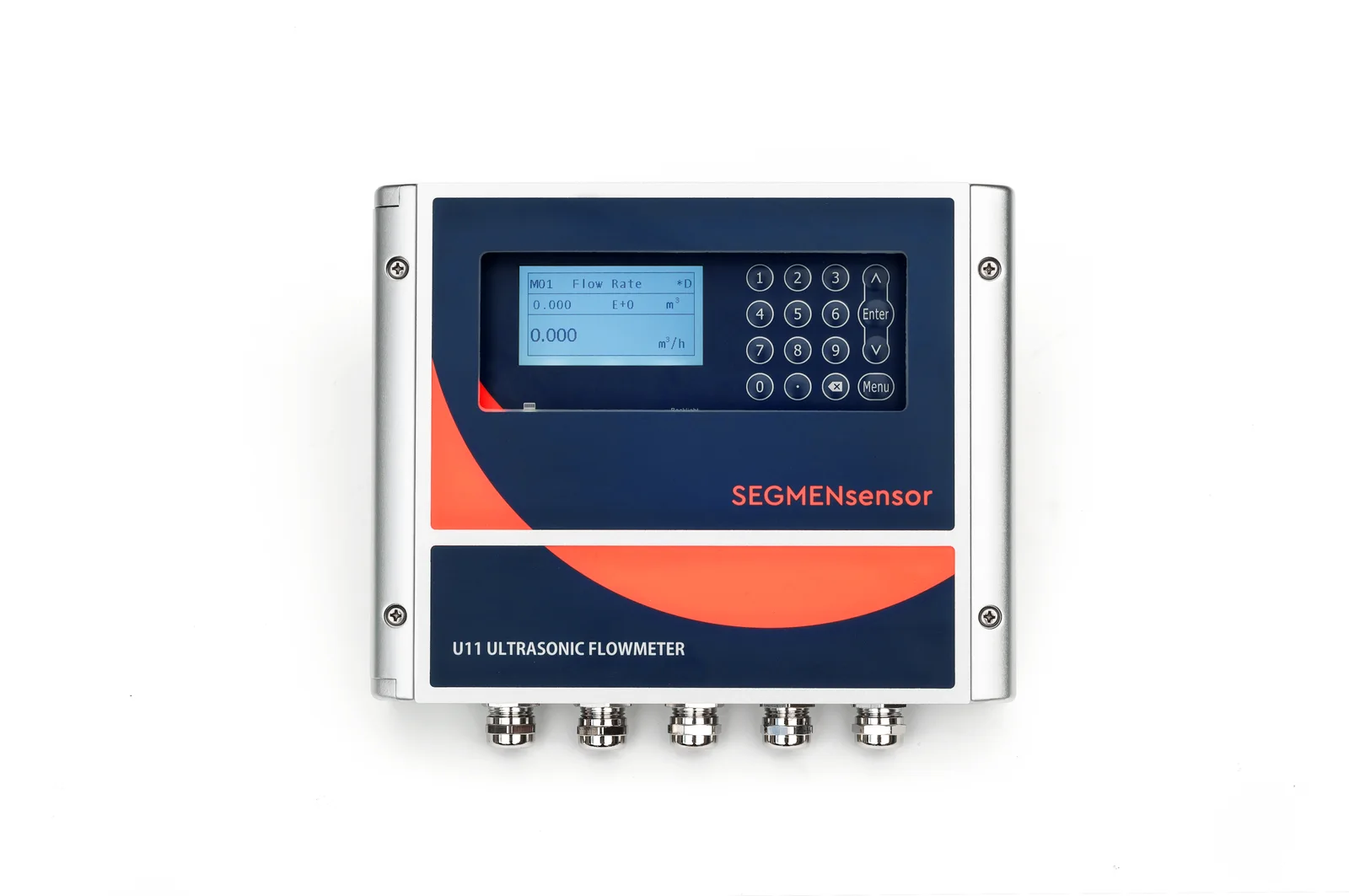
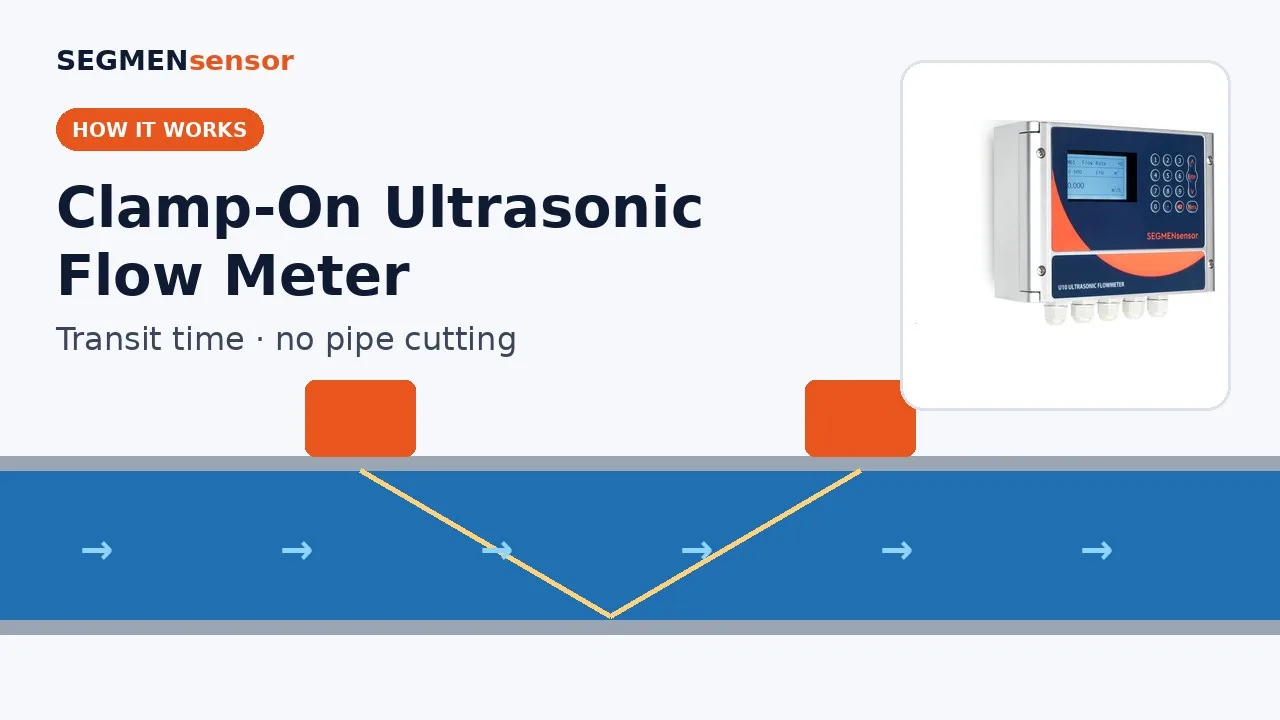
Use a transit-time clamp-on ultrasonic flow meter on the clean, closed cooling circuits of a steel mill — blast furnace, caster mould, equipment cooling and make-up water — and on the filtered supply of a dirty circuit once its solids content has been checked. Large mains take the U11 (15–5000 mm, ±0.5%) in Z-mode; temporary surveys use the U20. Unfiltered return water, scale pits, slag water and partly full returns are not suitable.
Why Measure Steel Mill Cooling Water with a Clamp-On Meter?
Because the cooling water of a furnace or caster cannot be switched off to fit a meter. A clamp-on ultrasonic flow meter straps two transducers to the outside of the pipe and times ultrasonic pulses sent with and against the flow; the transit-time difference gives velocity, and the pipe inner area gives volume flow. The method for liquids in closed conduits is described in ISO 12242 — Measurement of fluid flow in closed conduits: ultrasonic transit-time meters for liquid.
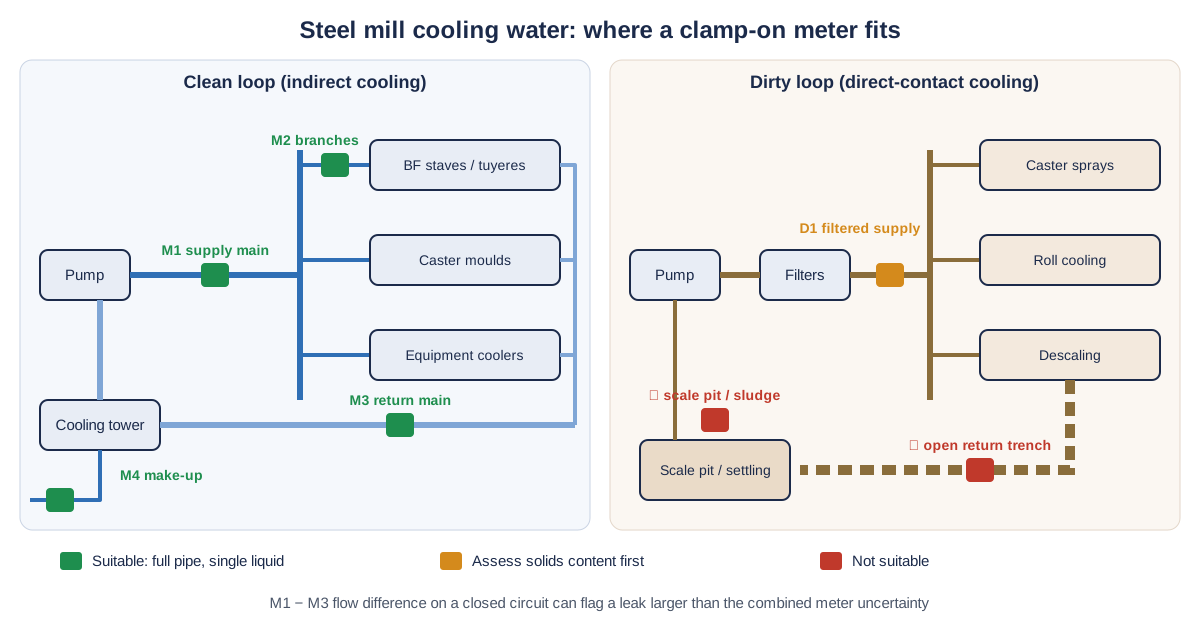
A steel mill runs two very different cooling systems. The clean loop (indirect cooling) carries softened or treated water through closed equipment — blast furnace staves and tuyeres, continuous caster moulds, electric arc furnace panels, motor and hydraulic coolers — and returns it to a cooling tower or heat exchanger. The dirty loop (direct-contact cooling) sprays water onto hot steel, rolls and descaling headers; the water returns carrying mill scale, oil and grease, passes through scale pits, settling and filters, and is pumped out again. In the United States the discharges from these process and cooling water systems are regulated under 40 CFR Part 420 — Iron and Steel Manufacturing Point Source Category, which is one reason mills meter water by circuit. Which loop a pipe belongs to decides more about a clamp-on meter than the pipe size does.
Typical Measuring Points in a Steel Mill
The table lists the lines where steel plants most often ask for a clamp-on meter. Pipe sizes and temperatures are typical values for orientation only; model data are from the SEGMENsensor product page and datasheets. We confirm the model from your pipe data and water analysis.
| Measuring point | Typical pipe | Medium and temperature | Suggested SEGMENsensor model | Confirm before ordering |
|---|---|---|---|---|
| Blast furnace stave and tuyere cooling — supply and return mains | Carbon steel, DN300–DN1200 and larger | Softened or treated water in a closed loop, usually within +80 °C | U11 (15–5000 mm, ±0.5%), Z-mode on large mains | Straight run near pumps and headers; wall thickness of old pipe; whether supply and return will be compared |
| Blast furnace or EAF cooling branches (staves, tuyeres, panels) | Carbon or stainless steel, DN50–DN200 | Clean closed-loop water; return side warmer | U10S or U11; H1A sensors (to +130 °C) if the return wall can exceed +80 °C | Radiant heat at the measuring spot; space for transducers between hoses and fittings |
| Continuous caster mould cooling water | Stainless or carbon steel, DN100–DN300 | Clean, treated water, single phase | U11 for a ±0.5% mould water balance; U10S for monitoring | Distance from control valves; relay output for a low-flow alarm to the caster PLC |
| Equipment cooling (motors, hydraulic and lube oil coolers, compressors) | Carbon steel, DN25–DN150 | Clean water | U10S, or U12 (DN15–DN65) on skid pipework | Pipe OD and material; output to the area PLC |
| Make-up and softened water to the cooling towers | Carbon steel, ductile iron or PVC, DN80–DN600 | Raw, softened or recycled water near ambient temperature | U10 or U10S (±1%); U11 on large intakes | Pipe material and lining; pulse output for daily water totals |
| Dirty-loop supply after the filters (caster sprays, roll cooling, descaling feed) | Carbon steel, DN100–DN600 | Filtered direct-contact water; residual scale and oil | U11 (tolerates intermittent bubbles or impurities up to 5 s) — only after a solids and oil check | Water analysis or a test with the U20 first; filter condition; measure on the pump discharge side |
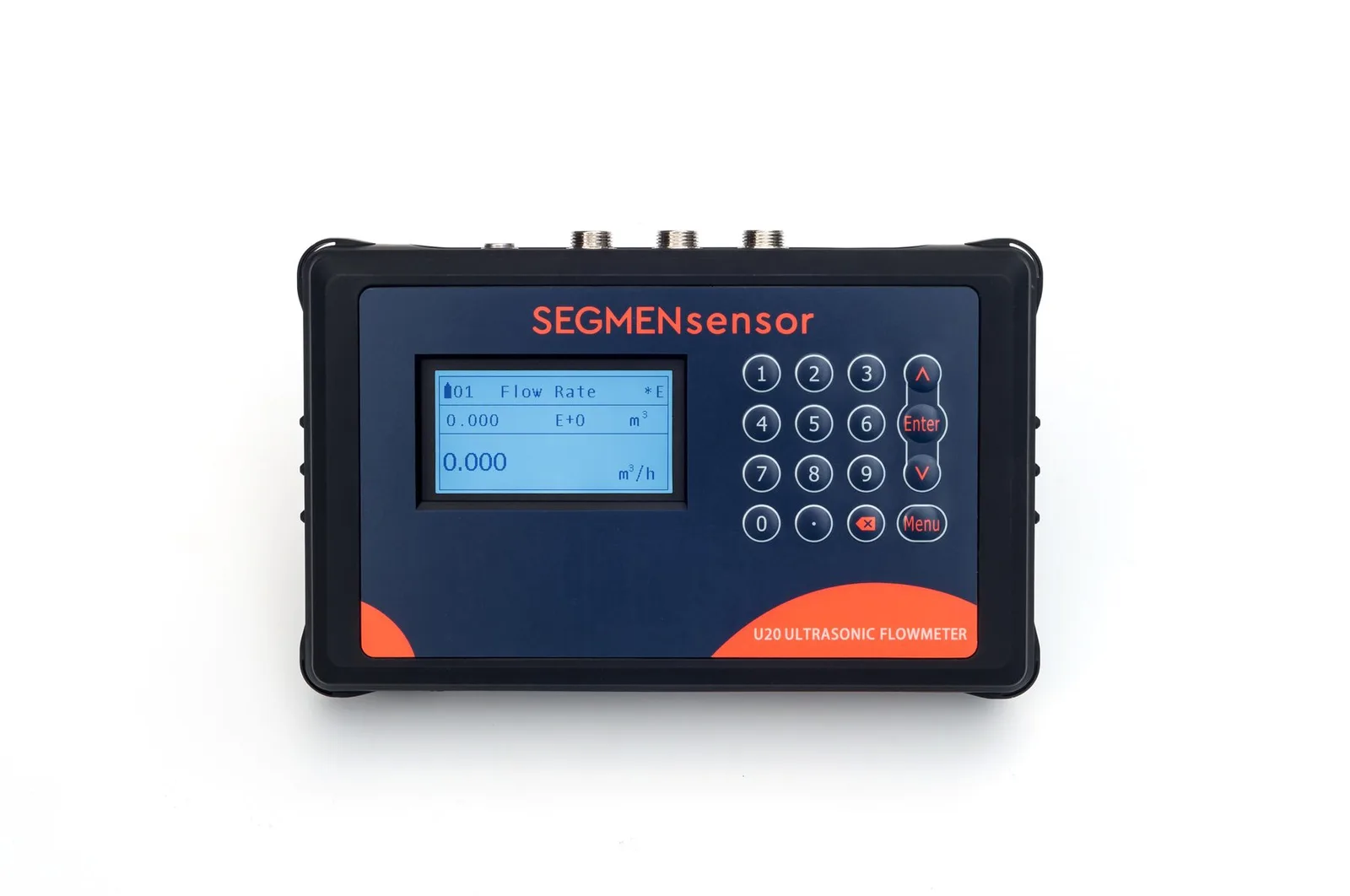
| Flow surveys, pump checks and verifying existing meters | Any of the above, 25–1200 mm | Clean water | U20 portable (P2 to +80 °C, P2H to +130 °C) | Transducer pair for the pipe range; battery time for the survey |
Installation Difficulties in Steel Mills and How to Handle Them
Old pipe with internal scale or rust
Cooling mains in older plants carry internal scale that reduces the real bore and weakens the signal. Measure the wall with a thickness gauge, enter any known scale layer as a lining at set-up, and prefer a newer or recently cleaned section. Clean the outside to bare metal where the transducers sit.
Large mains and short straight runs
Pump houses and headers leave little straight pipe. On large mains use Z-mode with the transducers on opposite sides, pick the longest straight section on the pump discharge side and keep away from headers, bends and control valves. The full procedure is in the clamp-on flow meter installation guide and the installation video with chapters.
Radiant heat and hot pipe walls
Near furnaces and casters the pipe wall can be far hotter than the water. Measure the wall temperature at the spot, choose A2 (to +80 °C), H1A (to +130 °C) or H2A (to +180 °C) sensors by the highest value, and use couplant rated for it. Mount the transmitter away from radiant heat; on wall-mount models the sensor cable can be up to 274 m, so the transmitter can sit in an electrical room.
Electrical noise from mill drives
Rolling mills and pump houses have large variable-frequency drives. Run the transducer cables away from motor and drive power cables, in their own tray or conduit, and ground the transmitter as the manual describes. Bring the flow signal to the PLC as 4-20 mA or RS485 Modbus.
Dust, water spray and wash-down
Transducers are IP68 and the U10-series transmitter is IP65 (enclosure codes per IEC 60529 — Degrees of protection provided by enclosures (IP Code)). Keep the transmitter out of direct spray and scale dust, cable entries facing down, and protect the transducer spot with a cover on the pipe.
Send your cooling circuit data for a flow meter selection
Tell us the circuit (clean or dirty loop), pipe OD, wall thickness and material, water temperature and the highest wall temperature, available straight run, output to the PLC or DCS and quantity. OEM volume supply · samples 1–5 pcs in 5–7 working days · production lead time and MOQ confirmed with the quotation · quotation within 24 hours.
Can a Clamp-On Meter Measure Dirty (Turbid) Cooling Water?
Sometimes — on the filtered supply, after a check; never on the unfiltered return. Transit-time measurement needs the ultrasonic pulse to cross the pipe, and suspended mill scale, oil and air scatter it. SEGMENsensor does not publish a solids limit, so we decide from your water analysis and, where possible, a trial: measure the filtered supply for a few days with the U20 portable clamp-on flow meter and check that the signal stays stable. The U11 tolerates intermittent bubbles or impurities lasting up to 5 seconds, not continuous solids or entrained air. If the water carries too much, read transit-time vs Doppler ultrasonic flow meters and choose another measuring point or method.
Which Steel Mill Lines Are Not Suitable?
Unfiltered dirty water, slag and sludge lines, partly full returns, steam and gas lines, and gas-hazard zones are not suitable. Specifically:
- Unfiltered dirty-loop returns and scale-pit pump suction: heavy mill scale, oil and air.
- Slag granulation water, sludge and thickener underflow: high solids scatter the signal.
- Open trenches, gravity returns and partly full pipes: the meter needs a full pipe.
- Steam, condensate that flashes, and gas lines (blast furnace gas, coke oven gas, oxygen, nitrogen): transit-time meters measure single-phase liquids only.
- Gas-hazard (Ex) zones around gas holders, coke ovens and gas cleaning: SEGMENsensor flow meters have no explosion-protected model.
- Pipe walls above +180 °C (H2A limit) and very small pipes below the model range.
Supply–Return Comparison on Closed Cooling Circuits
On a closed circuit such as blast furnace stave cooling, the flow in should equal the flow out; a persistent difference points to a leak. Two meters on the supply and return mains (M1 and M3 in the diagram) can show that difference over RS485 Modbus or two 4-20 mA inputs. Size the expectation honestly: with two U11 meters at ±0.5% each, the difference reading can carry up to about ±1% of circuit flow (calculated value, worst case of two readings added), so watch the trend over hours and alarm on a change, not on one sample. Install both pairs with the same set-up and similar straight runs.
Specifications That Matter for Steel Mill Cooling Water
The values below are taken from the SEGMENsensor ultrasonic flow meter product page and datasheets. Compare every model in the U10 to U20 model comparison.
| Parameter | U10 / U10S / U10S PRO | U11 | U20 portable |
|---|---|---|---|
| Pipe size | 25–1200 mm (U10) · 15–1200 mm (U10S, U10S PRO) | 15–5000 mm | 25–1200 mm |
| Accuracy | ±1% | ±0.5% | ±1% |
| Liquid | U10: water (a small amount of bubbles allowed) · U10S / U10S PRO: single, acoustically conductive liquid | Single, acoustically conductive liquid; tolerates intermittent bubbles or impurities up to 5 s | Clean liquid in a full pipe |
| Sensor temperature | A2 −40 to +80 °C · H1A to +130 °C · H2A to +180 °C | Same sensors as the U10 series | P2 −40 to +80 °C · P2H −40 to +130 °C |
| Outputs | Choose two: 4-20 mA, pulse (OCT), relay, RS232 / RS485 Modbus; HART optional | Data logging to SD card; rechargeable battery for about 16 hours | |
| Protection | Transmitter IP65, sensors IP68 | Sensors IP68 | P2 / P2H sensors IP68 |
| Certification | CE, UKCA (no explosion-protected model) | ||
Download the one-page datasheet (PDF)
Pipe size ranges, accuracy, transducer types and temperature ratings, outputs, power supply, enclosure ratings and ordering code for the SEGMENsensor clamp-on ultrasonic flow meter range. No registration required.
How Do You Connect the Meter to the Mill PLC or DCS?
Use 4-20 mA for the flow value and RS485 Modbus for flow, totalizer and diagnostics. On the U10 series and U11 you choose two outputs from 4-20 mA, pulse (OCT), relay and RS232 / RS485 Modbus, with HART as an option. A relay output gives a low-flow alarm on caster mould or tuyere cooling, and a pulse output feeds the daily water totals for make-up water. For the same connection logic on large plant utilities, see our power plant cooling water guide and the chemical plant guide. The principle in one minute is in the transit-time video.
What Affects the Quotation?
We do not publish list prices because the configuration drives the quotation: pipe size range and transducer type, temperature rating, accuracy class, outputs, cable length and quantity. Quotations are FOB China and exclude international freight and import duties or taxes; payment is 100% T/T in advance, and meters carry a 12-month warranty.
Get a clamp-on flow meter for your cooling circuits
U11 for large cooling mains, U10 series for branches and make-up water, U20 for surveys and trials. OEM volume supply · samples 1–5 pcs in 5–7 working days · production lead time and MOQ confirmed with the quotation · quotation within 24 hours. Download the clamp-on flow meter datasheet (PDF).
Frequently Asked Questions
Yes. Stave and tuyere cooling is a closed circuit of clean, treated water in full pipes, which suits a transit-time clamp-on meter. Use the U11 on large supply and return mains and choose the sensor temperature by the highest pipe wall temperature at the measuring spot.
Only on the filtered supply, and only after a check of the solids and oil content, ideally with a trial using the U20. Unfiltered returns, scale-pit water, slag water and sludge scatter the ultrasonic signal and are not suitable.
They can show a leak that is larger than the combined meter uncertainty. With two U11 meters at ±0.5% each, the difference can carry up to about ±1% of circuit flow (calculated value), so alarm on a change in the trend, not on a single reading.
A2 sensors are rated −40 to +80 °C, H1A to +130 °C and H2A to +180 °C at the pipe wall. Near furnaces, measure the wall temperature at the spot and keep the transmitter away from radiant heat; wall-mount models allow sensor cable up to 274 m.
Not inside areas classified as hazardous. SEGMENsensor ultrasonic flow meters have no explosion-protected model, so use them only on water lines in non-hazardous locations.
Samples of 1–5 pcs ship in 5–7 working days. Production lead time and MOQ are confirmed with the quotation, which we send within 24 hours on working days, FOB China.