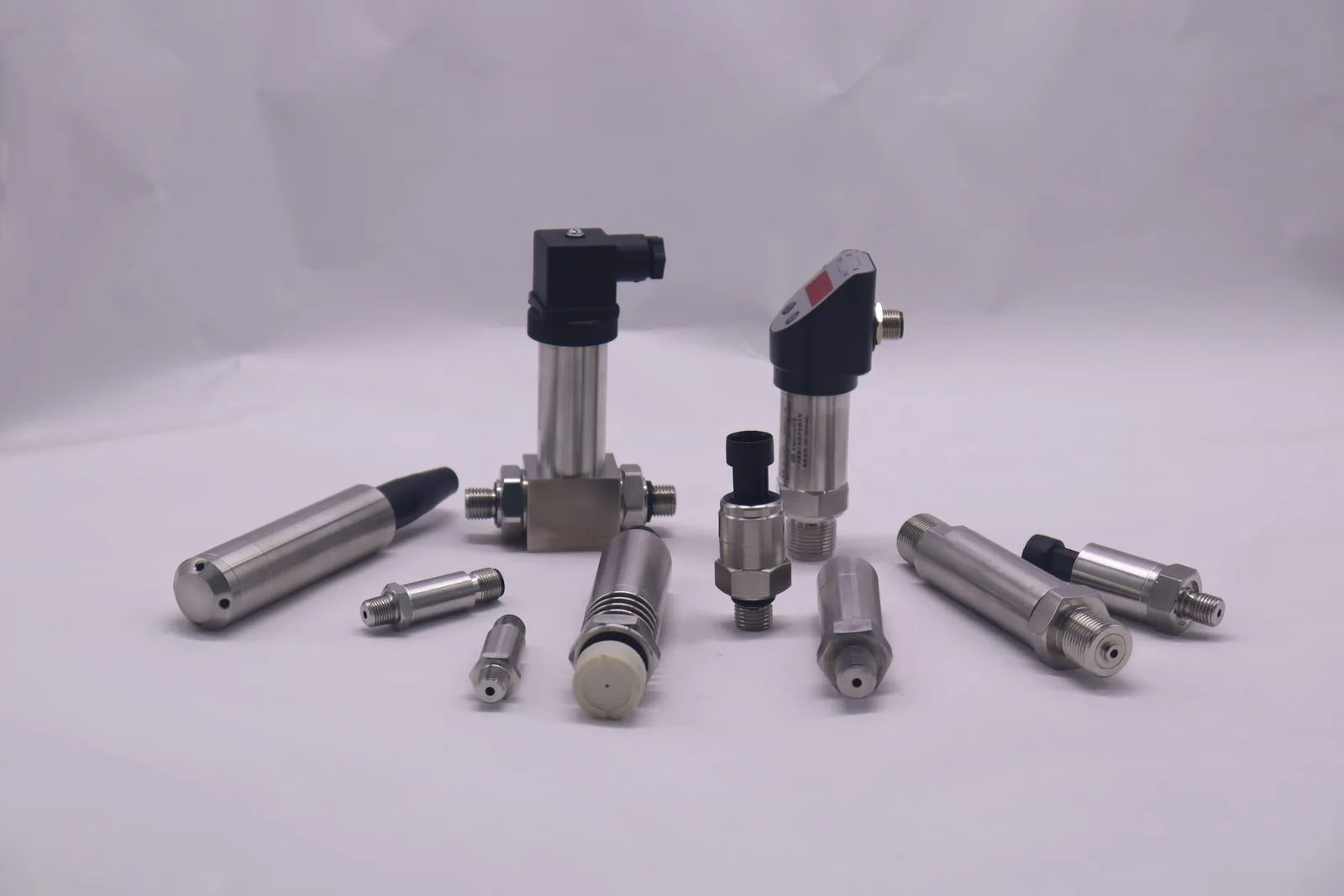
Choose a vacuum pressure transmitter by the pressure your process actually sees. If it only goes below atmosphere, specify a gauge vacuum range such as -1 to 0 bar. If it swings between vacuum and positive pressure, specify a compound range such as -1 to +9 bar. If the reading must not change with weather or altitude, specify an absolute range.
This guide is for machine builders and OEM engineers who need a continuous vacuum signal — packaging, pick-and-place, vacuum filtration, degassing, refrigeration service equipment and pump suction monitoring. It explains the three ways to reference vacuum, how a negative range maps onto 4-20 mA, how accuracy works out on small spans, and when a vacuum switch is the better buy. Product details are on the 4-20 mA pressure transmitter and pressure sensors and vacuum switches pages.
What Is a Vacuum Pressure Transmitter?
It is a pressure transmitter calibrated for pressures below the local atmosphere. The sensing element is the same diaphragm-and-bridge design used for positive pressure (see types of pressure sensors); the difference is the calibrated range and, for absolute versions, the sealed reference. "Vacuum" on a datasheet can mean three different things, so the first job is to state the reference clearly:
- Gauge vacuum (negative gauge): measured against local atmospheric pressure through a vent. 0 bar g is atmosphere and -1 bar g is the theoretical full vacuum. Common ranges: -1 to 0 bar, -0.5 to 0 bar.
- Compound: a gauge range that crosses zero, such as -1 to +9 bar. Used where the same port sees suction and pressure, for example a pump inlet or a vessel that is evacuated and then pressurised.
- Absolute: measured against a sealed vacuum inside the sensor. 0 bar a is perfect vacuum and atmosphere is roughly 1 bar a at sea level. The reading of a given vacuum does not drift with weather or altitude.
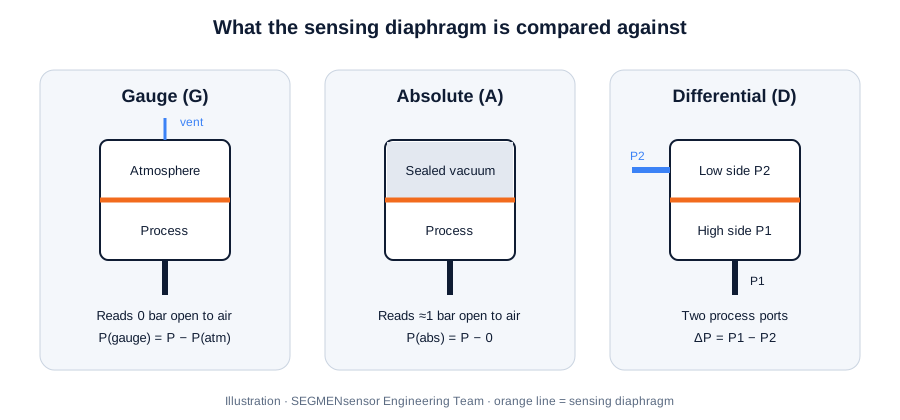
Gauge Vacuum vs Compound vs Absolute: Which Range Do You Need?
Use the table below to pick the reference. The example ranges are illustrative; the exact range is specified at order.
| Range type | Zero point | Example range | Typical uses (evaluated per project) | Watch out for |
|---|---|---|---|---|
| Gauge vacuum | Local atmosphere | -1 to 0 bar g | Vacuum grippers, packaging, vacuum tables, filtration | Reading of the same vacuum shifts with barometric pressure |
| Compound | Local atmosphere | -1 to +9 bar g | Pump suction, evacuate-then-pressurise vessels, refrigeration service lines | Larger span means coarser absolute error in the vacuum part |
| Absolute | Sealed vacuum reference | 0 to 1 bar a, or higher | Degassing, sealed processes, altitude-independent readings | Absolute ranges and build are confirmed per project |
| Vacuum switch (not a transmitter) | Local atmosphere | -1 to 0 bar, adjustable set point | Simple vacuum OK / not OK signal to a PLC | On/off only, ±2% FS |
For a wider explanation of reference types, see gauge vs absolute vs differential pressure transmitters and gauge vs absolute vs sealed gauge pressure.
How Does a Negative Range Map to 4-20 mA?
Linearly, from the bottom of the range to the top. On a compound -1 to +9 bar transmitter the span is 10 bar, so each bar is 1.6 mA: -1 bar reads 4 mA, atmospheric pressure (0 bar g) reads 5.6 mA and +6 bar reads 4 + 7 × 1.6 = 15.2 mA (calculated values). On a -1 to 0 bar vacuum transmitter each bar is 16 mA, so -0.8 bar reads 4 + 0.2 × 16 = 7.2 mA (calculated).
State at order whether 4 mA should correspond to full vacuum or to atmospheric pressure; either direction can be set up, and the PLC scaling must match. A signal below about 3.8 mA indicates a broken loop rather than a pressure value — one reason 4-20 mA is preferred for vacuum circuits on moving machines. You can check scaling with the 4-20 mA calculator; wiring is covered in the 4-20 mA pressure transmitter wiring guide.
How Do You Choose a Vacuum Pressure Transmitter? (Selection Steps)
- Write down the lowest and highest pressure. Include start-up, purge and test conditions. If the port ever sees positive pressure, a pure vacuum range is the wrong choice — use a compound range and make sure the maximum positive pressure stays inside the overload limit.
- Pick the reference. Gauge for most machine vacuum, where "how far below atmosphere" is what matters; absolute when the process depends on the true residual pressure, for example degassing or boiling-point control.
- Keep the span tight. Accuracy is stated as % of full scale, so a smaller span gives a smaller error in millibar. A -1 to 0 bar transmitter at ±0.25% FS is within ±2.5 mbar; a -1 to +9 bar compound transmitter at ±0.25% FS is within ±25 mbar across its whole range (calculated). If the vacuum part of a compound range is critical, choose the ±0.1% FS version or a separate vacuum transmitter. See accuracy: % of full scale vs % of reading.
- Check medium and temperature. 316L stainless steel wetted parts suit air, water, oils and many process gases. Rated media temperature is -20 °C to +85 °C; condensing vapours, oil mist from vacuum pumps and aggressive media are reviewed per project.
- Match output and connection. 4-20 mA 2-wire is standard; 0-10 V and RS485 / Modbus RTU are available. G1/4" male is the standard process thread, with G1/2", 1/4" NPT and 1/2" NPT available; electrical connection is M12×1 4-pin, Hirschmann (DIN) plug or flying lead.
- Protect the vent. A gauge vacuum transmitter references the atmosphere through its vent; on wash-down machines specify IP67 or optional IP68 and keep the vent path dry. IP codes are defined in IEC 60529 ↗.
Specifying a vacuum or compound range for your machine?
Send the lowest and highest pressure, reference (gauge or absolute), medium, temperature, output, process thread and annual volume. We recommend the range and build and return a written quotation within 24 hours on working days.
SEGMENsensor Vacuum and Compound Pressure Transmitter Specifications
All figures below are taken from the 4-20 mA pressure transmitter and pressure sensor product pages. Unit conversions are calculated values.
| Parameter | Specification |
|---|---|
| Standard ranges | 0–0.1 bar to 0–400 bar (0.1 bar = 10 kPa ≈ 1.45 psi, calculated) |
| Vacuum and compound ranges | Vacuum (negative) ranges and compound ranges such as -1 to +9 bar on request (-1 bar ≈ -14.5 psi, calculated) |
| Accuracy | ±0.25% FS standard; ±0.1% FS high-accuracy version |
| Output | 4-20 mA 2-wire loop-powered; 0-10 V or RS485 / Modbus RTU available |
| Supply voltage | 12–36 V DC; max loop resistance 600 Ω at 24 V |
| Wetted materials | 316L stainless steel diaphragm and housing |
| Process connection | G1/4" male standard; G1/2", 1/4" NPT, 1/2" NPT |
| Electrical connection | M12×1 4-pin, Hirschmann (DIN) plug or flying lead |
| Temperature | Media -20 °C to +85 °C; ambient -40 °C to +85 °C; compensated 0 °C to +60 °C |
| Protection | IP67 standard; IP68 optional |
| Stability | ±0.1% FS per year |
| Vacuum switch alternative | -1 to 0 bar, NPN / PNP / relay / optional IO-Link, ±2% FS, 10–30 V DC, IP67 |
| Certifications | CE, RoHS 3; ISO 9001:2015 quality system |
| Samples and lead time | Qualification samples 1–5 pcs in 5–7 working days; production lead time and MOQ confirmed with the quotation |
Download the one-page datasheet (PDF)
Ranges, accuracy classes, outputs, supply voltage, process connections, materials, temperature limits, IP rating, dimensions and the ordering code for SEGMENsensor pressure transmitters. Vacuum and compound ranges are specified in the ordering code.
More documents: pressure sensor downloads
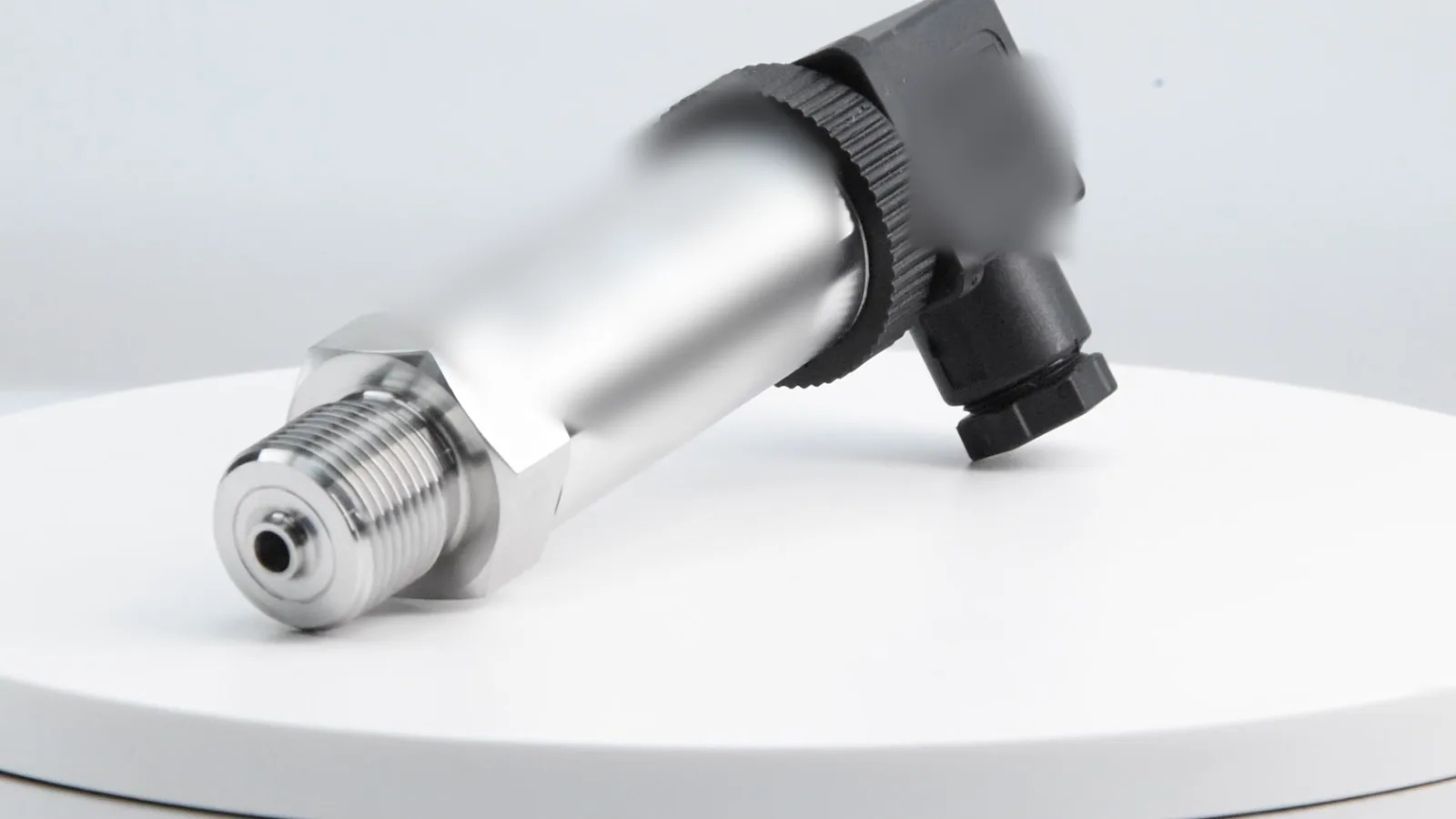
Vacuum Transmitter or Vacuum Switch?
Use a switch when the controller only needs to know "vacuum reached" — for example a gripper that must hold before a robot moves. Use a transmitter when the controller needs the value: to trend pump performance, detect a slow leak before it becomes a fault, control a valve to a set vacuum, or log a process. Many machines use both: a transmitter on the main vacuum header and switches at individual cups.
| Need | Vacuum transmitter | Vacuum switch |
|---|---|---|
| Signal | Continuous 4-20 mA, 0-10 V or RS485 | On/off (NPN, PNP, relay, optional IO-Link) |
| Accuracy | ±0.25% FS (±0.1% FS option) | ±2% FS |
| Range | Vacuum, compound or absolute, specified at order | -1 to 0 bar, adjustable set point |
| Best for | Control, trending, leak detection, data logging | Interlocks and simple go / no-go checks |
Installation Tips for Vacuum Service
- Mount above the line where possible, so condensate and pump oil drain back instead of collecting on the diaphragm.
- Keep the sensing line short and leak-tight. A small leak at the fitting makes the transmitter read a weaker vacuum than the process actually has.
- Zero gauge transmitters at atmosphere during commissioning, with the port open to air, and record the reading.
- Plan for pulsation. Reciprocating vacuum pumps can produce a pulsing signal; filter it in the PLC or fit a snubber (see pressure snubbers).
Factory Supply for OEM Vacuum Applications
Segmen Industrial Development Co., Ltd. (SEGMENsensor) was founded in Shenzhen in 2019, with an engineering team that has 20+ years of sensor experience, and supplies 200+ OEM customers in 30+ countries. For vacuum and compound ranges we set the range, signal direction, process thread, connector, cable length and private labelling to your drawing, and every transmitter is tested before shipment. Quotations are FOB China with 100% T/T before shipment and a 12-month warranty.
FAQ
General questions
A vacuum transmitter measures only below atmospheric pressure, for example -1 to 0 bar. A compound transmitter measures both below and above atmosphere in one range, for example -1 to +9 bar, so the same port can see suction and positive pressure.
Use gauge for most machine vacuum, where the level below atmosphere is what matters. Use absolute when the process depends on true residual pressure or the reading must not change with weather or altitude; absolute ranges are confirmed per project.
The span is 10 bar, so each bar is 1.6 mA. At atmospheric pressure (0 bar g) the output is 4 + 1 × 1.6 = 5.6 mA, and at full vacuum it is 4 mA (calculated values).
SEGMENsensor transmitters are ±0.25% FS as standard and ±0.1% FS in the high-accuracy version. On a -1 to 0 bar range, ±0.25% FS equals ±2.5 mbar; on a -1 to +9 bar range it equals ±25 mbar (calculated).
Procurement Q&A
Send the lowest and highest pressure, gauge or absolute reference, medium, media temperature, output, signal direction, process thread, connector and annual volume. Engineers reply within 24 hours on working days; quotations are FOB China.
Qualification samples of 1–5 pcs ship in 5–7 working days. Production lead time and MOQ are confirmed with the quotation.
References
- IEC 60770-1 — Transmitters for use in industrial-process control systems: methods for performance evaluation ↗
- IEC 60381-1 — Analogue signals for process control systems: direct current signals ↗
- IEC 60529 — Degrees of protection provided by enclosures (IP code) ↗
Related reading: 4-20 mA pressure transmitters · Gauge vs absolute vs differential · Pressure transducer vs transmitter · 4-20 mA pressure transmitter selection guide
Last updated: 15 November 2026. Specifications reflect SEGMENsensor product pages and datasheets at the time of writing; combinations of range, reference, output, connection and temperature are confirmed per project.