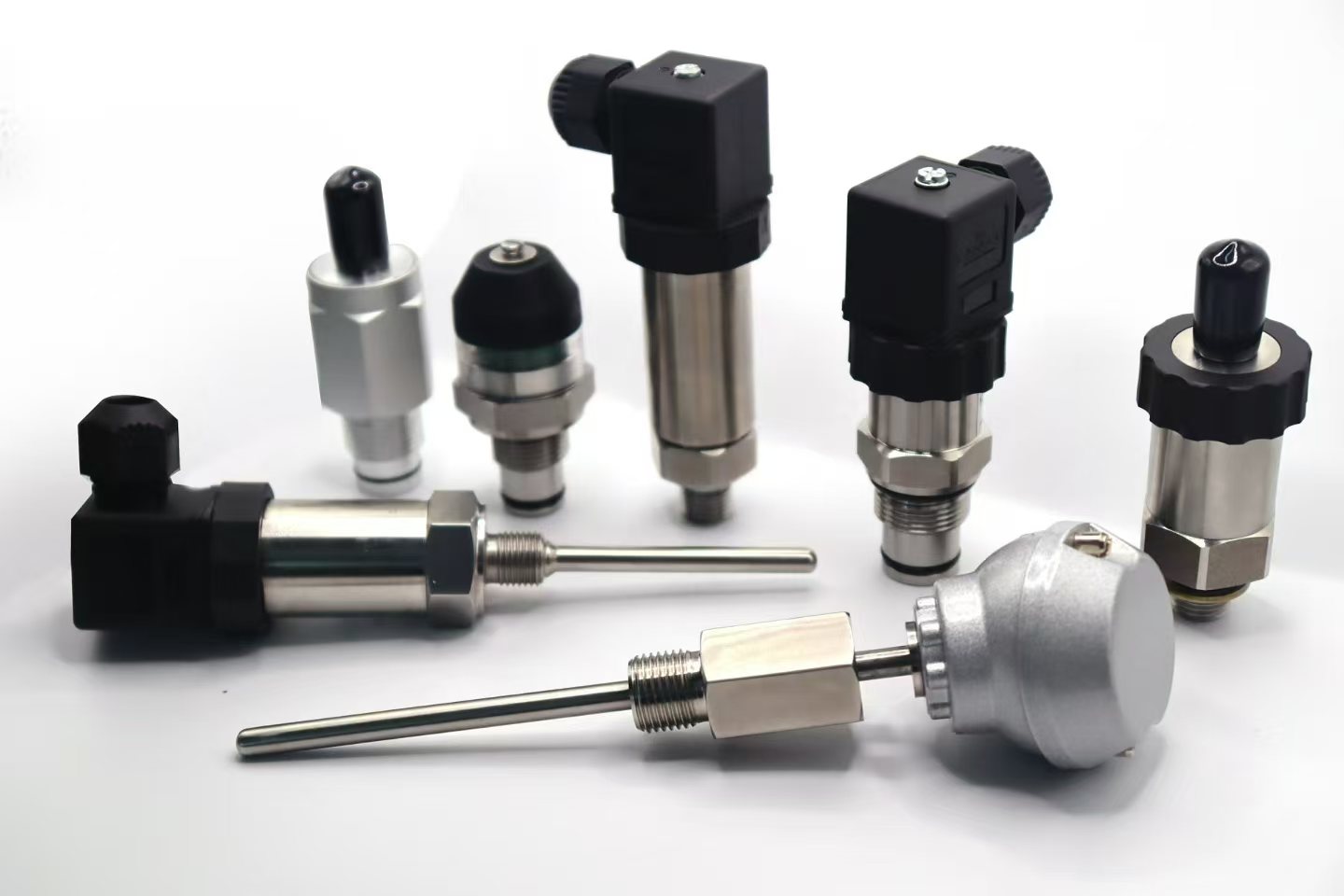
The main types of pressure sensors are grouped by reference (gauge, absolute, sealed gauge, differential and vacuum), by sensing element (piezoresistive silicon, ceramic, thin-film strain gauge, capacitive and resonant) and by output (pressure switch, millivolt transducer or 4–20 mA / digital transmitter). Choose the reference first, then the element for your medium, then the output your controller reads.
What are the types of pressure sensors by pressure reference?
Every pressure reading is measured against a reference, so the reference type is the first thing to fix in a specification. Getting it wrong gives a reading that drifts with the weather or with altitude even when the sensor itself is perfect.
| Reference type | Measured against | Reads zero when | Typical use |
|---|---|---|---|
| Gauge (vented) | Local atmospheric pressure, through a vent | The port is open to air | Pumps, hydraulics, compressed air, open tanks |
| Sealed gauge | A fixed pressure sealed in the sensor (near one atmosphere) | Ambient equals the sealed pressure | High ranges and wet or dusty sites where a vent could let water in |
| Absolute | A sealed vacuum | Perfect vacuum | Barometric, vacuum processes, sealed vessels, altitude-independent readings |
| Differential | A second process port (P1 − P2) | Both ports see the same pressure | Filter clogging, flow across an orifice, level in pressurised tanks |
| Vacuum / compound | Atmosphere, reading below (and for compound also above) it | The port is open to air | Suction, vacuum packaging, refrigerant recovery |
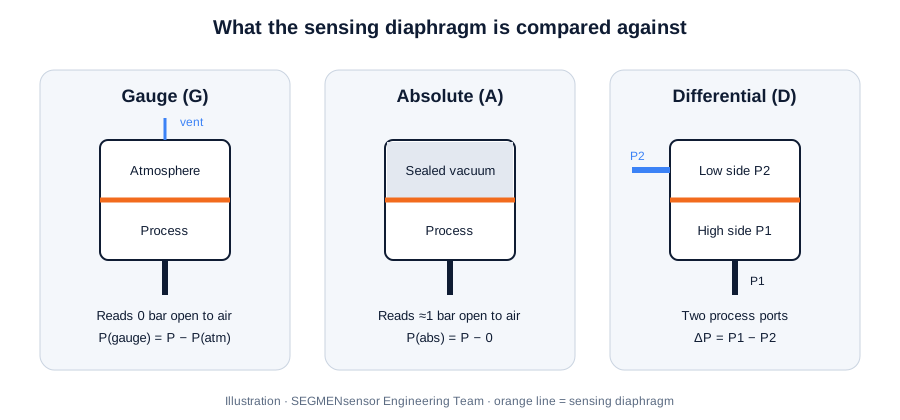
For high ranges the difference between gauge and sealed gauge is small: one atmosphere (about 1.01 bar) is 0.25% of a 400 bar span. For low ranges it dominates, which is why level and low-pressure HVAC sensors are almost always vented gauge or differential. The full comparison with worked examples is in gauge vs absolute vs differential pressure transmitters and gauge vs absolute vs sealed gauge.
What are the types of pressure sensing elements?
All electronic pressure sensors use a diaphragm that deflects under pressure; they differ in how that deflection becomes an electrical signal. The element decides media compatibility, overload behaviour and long-term stability more than any other choice.
| Sensing element | How it works | Strengths | Watch out for |
|---|---|---|---|
| Piezoresistive (silicon) | Resistors diffused into a silicon chip form a Wheatstone bridge; strain changes their resistance. Usually isolated from the medium by a 316L diaphragm and oil fill. | High sensitivity, so it suits low ranges; small size; wide range coverage | Needs temperature compensation; oil fill must suit the process |
| Ceramic | A ceramic diaphragm carries a thick-film resistor bridge or forms one plate of a capacitor | Resists many acids, alkalis and abrasive media without an isolating fluid; good overload margin | Needs an elastomer seal chosen for the medium |
| Thin-film strain gauge | A strain gauge sputtered onto a steel diaphragm | Welded, fully metallic design; suits high pressure and vibration | Less sensitive at very low ranges |
| Capacitive | Diaphragm movement changes the gap between two plates | Very low ranges and differential pressure | Sensitive to electronics design and stray capacitance |
| Resonant | Pressure shifts the resonant frequency of a vibrating element | Very high stability for reference instruments | Specialist, laboratory-grade parts |
SEGMENsensor transmitters use piezoresistive elements behind a 316L stainless diaphragm and ceramic diaphragm elements for aggressive media; the other rows are listed so you can compare offers on the same basis. Whatever the element, the electronics apply compensation and linearisation, and the result is stated as accuracy in % of full scale — see % FS vs % of reading for what that means at the low end of the range.
What are the types of pressure sensors by output?
The same sensing element can be built into three different products. What your controller needs to receive decides which one you buy.
| Product type | Output | Best for |
|---|---|---|
| Pressure switch (mechanical or electronic) | Contact or transistor that changes state at a set point, with a reset point below it | Pump start/stop, alarms, safety cut-outs |
| Pressure transducer | Millivolt bridge signal (mV/V) or a ratiometric voltage such as 0.5–4.5 V | Short cables to an embedded controller that supplies its own excitation |
| Pressure transmitter | Conditioned 4–20 mA, 0–10 V, RS485 / Modbus RTU, HART or IO-Link | PLCs, long cable runs, noisy plants, process control |
The 4–20 mA loop is defined by IEC 60381-1 ↗ and stays accurate over long cables because current does not drop along the wire. The distinction between a transducer and a transmitter is explained in pressure transducer vs transmitter, and switch versus transmitter selection in pressure switch vs pressure transmitter.
Which special pressure sensor types are used for level and harsh conditions?
Several products are pressure sensors in a different housing, built for one job:
- Submersible (hydrostatic) level transmitters hang at the bottom of a tank or well and convert liquid head to level: 1 m of water is about 0.098 bar (calculated value). SEGMENsensor probes cover 0–0.5 to 0–200 mWC with ±0.1% FS, a vented cable and 12–36 V DC supply — see the submersible level transmitter and how hydrostatic level sensors work.
- Vacuum pressure switches cover -1 to 0 bar with NPN, PNP, relay or IO-Link output and ±2% FS accuracy, for packaging and suction equipment.
- Corrosion-resistant transmitters with a ceramic or 316L diaphragm handle acids, alkalis and solvents; ATEX versions are available for Zone 1/2, confirmed per order.
- Pressure transmitters for pulsating lines are protected with a snubber, and every transmitter has a rated overpressure and burst pressure — see pressure snubbers and water hammer and overpressure vs burst pressure.
SEGMENsensor pressure sensor types: key data
| Product | Type | Key data |
|---|---|---|
| Pressure transmitter | Piezoresistive or ceramic; gauge, absolute, differential | 0–0.1 to 0–400 bar; ±0.25% FS (±0.1% FS option); 4–20 mA, 0–10 V, RS485, HART or IO-Link; IP68 (1.5 m continuous); media -40 to +125 °C; G1/4 or NPT |
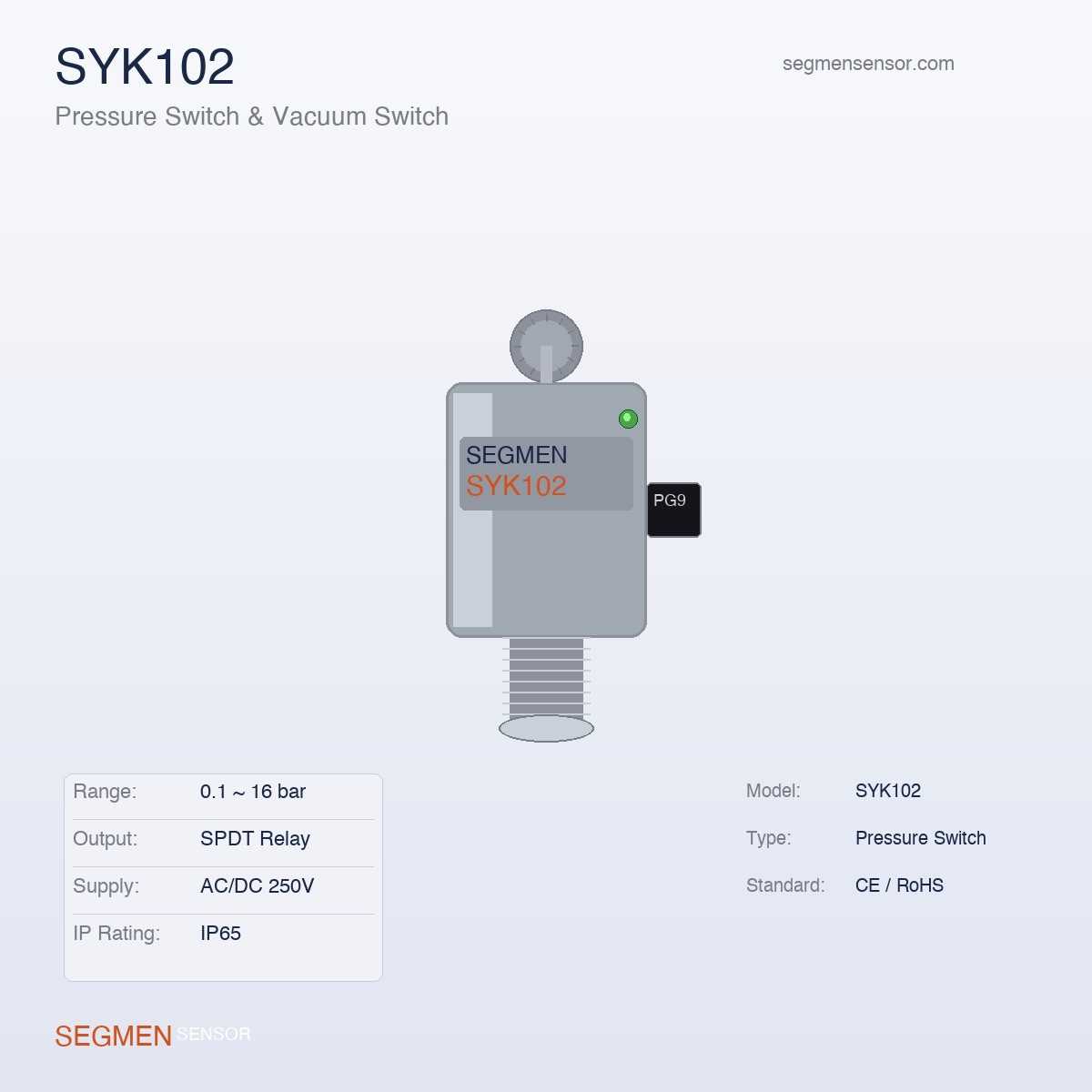
| SYK102 | Mechanical pressure switch | Adjustable 0.5–8.5 bar; SPDT 16 A / 250 V AC; set-point accuracy ±2%; IP65 |
| Vacuum switch | Electronic or mechanical vacuum switch | -1 to 0 bar; NPN, PNP, relay or IO-Link; ±2% FS |
| Submersible level transmitter | Hydrostatic (vented gauge) | 0–0.5 to 0–200 mWC; ±0.1% FS; 4–20 mA or 0–10 V; 12–36 V DC; -20 to +80 °C |
| Samples | Samples: from 1 pc for qualification (1–5 pcs in 5–7 working days); volume per project | |
Download the one-page datasheet (PDF)
The pressure transmitter datasheet lists all ranges, both accuracy classes, output options, process connections, wetted materials, temperature limits, IP rating, dimensions and the ordering code. No registration required.
How do I specify the right pressure sensor type?
Answer five questions in this order and the type follows; this is also the information our engineers ask for in a quotation request.
- Reference: gauge, sealed gauge, absolute, differential or vacuum.
- Range and overload: normal operating pressure, peak or spike pressure, and the unit (bar, psi, kPa, mWC). Pick a range so normal operation sits in the upper half of the span.
- Medium and temperature: the fluid, its temperature and any particles or chemicals, which set the diaphragm material and element.
- Output and supply: switch, mV, 4–20 mA, 0–10 V, RS485, HART or IO-Link, and the supply voltage available.
- Connection and protection: process thread (G1/4, NPT and others), electrical connector or cable, IP rating, and hazardous-area requirements.
Performance tests for process transmitters follow IEC 60770-1 ↗, and you can check a delivered unit yourself with the steps in how to calibrate a pressure transducer. For loop design see the 4–20 mA pressure transmitter selection guide.

Not sure which pressure sensor type fits your equipment?
Send the medium, pressure reference, normal and peak pressure, temperature, output and connection. Our engineers will propose the type and configuration. Qualification samples 1–5 pcs in 5–7 working days · production planned around your annual volume · FOB China · reply within 24 hours.
Frequently Asked Questions
Gauge, absolute, differential and sealed gauge. Gauge pressure is measured against local atmosphere, absolute against a vacuum, differential between two ports, and sealed gauge against a fixed pressure sealed inside the sensor. Vacuum and compound sensors are gauge sensors that read below atmosphere.
The piezoresistive gauge pressure transmitter with a 2-wire 4–20 mA output. It covers ranges from 0–0.1 bar to several hundred bar, works with almost every PLC input and stays accurate over long cable runs.
Pressure sensor is the general term. A transducer usually outputs a millivolt or ratiometric voltage signal, while a transmitter conditions the signal into 4–20 mA, 0–10 V or a digital protocol such as RS485, HART or IO-Link for use over longer distances.
Neither is better in every case. Ceramic resists many acids, alkalis and abrasive media and needs a suitable elastomer seal; a welded 316L stainless diaphragm suits hydraulic oil, water and higher pressures. Choose by the medium, temperature and peak pressure.
Yes. A submersible or bottom-mounted gauge pressure sensor measures the liquid head, and level equals pressure divided by density and gravity; 1 m of water is about 0.098 bar. SEGMENsensor submersible level transmitters cover 0–0.5 to 0–200 mWC with ±0.1% FS.