4-20mA Pressure Transmitter — 0–400 Bar, OEM China Factory
SEGMENsensor 4-20mA pressure transmitters convert process pressure to industry-standard 4-20mA loop current, compatible with all PLCs, DCS, and SCADA systems. Piezoresistive or ceramic sensing element, 316L stainless steel wetted parts, ±0.25% FS accuracy as standard (±0.1% FS high-accuracy version). Range 0–0.1 bar to 0–400 bar. Process connections G1/4", G1/2", 1/4" NPT, 1/2" NPT. CE and RoHS certified. OEM from Shenzhen since 2019, OEM volume supply.
CE Certified±0.25% FS (±0.1% FS option)0–400 Bar RangeOEM volume supply
Key facts
A SEGMENsensor 4-20 mA pressure transmitter is a two-wire, loop-powered instrument that converts process pressure into a 4 mA (zero) to 20 mA (full scale) current signal for any PLC, DCS or SCADA analog input. Ranges run from 0–0.1 bar to 0–400 bar with piezoresistive or ceramic sensing and 316L wetted parts.
Measuring range is 0–0.1 bar to 0–400 bar, specified at order.
Accuracy is ±0.25% FS as standard, with a ±0.1% FS high-accuracy version.
Loop supply is 12–36 V DC with a maximum loop resistance of 600 Ω at 24 V (check your cable run with the 4–20 mA loop resistance calculator).
Process connections are G1/4 (standard), G1/2, 1/4 NPT or 1/2 NPT; protection is IP67, with IP68 optional.
Qualification samples of 1–5 pcs ship in 5–7 working days and quotations are FOB China.
Last updated · SEGMENsensor Engineering Team
Watch: wiring a 4–20 mA pressure transmitter to a PLC
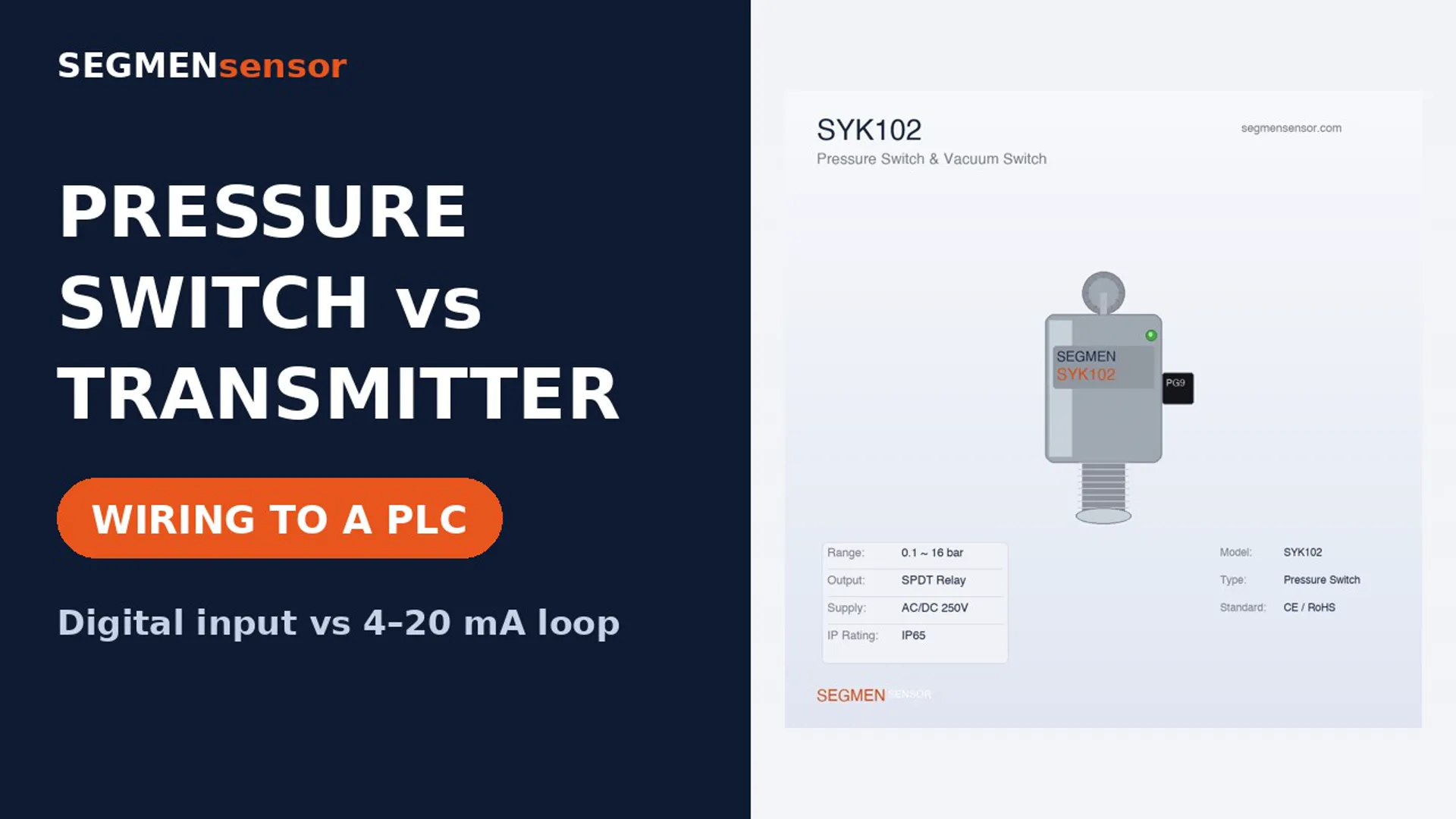
Pressure Switch vs Pressure Transmitter: How to Wire Each to a PLCThe difference in one picture, then the wiring: a pressure switch contact to a digital input, a 2-wire 4–20 mA pressure transmitter to an analog input, loop resistance, live zero and how to choose.
Pressure switch or pressure transmitter, and how to wire each one to a PLC. Both sense the same pressure. A switch has a set point: above it, the contact switches on. It switches off again only at a lower reset point. That gap is the hysteresis. A transmitter sends a continuous 4–20 mA signal that follows the pressure. Wiring a switch is simple: the relay contact connects 24 V to a digital input of the PLC. When pressure passes the set point, the contact closes and the input turns on. Below the reset point, it turns off again. A transmitter uses a current loop. The supply, the transmitter and the PLC input sit in one series circuit. Connect the supply positive to the transmitter, and its return to the PLC analog input. One pair of wires carries both power and signal. Keep the total loop resistance within 600 Ω at 24 V. The PLC converts the current to pressure: 4 mA is zero, 20 mA is the full range. Because zero pressure reads 4 mA, a reading of 0 mA means a broken wire, not zero pressure. Which one? Use a switch for a simple trip, an alarm or a pump cut-out. It even works without a PLC. Use a transmitter when a PLC must read, log or control the actual pressure value. The SYK102 switch adjusts from 0.5 to 8.5 bar, with an SPDT contact rated 16 A / 250 V AC. Pressure transmitters cover 0–0.1 bar up to 0–400 bar, at ±0.25% FS. Vacuum switches are also available, with NPN, PNP, relay or IO-Link output. SEGMENsensor pressure switches and transmitters. OEM volume supply. Quotes at segmensensor.com.
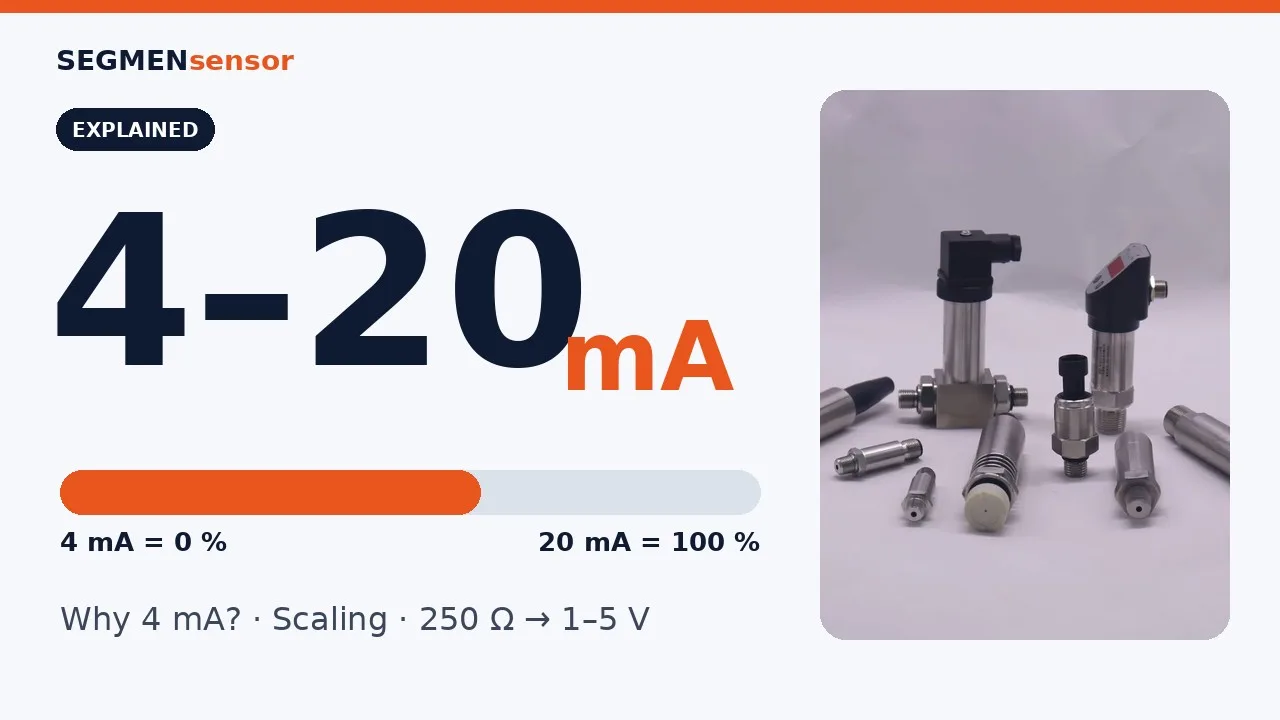
4–20 mA Explained: Scaling, Live Zero and the 250 Ω ResistorOne-minute animation of the 4–20 mA current loop: series loop, scaling from 4 mA (0 %) to 20 mA (100 %), the formula with a worked example, why the signal starts at 4 mA, and converting it to 1–5 V in the PLC.
4–20 mA: why is it everywhere? A 4–20 mA transmitter, its power supply and the PLC input form one series loop. The same current flows through every part of it. The current represents the measured value. 4 mA is the bottom of the range, 20 mA is full scale. Here, 0–10 bar. The formula: I = 4 + 16 × value ÷ span. At 6 bar, that is 13.6 mA. Why start at 4? A live zero shows a broken wire as 0 mA, it can power a 2-wire transmitter, and cable resistance does not change the signal. In the PLC, a 250 Ω resistor turns 4–20 mA into 1–5 V. SEGMENsensor pressure transmitters with 4–20 mA output. Try our calculator at segmensensor.com.
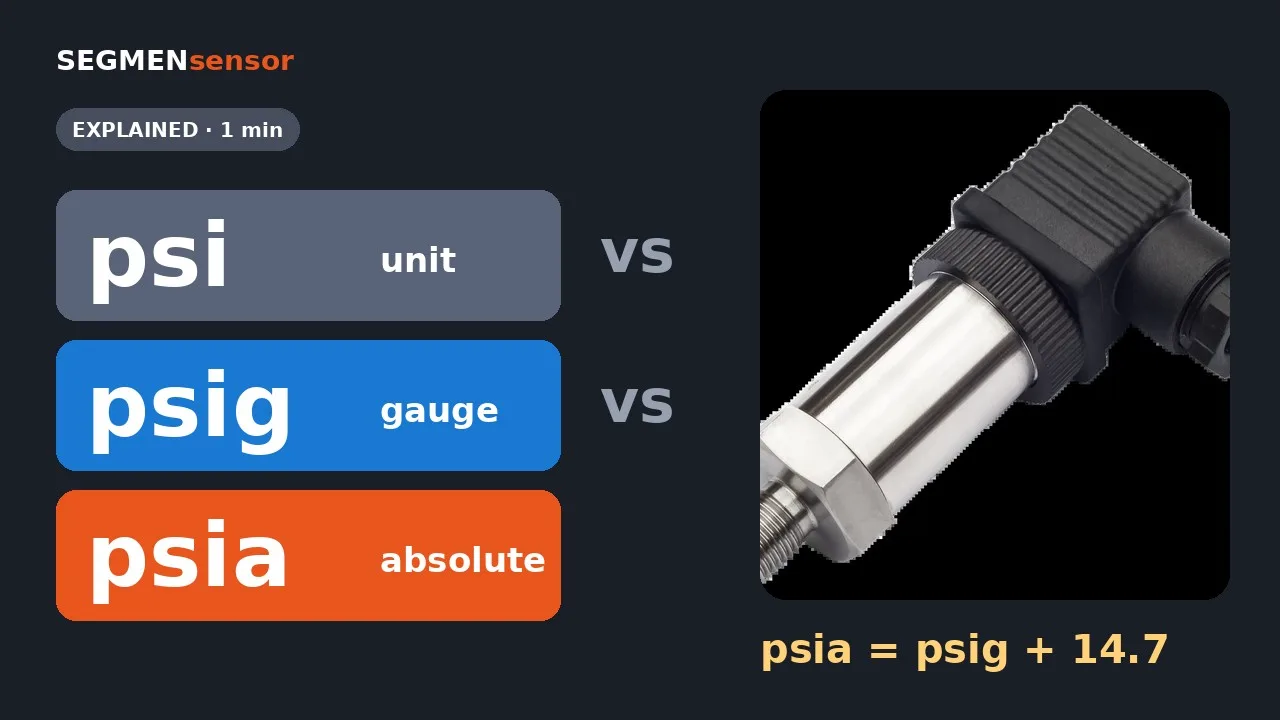
psi vs psig vs psia: Gauge and Absolute Pressure ExplainedOne-minute animation of pressure references: absolute zero, atmospheric pressure, how psia and psig are measured, vacuum readings, and when to choose a gauge or an absolute pressure transmitter. Read the full guide: gauge vs absolute vs differential pressure transmitter.
psi, psig, psia: what is the difference? Pressure is always measured from a reference. Absolute zero is a perfect vacuum. At sea level, the atmosphere adds about 14.7 psi. Absolute pressure, psia, is measured from the vacuum. This process sits at 34.7 psia. Gauge pressure, psig, is measured from the air around the sensor. The same process reads 20 psig. Below atmosphere, gauge pressure turns negative. −10 psig is 4.7 psia. Use gauge for most tanks and hydraulic systems, and absolute for vacuum or sealed processes. 1 bar = 14.5 psi. SEGMENsensor pressure transmitters: gauge, absolute and differential. Try our unit converter at segmensensor.com.
A closer look at the transmitter
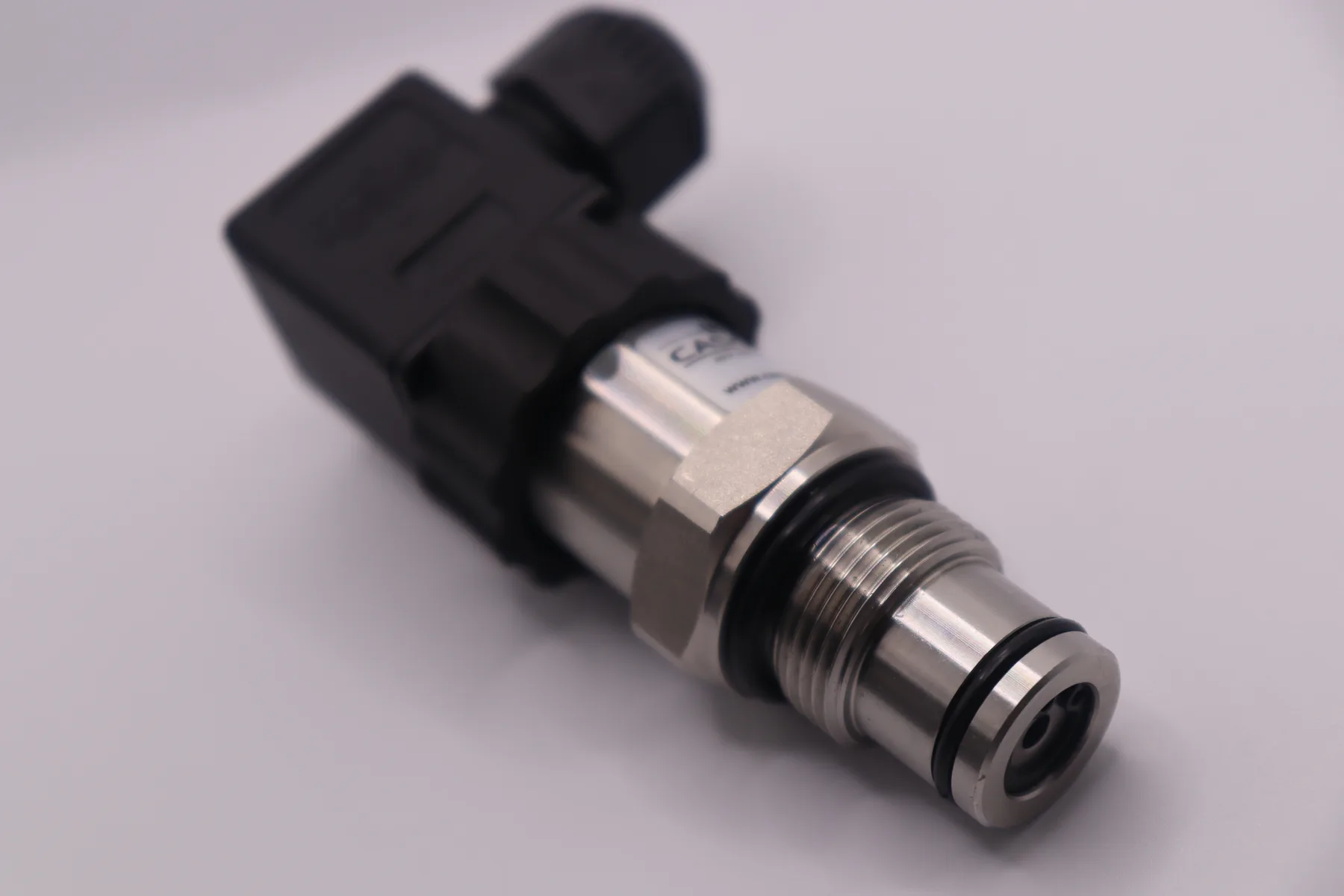
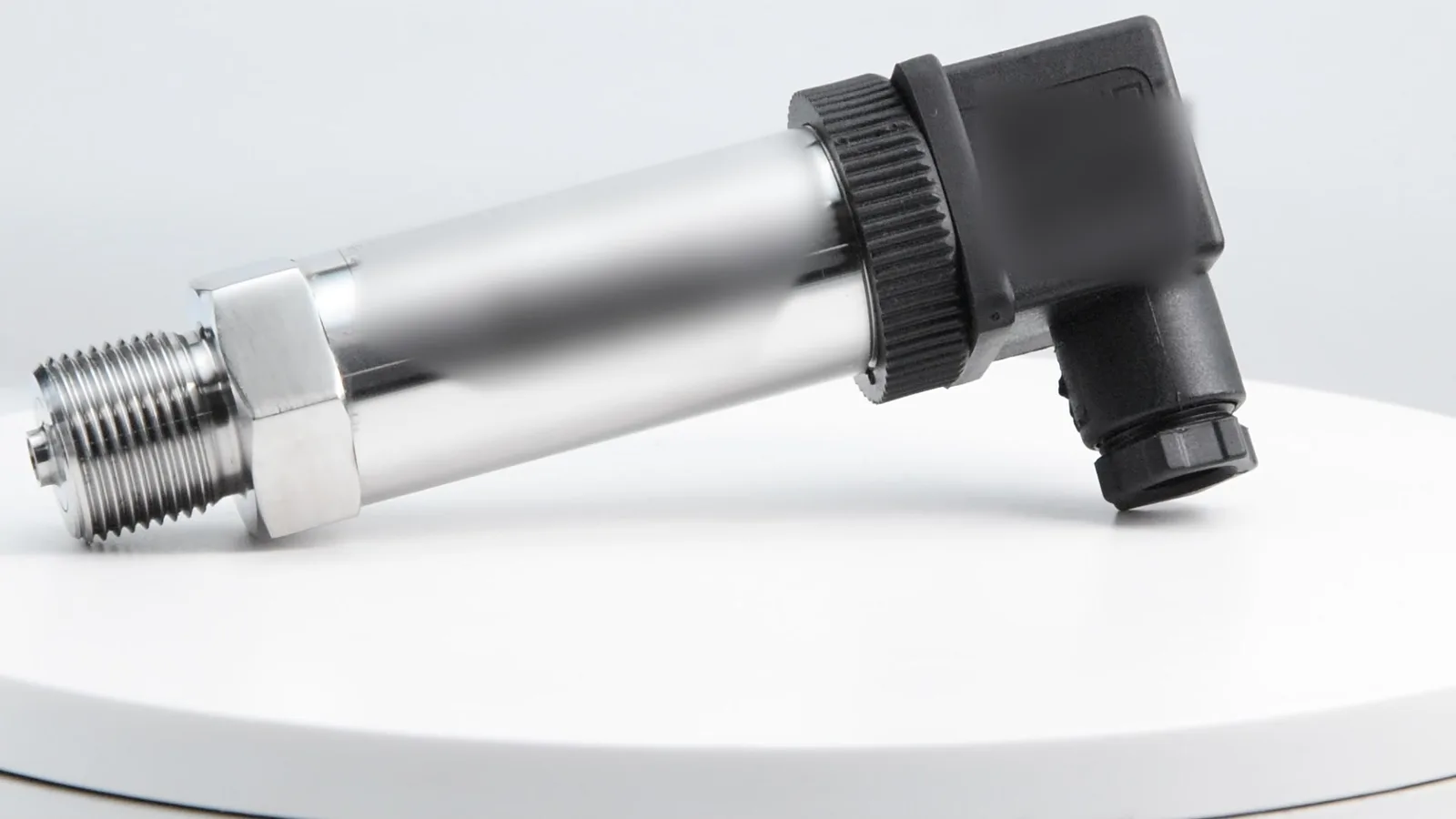
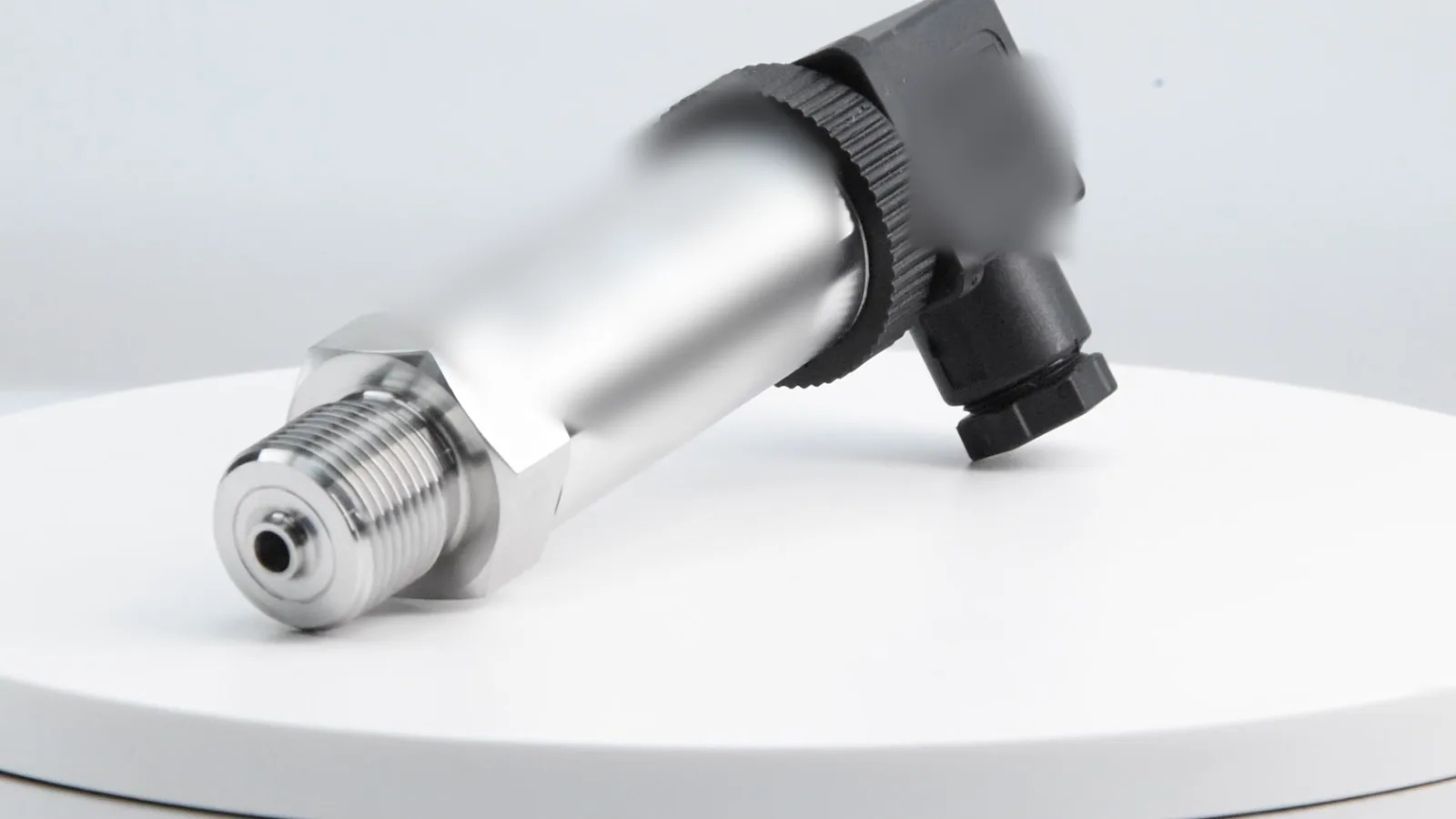
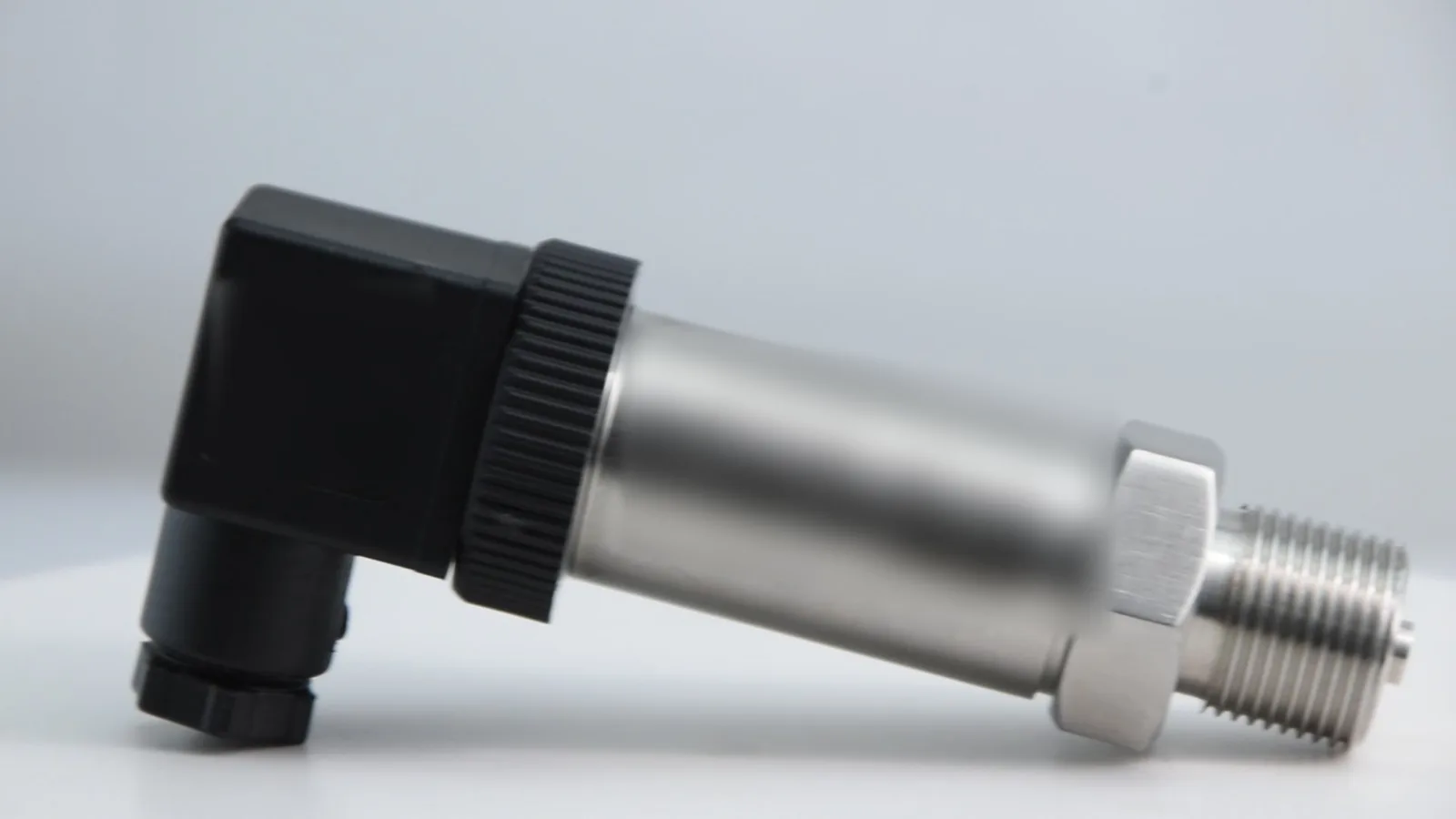
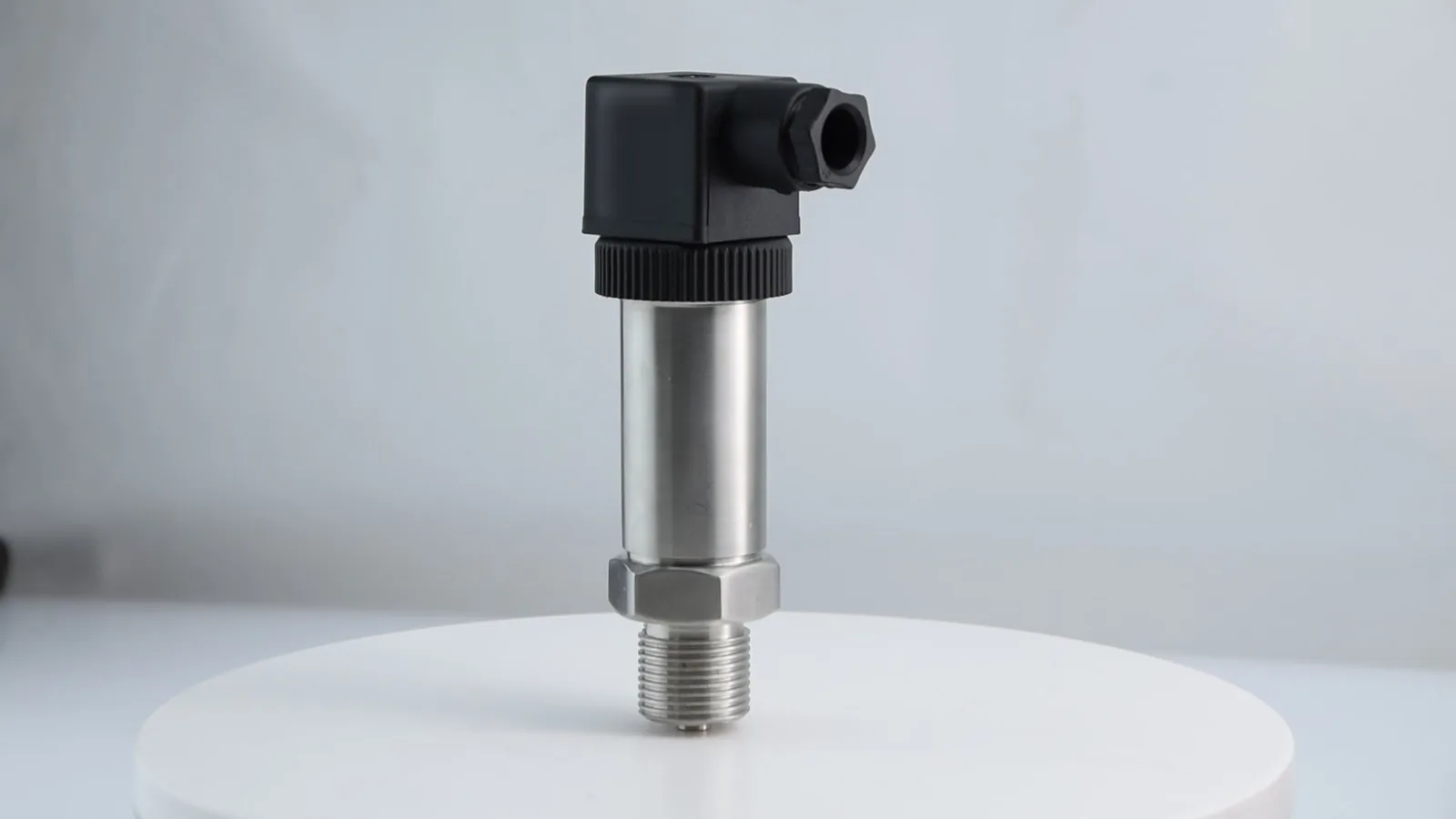
Stainless steel pressure transmitter with angled DIN-style plug connectorThreaded process connection and pressure portStainless housing, hex and male thread in detailCompact transmitter in vertical mounting position
Close-up photos of a standard build. Process connection, range, output and connector options are listed in the specifications.
What is a 4-20mA Pressure Transmitter?
A 4-20mA pressure transmitter is a two-wire loop-powered device that converts pressure measurements into a proportional 4-20mA DC current signal. At minimum pressure (zero), output is 4mA; at maximum pressure (full scale), output is 20mA. The 4-20mA signal is the universal analog standard in industrial automation — immune to cable resistance losses, noise from motors and inverters, and compatible with any analog input card. Used in hydraulic systems, process piping, compressed air networks, water treatment, and chemical processing worldwide.
Specifications
4-20mA Pressure Transmitter — Full Technical Specifications
Standard specifications for SEGMENsensor 4-20mA pressure transmitters. Custom ranges, connections, and output variants available on request.
G1/4" male (standard); G1/2", 1/4" NPT, 1/2" NPT available
Electrical Connection
M12×1 4-pin connector (standard) / Hirschmann / flying lead
IP Rating
IP67 (standard) / IP68 (optional)
Burst Pressure
3× full scale (standard ranges)
Long-term Stability
±0.1% FS / year
Operating Temperature
-20°C to +85°C (media); -40°C to +85°C (ambient)
Compensated Temperature Range
0°C to +60°C
Vibration
10g, 10–2000 Hz
Samples
Samples 1–5 pcs for qualification; volume per project
Lead Time
Confirmed with the quotation (standard production); samples 1–5 pcs in 5–7 days; custom OEM confirmed at order
Certifications
CE, RoHS
Download the pressure transmitter datasheet (PDF)
One-page datasheet with all ranges, accuracy classes, output options, supply voltage, process connections, materials, temperature limits, IP rating, dimensions and the ordering code. No registration required.
Which 4-20mA Pressure Transmitter Variant Do You Need?
Match your pressure range and process medium to the right transmitter variant. Three tiers cover the full industrial pressure range from 0.1 to 400 bar.
💧
Standard Range 0.1–40 bar
Pneumatic systems, water treatment, HVAC, compressed air
Ceramic diaphragm — resistant to scale and mild media
PVDF or Hastelloy C diaphragm for chemical resistance
Hygienic tri-clamp process connection, flush diaphragm design
Custom wetted material — specify process medium at order
→ PT-S series (special media / flush)
Not sure which variant fits your pressure range or process medium?
Tell us your operating pressure, process medium, process connection type, and PLC brand — our engineers will recommend the correct model and range within 24 hours.
4-20mA Pressure Transmitter OEM — 8 Industry Applications
SEGMENsensor 4-20mA pressure transmitters are deployed across hydraulic systems, process plants, HVAC, semiconductor fabs, and more — wherever pressure must be measured with a long-run analog signal.
🔧
Hydraulic Power Units
Monitor system pressure in HPU lines, filter differential pressure, accumulator pre-charge. Specify 0–250 or 0–400 bar range with high-pressure G1/2" connection.
💨
Compressed Air Systems
Line pressure monitoring, compressor outlet, air receiver tank. Standard 0–10 or 0–16 bar ceramic sensing transmitter, G1/4" connection, IP67.
💧
Water Treatment Plants
Pump discharge pressure, filter pressure drop, UV reactor inlet pressure. 316L SS wetted parts for potable water compliance. 0–10 to 0–40 bar range.
🧪
Chemical Processing
Reactor vessel pressure, pipeline pressure monitoring. Specify process medium when ordering — Hastelloy C or PVDF diaphragm available for corrosive media.
⚙️
CNC Machine Tools
Coolant pressure, spindle air purge pressure, hydraulic clamp pressure. Compact G1/4" transmitter, M12 connector for easy PLC integration. IP67 standard.
🏢
HVAC Systems
Chiller condenser and evaporator pressure, fan differential pressure, duct static pressure. Low-range 0–1 to 0–6 bar ceramic transmitters for building automation.
🛢️
Oil & Gas
Well head pressure, separator pressure, flow line pressure. Confirm ATEX-rated variant for hazardous area classification. 0–160 to 0–400 bar range available.
🔬
Semiconductor Fabs
Ultra-pure water (UPW) pressure, process gas pressure, vacuum (specify negative range). Electropolished 316L SS wetted parts; low-outgassing cable option available.
Wiring & Connection
How to Wire a 4-20mA Pressure Transmitter
Three practical wiring scenarios — from basic 2-wire loop connection to PLC calibration formula.
01
Standard 2-Wire Connection
Brown (+) → PLC analog input (+) or +24V supply; Blue (–) → PLC analog input (–). The loop requires a PLC built-in 24V DC supply or an external 24V DC power source. Maximum loop resistance: 600Ω at 24V. No separate signal cable needed — power and signal share the same 2-wire loop.
02
Reading Current as Voltage
Insert a precision 250Ω shunt resistor in series with the loop. Measure voltage across the resistor: 4mA × 250Ω = 1V (zero pressure), 20mA × 250Ω = 5V (full scale). Any voltage-input analog card or digital multimeter can then read the signal — no current-input card required. Use a 0.1% precision resistor for best accuracy.
03
PLC Scaling Formula
Pressure = (mA – 4) ÷ 16 × Full-Scale Pressure. Example: full scale 10 bar, live reading 12mA → (12 – 4) ÷ 16 × 10 = 5 bar. In most PLCs, the analog input card outputs a raw integer (e.g., 0–27648 for standard 16-bit cards). Map: Pressure = (Raw – 5530) ÷ 22118 × Full-Scale Pressure (for 4mA = 5530 counts, 20mA = 27648 counts).
Wire colour and pin to function
Cable and M12 connector versions of the 2-wire loop. Pin numbers and any wire colour not listed here are confirmed with the order.
Function
Cable version
M12 connector version
Loop supply / signal (+)
Brown
Pin confirmed at order
Loop return / signal (–)
Blue
Pin confirmed at order
Shield (if fitted)
Confirmed at order
Confirmed at order
Compatible with
PLC analog input
Any 4–20 mA current input, or a voltage input with a 250 Ω sense resistor (1–5 V).
Choose the cable length or the M12 connector version when you request a quote.
FAQ
Frequently Asked Questions
Technical and sourcing questions from OEM buyers about 4-20mA pressure transmitters.
What does 4-20mA mean in a pressure transmitter?
4-20mA is the output current range of the transmitter. 4mA represents the minimum (zero) pressure, and 20mA represents the full-scale (maximum) pressure. The 4mA live-zero allows the system to detect a wiring fault: if the signal drops below 4mA (e.g., to 0mA), it indicates a broken wire or power loss — not a valid low-pressure reading. The current loop is powered by the 24V DC supply in the PLC/DCS control panel (loop-powered, 2-wire). The current value is the same regardless of the cable length or resistance (up to the rated load resistance limit).
What pressure range should I select for my application?
Select a range where normal operating pressure falls between 60–80% of full scale. Example: a hydraulic system operating at 150–180 bar should use a 0–250 bar transmitter. Avoid over-ranging: operating near 100% full scale permanently reduces diaphragm life. Avoid under-ranging: operating below 20% of full scale wastes resolution. SEGMENsensor standard ranges: 0–1, 0–2.5, 0–4, 0–6, 0–10, 0–16, 0–25, 0–40, 0–60, 0–100, 0–160, 0–250, 0–400 bar. Vacuum ranges (negative) and compound ranges (e.g., -1 to +9 bar) available on request.
What is the difference between a pressure transmitter and a pressure transducer?
Both convert pressure to an electrical signal, but the output differs. A pressure transducer typically outputs a millivolt (mV) or voltage (0–5V, 0–10V) signal — requires amplification and is sensitive to cable length and noise. A pressure transmitter outputs 4-20mA — current-mode signal, immune to cable resistance (up to 600Ω load), resistant to electrical interference from motors and variable-frequency drives. For industrial process control with cable runs over 5 meters, always use a 4-20mA transmitter. For short-range lab or bench applications, a transducer may suffice. Signal-chain diagram and comparison table: pressure transducer vs pressure transmitter.
Can I use a 4-20mA pressure transmitter on aggressive media (acids, alkalis)?
Standard 316L stainless steel is suitable for water, oil, mildly alkaline or acidic media (pH 4–10), hydraulic fluids, and fuels. For strong acids (H₂SO₄, HCl, HNO₃) or strong alkalis (NaOH >30%), specify the Hastelloy C diaphragm or PVDF-coated flush diaphragm variant. For food and pharmaceutical media, specify the hygienic variant with 316L flush diaphragm and tri-clamp or DIN 11851 dairy connection, compliant with surface roughness Ra ≤0.8 µm. Always specify your process medium when requesting a quote — incorrect material selection causes premature diaphragm failure.
What is flush diaphragm and when is it needed?
A flush (flat-face) diaphragm pressure transmitter has the sensing membrane flush with the process connection face — no internal cavity or impulse line where media can accumulate. Standard pressure transmitters have a small internal cavity and impulse port (typically G1/4"), where viscous media, slurries, or crystallizing fluids can plug the pressure path. Flush diaphragm transmitters are essential for: viscous fluids (resins, pastes, molasses), slurries (sewage, paper pulp), polymerizing media (epoxy), and food products requiring full CIP washdown. SEGMENsensor supplies flush diaphragm variants in G1/2" and 1" process connections.
What is the maximum loop resistance for a 4-20mA pressure transmitter?
At 24V DC supply, maximum loop resistance is (24V – 12V min supply) / 0.020A = 600Ω. This includes the cable resistance, PLC input impedance (typically 50–250Ω), and any series shunt resistors. At 28V DC supply, maximum loop resistance increases to (28V – 12V) / 0.020A = 800Ω. For long cable runs (>200 m with 0.5mm² cable ≈ 140Ω/km), calculate total loop resistance and ensure compliance. SEGMENsensor recommends 24–30V DC supply for standard installations. Minimum supply voltage at the transmitter terminals: 12V DC.
How do I calibrate a 4-20mA pressure transmitter?
SEGMENsensor pressure transmitters are factory-calibrated and shipped with a calibration report at 5 points (0%, 25%, 50%, 75%, 100% FS). Field zero and span adjustment is possible via the two-button configuration panel (where fitted) or via HART communicator for HART-enabled models. For most installations, no field calibration is required on receipt. Periodic calibration interval: typically 12–24 months per ISO 9001 instrumentation maintenance procedures. For quality-audited facilities, SEGMENsensor provides traceable calibration certificates (NIST/NIM traceable) on request.
What is the MOQ and lead time for OEM 4-20mA pressure transmitters from China?
OEM volume supply for standard catalog configurations. Samples 1–5 pcs ship in 5–7 days. Standard configurations (range, connection, connector, IP67): production lead time confirmed with the quotation. Custom configurations (non-standard range, flush diaphragm, special connection, HART output, IP68, OEM label): lead time confirmed at order. Private label (custom housing color, logo, tag plate): quoted by quantity, OEM volume supply. CE declaration of conformity, RoHS declaration, and calibration certificate with every order. Factory: SEGMEN (Shenzhen) Industrial Development Co., Ltd., Registration No. 91440300MAEUXXQU04, Shenzhen, Guangdong, China.
Can I get qualification samples of the 4-20mA pressure transmitter before a volume order?
Yes. Qualification samples of 1–5 pcs ship in 5–7 working days so your engineers can validate range, output and process connection on your equipment. Production lead time and MOQ are confirmed with the quotation.
Can the 4-20mA pressure transmitter be customized for my OEM product?
Yes. Pressure range, process connection, electrical connector, cable length and branding can be adapted to your project. Send the target specification and our engineers will reply within 24 hours on working days.
What are the shipping terms for 4-20mA pressure transmitters?
Quotations are FOB China. International freight and import duties or taxes are not included and are arranged by the buyer. All orders are paid by 100% T/T prepayment.
What warranty do 4-20mA pressure transmitters have?
SEGMENsensor pressure transmitters carry a 12-month warranty against manufacturing defects. Contact info@segmensensor.com with the model, serial number and a description of the fault to start a claim.
Ready to Source 4-20mA Pressure Transmitters from a China OEM Factory?
Tell us your pressure range, process medium, process connection, and output — we'll send a quote and datasheet within 24 hours.