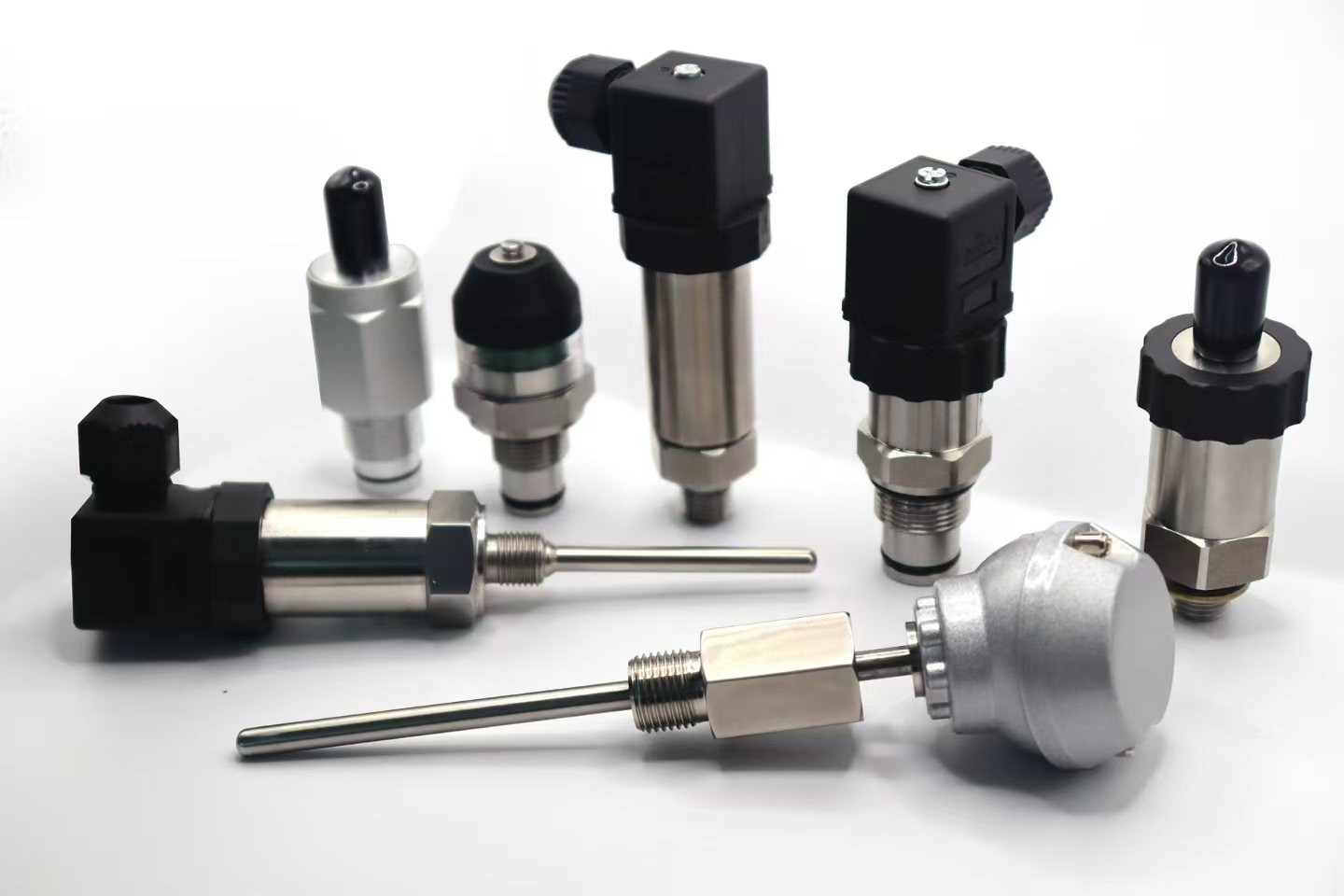
Choose a gauge pressure transmitter when you care about pressure above the local atmosphere (pumps, hydraulics, compressed air, water). Choose an absolute transmitter when atmospheric changes must not affect the reading (vacuum, low-pressure gas, barometric). Choose a differential transmitter when you need the difference between two points (filters, flow across an orifice, pressurised-tank level).
What is the difference between gauge, absolute and differential pressure?
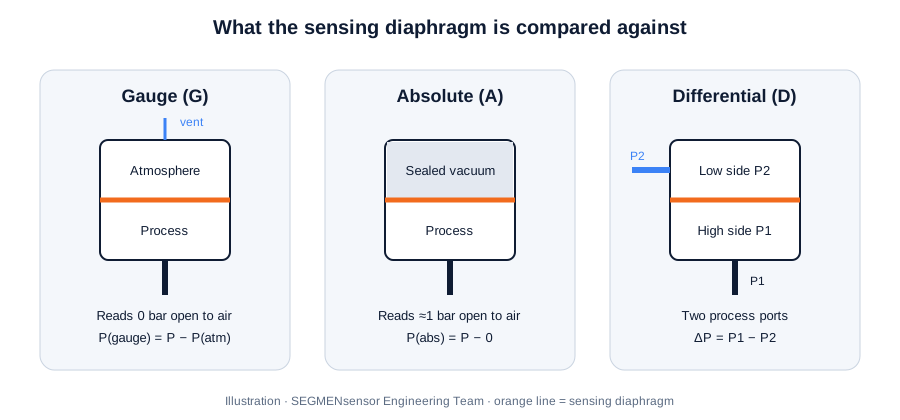
Every pressure transmitter measures the deflection of a sensing diaphragm. What changes between the three types is what sits on the other side of that diaphragm, called the pressure reference:
- Gauge (G, also written “gage”, unit bar(g) or psig) — the back of the diaphragm is vented to the local atmosphere. The transmitter reads 0 when its port is open to air.
- Absolute (A, bar(a) or psia) — the back of the diaphragm faces a sealed vacuum chamber. Open to air at sea level it reads about 1.013 bar, and the reading moves with the weather and altitude.
- Differential (D, ΔP) — the diaphragm sits between two process ports, P1 (high side) and P2 (low side), and the output represents P1 − P2.
The relationship is simple: absolute = gauge + atmospheric. Pressure units and their conversion follow the SI definitions published by NIST — SI units (1 bar = 100 kPa).
Gauge vs absolute vs differential: comparison table
Use this decision table to match the reference type to the measurement you actually need to control.
| Criterion | Gauge (G) | Absolute (A) | Differential (D) |
|---|---|---|---|
| Reference | Local atmosphere (vented) | Sealed vacuum | Second process port (P2) |
| Reading open to air | 0 bar(g) | About 1.013 bar(a) at sea level | 0 (both ports at the same pressure) |
| Affected by weather / altitude | No — atmosphere cancels out | Yes — the reading includes atmosphere | No — only P1 − P2 matters |
| Typical applications | Pumps, hydraulic lines, compressed air, water mains, tank head | Vacuum processes, low-pressure gas, barometric and altitude-sensitive points | Filter clogging, flow across an orifice or venturi, pump ΔP, level in pressurised tanks |
| Process connections | One port | One port | Two ports (high and low side) |
| Installation point to watch | Keep the vent path open and dry | Specify whether the range starts at vacuum | Confirm static (line) pressure and which port is P1 |
When should you choose a gage pressure transmitter?
A gauge transmitter is the default for most industrial machines because the pressure that does work — pushing hydraulic oil, lifting water, driving pneumatic cylinders — is the pressure above atmosphere. If a pump datasheet, a hydraulic circuit drawing or a compressor setting is given in bar(g) or psig, order a gauge transmitter with the same unit. SEGMENsensor gauge transmitters are used on hydraulic power units, water and pump systems, compressors and pneumatic lines, with ranges up to 0–400 bar for high-pressure hydraulics.
For water and pump stations the 2-wire 4-20 mA output is the common choice; see our 4-20 mA pressure transmitter wiring guide for 2-wire and 3-wire loop connections to a PLC.
When do you need an absolute pressure transmitter?
Atmospheric pressure changes by several tens of millibar with weather and drops with altitude. On a 0–400 bar hydraulic line that variation is negligible, but on a 0–1 bar range it is a visible error. Choose an absolute reference when:
- the process runs below atmospheric pressure (vacuum chambers, degassing, vacuum packaging) and you need a value that never goes negative;
- you measure low-pressure gas where the mass or density calculation needs absolute pressure;
- the same machine is shipped to sites at very different altitudes and must read identically.
For simple vacuum on/off duties a switch may be enough — the SEGMENsensor vacuum pressure switch covers −1 to 0 bar with NPN, PNP, relay or IO-Link output. Our article on pressure switch vs pressure transmitter explains when a continuous signal is worth it.
When is a differential pressure transmitter the right choice?
A differential transmitter answers the question “how much higher is one point than another?” directly, without subtracting two separate sensor readings and adding both of their errors. Typical uses are:
- Filter monitoring — rising ΔP across an air or liquid filter signals clogging before flow drops.
- Flow measurement — across an orifice plate or venturi, ΔP rises with the square of flow; the PLC applies square-root extraction.
- Pump performance — inlet-to-outlet ΔP shows pump head and wear.
- Level in closed tanks — bottom-to-top ΔP removes the gas-cushion pressure from the level reading.
- HVAC — fan, duct and chiller differential pressure in building automation.
When you order a differential unit, state both the ΔP range and the maximum static (line) pressure on the ports, because a small ΔP can sit on top of a high system pressure.
Not sure which reference your application needs?
Send us the medium, the pressure you need to control, the range in bar(g), bar(a) or ΔP, the output signal and quantity. MOQ 1 pc · samples 1–5 pcs in 5–7 days · production 3–5 weeks · quotation within 24 hours.
SEGMENsensor pressure transmitter specifications
All three reference types are built on the same transmitter platform. The values below are taken from the SEGMENsensor pressure sensor and transmitter product page and datasheet.
| Parameter | SEGMENsensor pressure transmitter |
|---|---|
| Pressure reference | Gauge, absolute or differential |
| Measuring range | 0–0.1 bar to 0–400 bar (specified at order) |
| Accuracy | ±0.25% FS standard; ±0.1% FS high-accuracy version |
| Sensing element | Piezoresistive or ceramic membrane |
| Output | 4-20 mA 2-wire, 0-10 V or RS485 |
| Wetted materials | 316L stainless steel, Hastelloy or ceramic |
| Process connection | G1/4, G1/2, 1/4 NPT, 1/2 NPT or flush diaphragm |
| Electrical connection | M12×1, Hirschmann or flying lead |
| Certifications | CE, RoHS 3; ATEX / IECEx options |
| MOQ / samples / production | 1 pc / 1–5 pcs in 5–7 days / 3–5 weeks |
Download the one-page datasheet (PDF)
Ranges, accuracy classes, outputs, process and electrical connections, wetted materials and ordering information for SEGMENsensor pressure transmitters and switches. No registration required.
Transmitter performance terms such as accuracy, hysteresis and repeatability are defined for industrial process transmitters in IEC 60770-1 — Transmitters for use in industrial-process control systems. Enclosure protection is stated as an IP code according to IEC 60529 — Degrees of protection provided by enclosures (IP Code).
Three common selection mistakes
- Ordering absolute when the drawing says bar(g). The transmitter then reads about 1 bar too high at sea level — a full-scale error on a 0–1 bar range.
- Blocking the vent of a gauge transmitter. Paint, potting or a sealed enclosure over the vent turns a gauge unit into an unintended sealed reference that drifts with temperature.
- Specifying only the ΔP range of a differential unit. Without the static line pressure the sensor may be over-stressed even though the difference is small.
What affects the price of a gauge, absolute or differential transmitter?
We do not publish prices because every quotation is configured. The cost depends on the pressure reference (differential units need two process ports), the range, the accuracy class (±0.25% or ±0.1% FS), output signal, wetted material (316L, Hastelloy or ceramic), process and electrical connections, certification such as ATEX / IECEx, and quantity. Quotations are FOB China and are sent within 24 hours on working days. For more selection detail see the 4-20 mA pressure transmitter selection guide and the 4-20 mA pressure transmitter product page.
Frequently Asked Questions
Gauge pressure is measured relative to the local atmosphere, so a gauge transmitter reads 0 bar when its port is open to air. Absolute pressure is measured relative to a perfect vacuum, so an absolute transmitter open to air reads the local atmospheric pressure, about 1.013 bar at sea level. Absolute pressure equals gauge pressure plus atmospheric pressure.
Use a gauge (gage) transmitter when the value you control is the pressure above the surrounding air: pump discharge, hydraulic lines, compressed air, water mains and tank head. Use an absolute transmitter when atmospheric changes would distort the reading, such as vacuum processes, low-pressure gas, altitude-sensitive or barometric measurements.
Yes. Across an orifice plate, venturi or other primary element, the differential pressure rises with the square of the flow rate, so a differential transmitter with square-root extraction in the PLC or flow computer gives flow. Differential transmitters are also used for filter clogging, pump inlet-to-outlet pressure and level in pressurised tanks.
SEGMENsensor pressure transmitters cover 0–0.1 bar to 0–400 bar, with ±0.25% FS standard accuracy and ±0.1% FS on the high-accuracy version. Gauge, absolute and differential configurations are available, with 4-20 mA 2-wire, 0-10 V or RS485 output and G1/4, G1/2, 1/4 NPT, 1/2 NPT or flush-diaphragm connections.
MOQ is 1 piece for every configuration. Samples of 1–5 pieces ship in 5–7 days, production orders take 3–5 weeks, and quotations are sent within 24 hours on working days. Quotes are FOB China and depend on reference type, range, output, wetted material, certification and quantity.
Get your gauge, absolute or differential transmitter quoted
Tell us the reference type, range, output, process connection, medium and quantity. MOQ 1 pc · samples in 5–7 days · production 3–5 weeks · 12-month warranty · reply within 24 hours. Download the datasheet (PDF).