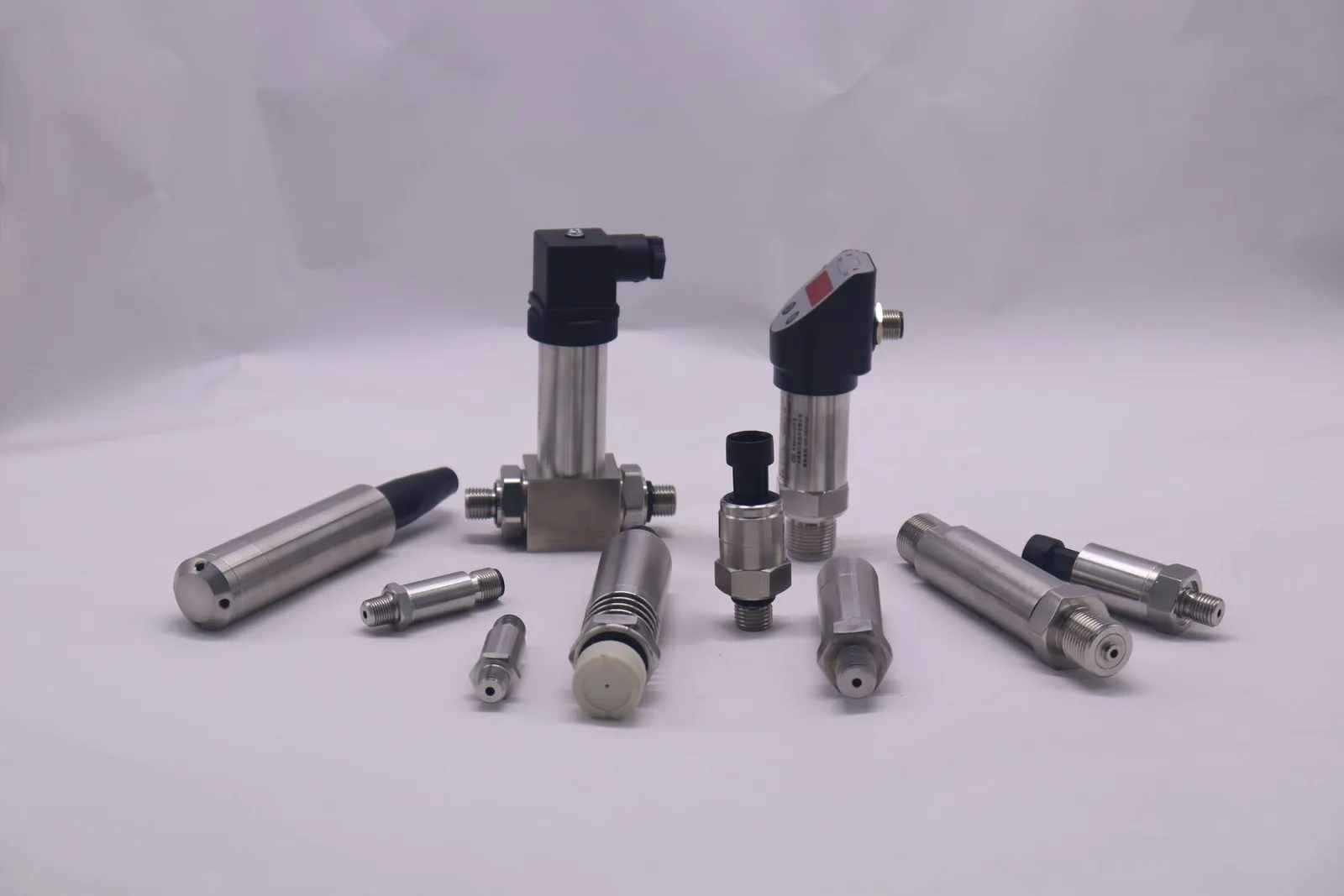
A pressure switch answers a yes/no question — "is pressure above (or below) the set point?" — by opening or closing a contact. A pressure transmitter answers "what is the pressure right now?" by sending a continuous analog or digital signal, typically 4–20 mA, to a PLC, DCS or display. Switches are simpler and drive a relay or alarm directly; transmitters need an analog or bus input but give you the full value, trend data and any number of software set points.
What does a pressure switch do?
A pressure switch changes the state of an electrical contact when process pressure reaches a set point. Pressure acts on a diaphragm, piston or bellows; when the force overcomes an adjustable spring, a snap-action mechanism flips the contact. When pressure falls back by the switch's differential (also called hysteresis or deadband), the contact resets. The differential stops the contact from chattering when pressure hovers near the set point.
The output is binary: a dry relay contact (NO, NC or SPDT changeover) on mechanical switches, or an NPN/PNP transistor output on electronic switches. Because the contact can switch a load directly, a mechanical switch such as the SYK102 pressure switch can start or stop a pump or compressor without a controller at all.
What does a pressure transmitter do?
A pressure transmitter measures pressure continuously and converts it into a standardized signal. In a piezoresistive transmitter, pressure deflects a stainless-steel or ceramic diaphragm carrying strain-sensitive resistors in a Wheatstone bridge; electronics linearize and temperature-compensate the bridge signal and output it as current, voltage or a digital value.
The most common output is the 2-wire 4–20 mA current loop defined in IEC 60381-1: 4 mA represents the lower range value, 20 mA the upper range value. Because zero pressure still produces 4 mA, a reading near 0 mA reveals a broken wire. See the 4–20 mA pressure transmitter page for ranges and connections.
How do the two output signals compare?
For a linear 4–20 mA transmitter the output is:
I = 4 mA + 16 mA × (P − Pmin) / (Pmax − Pmin)
Worked example: a 0–10 bar transmitter at 6 bar outputs 4 + 16 × 6/10 = 13.6 mA. At ±0.25% FS accuracy the reading is within ±0.025 bar of true pressure (0.25% × 10 bar). Check other values with the 4–20 mA to pressure calculator.
Pressure switch vs pressure transmitter: comparison table
| Criterion | Pressure switch | Pressure transmitter |
|---|---|---|
| Output | Discrete: relay contact (NO / NC / SPDT) or NPN / PNP transistor | Continuous: 4–20 mA, 0–10 V, or digital (RS485 Modbus RTU, IO-Link, HART) |
| What you learn | Whether pressure is above or below one set point | The actual pressure value at any moment |
| Set points | One per contact, adjusted on the device | Any number, set in PLC / DCS software |
| Controller needed? | No — a relay contact can switch a load directly | Yes — needs an analog or bus input |
| Power | None for mechanical switches; supply needed for electronic switches | Loop powered, e.g. 12–36 V DC for a 2-wire 4–20 mA unit |
| Accuracy statement | Set-point repeatability (SYK102: ±2%) | % of full scale over the range (±0.25% FS or ±0.1% FS) |
| Diagnostics | None on a dry contact; a broken wire may look like a normal state | Live-zero 4 mA makes a broken loop detectable |
| Typical uses | Pump and compressor cut-in/cut-out, low-oil or high-pressure safety trips, HVAC/refrigeration protection | Process monitoring, closed-loop control, data logging, hydraulic and pneumatic feedback |
Which one should you choose?
Choose a pressure switch when the machine only needs one action at one pressure: stop a compressor at high pressure, start a pump at low pressure, or trip an alarm. It is the simplest, controller-free solution.
Choose a pressure transmitter when you need to see the value, trend it, control to it (for example a PID loop on pump speed) or derive several alarm levels from one sensor. One transmitter can replace several switches, because each "switch point" becomes a comparison in software.
Use both where an independent hard-wired safety trip is required alongside continuous monitoring — the transmitter feeds the control system while the switch acts directly on the motor contactor.
How do you specify either device?
- Pressure range and type — gauge, absolute or vacuum; transmitter ranges from 0–0.1 to 0–400 bar, switch set points from 0.5 to 8.5 bar (SYK102) or -1 to 0 bar (vacuum switch).
- Output — relay or NPN/PNP for a switch; 4–20 mA, 0–10 V, RS485 or IO-Link for a transmitter.
- Process connection — G1/4, G1/2, 1/4 NPT or 1/2 NPT.
- Environment — ingress protection per IEC 60529 (switch IP65/IP67, transmitter IP68) and media temperature (transmitter -40 to +125 °C).
- Wiring check — for a 4–20 mA loop, total loop resistance must stay within 600 Ω at 24 V; see the 4–20 mA wiring guide.
For a full transmitter checklist, read the 4–20 mA pressure transmitter selection guide; to convert between bar, psi and kPa, use the pressure unit converter.
Frequently Asked Questions
No. "Pressure sensor" is the general term for any device that responds to pressure. A pressure switch is a sensor with a discrete on/off output at a set point; a pressure transmitter is a sensor with a continuous output proportional to pressure.
Yes, if a PLC or controller reads the 4–20 mA signal and compares it with a set point in software. If the device must switch a pump or contactor directly without a controller, a pressure switch with a relay contact is the simpler choice.
The differential (hysteresis or deadband) is the gap between the pressure at which the contact switches and the pressure at which it resets. It prevents rapid on/off cycling when pressure fluctuates around the set point.
A linear 4–20 mA transmitter outputs 12 mA at 50% of its range: 4 mA + 16 mA × 0.5. A 0–10 V transmitter outputs 5 V at the same point.
SEGMENsensor makes the SYK102 mechanical pressure switch (0.5–8.5 bar, SPDT 16 A / 250 V AC), vacuum pressure switches (-1 to 0 bar) and pressure transmitters from 0–0.1 to 0–400 bar at ±0.25% FS or ±0.1% FS with 4–20 mA, 0–10 V or RS485 output.
MOQ is 1 piece. Samples ship in 5–7 working days and production orders in 3–5 weeks. Quotations are FOB China with 100% T/T in advance, and we reply to inquiries within 24 hours.