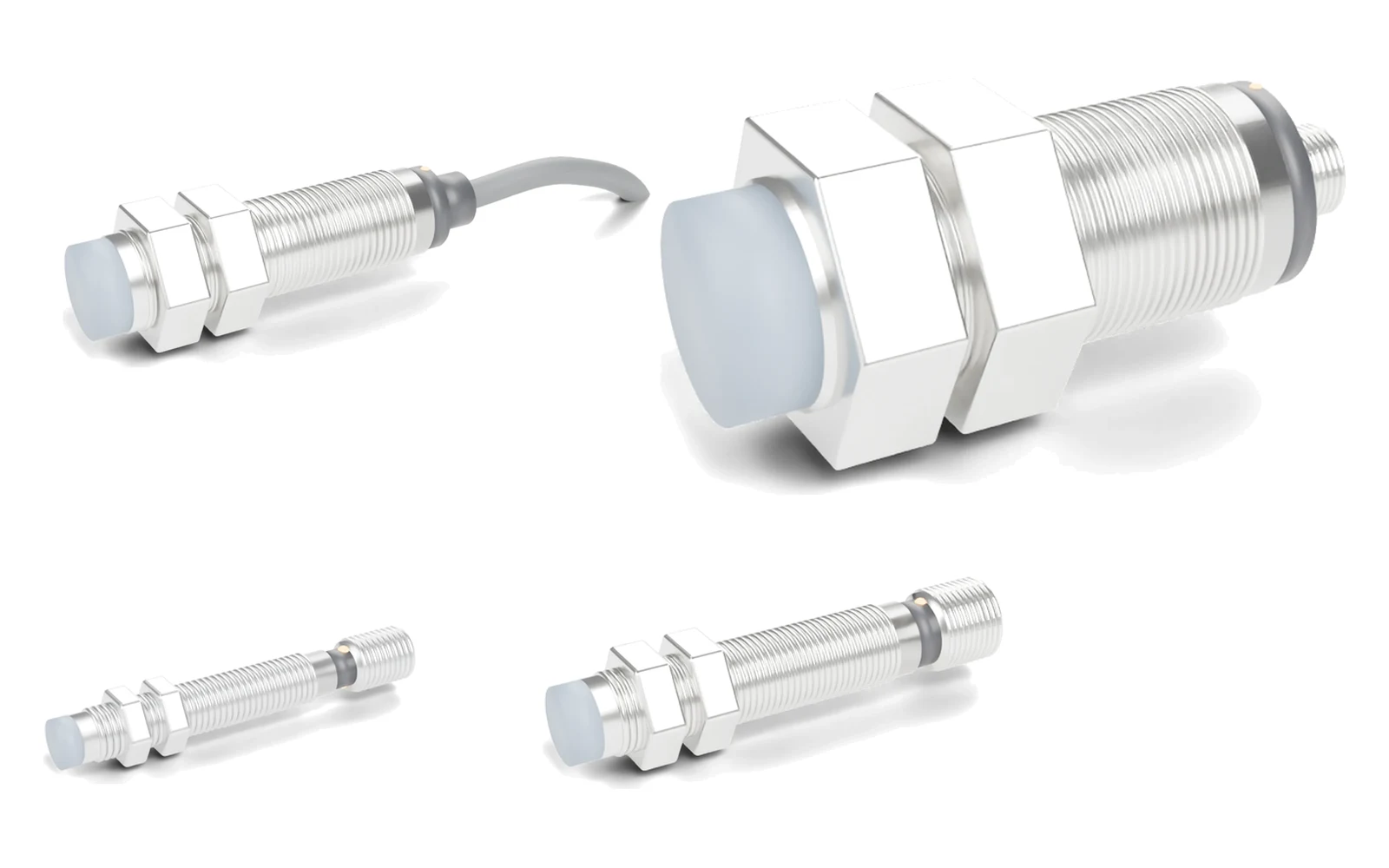
Choose NO when the machine should act on the presence of a part (counting, positioning, "part in place"). Choose NC when the machine should act on the absence of a condition and a cut wire or lost supply must be noticed (overtravel limits, "guard closed", low-level dry-run alarms). The sensing element is the same; only the output logic at rest is inverted.
What do normally open and normally closed mean on a sensor?
The terms come from mechanical contacts. A normally open contact is open (no current flows) until the switch is actuated; a normally closed contact is closed (current flows) until it is actuated. "Normally" always refers to the shelf state of the device — no target, no pressure, no float lift — and not to the state the machine usually runs in. A pressure switch on a line that is always pressurised still has its NO contact named for the unpressurised state.
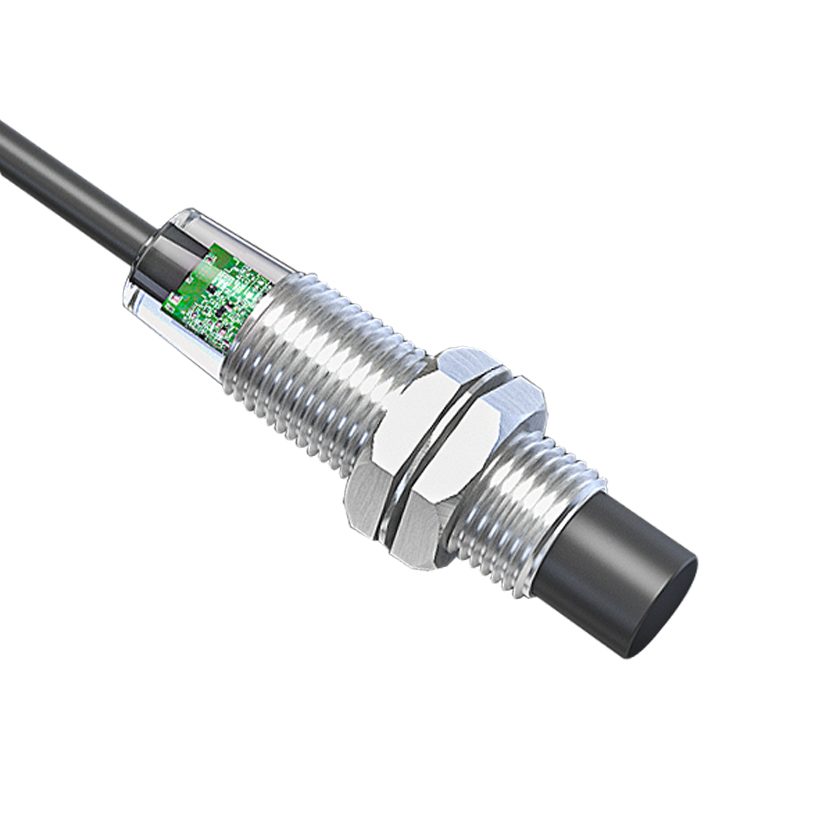
Electronic sensors such as inductive proximity sensors have no moving contact. Their output transistor plays the same role: in an NO sensor the transistor is off at rest and conducts when the target arrives; in an NC sensor it conducts at rest and turns off when the target arrives. Because a transistor is not a perfect open circuit, a small off-state leakage current flows; the value for each part number is on its datasheet.
NO vs NC sensor: comparison table
| Normally open (NO) | Normally closed (NC) | |
|---|---|---|
| Output with no target | OFF (open) | ON (closed) |
| Output with target | ON (closed) | OFF (open) |
| PLC input with no target | 0 (FALSE) | 1 (TRUE) |
| Signal wire cut or connector pulled | Reads as "no target" — the fault is hidden | Reads as "target present" — the fault is visible |
| Sensor supply lost | Reads as "no target" | Reads as "target present" |
| Typical uses | Part present, counting, end-of-stroke position, "start" conditions | Overtravel limit, guard or door closed monitoring, low-level dry-run cut-off, "permit to run" chains |
| Photoelectric equivalent | Light-on or dark-on, depending on the beam arrangement | The opposite mode |
| SEGMENsensor SGI-GP code | NA (NPN NO) · PA (PNP NO) · DA (DC 2-wire NO) | NB (NPN NC) · PB (PNP NC) · DB (DC 2-wire NC) |
Source for the codes: the SEGMENsensor part-number rules used on the proximity sensor part number lookup. The SGI-GP series also offers a 4-wire NO + NC output (code NC = NPN, PC = PNP), for example SGI-GP08S-010NC-C2 for an M8 flush, 1 mm NPN sensor with both outputs.
Why is normally closed called fail-safe?
Because every common wiring fault drives an NC circuit to its "tripped" state. A cut cable, a loose terminal, a pulled connector or a blown supply fuse all stop the current, which the controller reads exactly as if the sensor had detected its target. With an NO sensor the same faults look like "nothing detected", so a failed overtravel sensor would let an axis run past its limit without any warning.
This closed-circuit idea — the safe state is the de-energised state — is a basic principle in machinery safety standards such as IEC 60204-1 (electrical equipment of machines) and the ISO 13849-1 design principles for safety-related control parts. Note the limit: an NC output on a standard proximity sensor improves fault visibility, but it does not make the sensor a safety component. Personnel protection functions need devices designed and rated for that safety function.
NO and NC in PLC ladder logic
Do not confuse the sensor contact with the ladder instruction. An NO sensor wired to an input is usually read with an examine-if-closed (XIC, "normally open") instruction, so the rung is true when the part is present. An NC sensor gives a TRUE input at rest, so "target reached" is programmed with an examine-if-open (XIO, "normally closed") instruction. You can invert an NO signal in software, but the program then cannot tell a broken wire from "no target"; only the NC hardware output gives that information.
How do you choose between an NO and an NC sensor?
Ask what the controller must do when the signal disappears for any reason. Then work through these steps:
- Define the event. Is the machine waiting for something to arrive (use NO) or watching for something to leave or a limit to be reached (consider NC)?
- Check the consequence of a wire break. If an undetected break could cause a crash, overflow or dry-running pump, choose NC.
- Match the PLC input type. NO or NC is independent of NPN or PNP: a PNP NC sensor still needs a sourcing input. See NPN vs PNP proximity sensor wiring.
- Consider both outputs. A 4-wire NO + NC sensor lets the PLC compare the two signals; if both read the same, the sensor or wiring has failed.
- Write the contact into the part number. State NO or NC on the purchase order so the label, datasheet and spare parts all match.
Do float switches, pressure switches and photoelectric sensors use NO and NC too?
Yes, but each defines its rest state differently, so read the rest condition before choosing a contact:
- Float level switches — rest is "float down" (low level). SEGMENsensor float level switches use an SPDT reed contact with three terminals (common, NO, NC), so one switch can be wired either way; with the float down, C–NC is closed. See the float level switch selection guide.
- Pressure switches — rest is "below set point". The SYK102 mechanical pressure switch adjusts from 0.5 to 8.5 bar and has an SPDT contact rated 16 A / 250 V AC; compare it with a transmitter in pressure switch vs pressure transmitter.
- Photoelectric sensors — use "light-on" (output on when the receiver sees light) and "dark-on" (output on when the beam is blocked) instead of NO and NC. Which one behaves like NO depends on the mode: on a through-beam pair, dark-on switches on when a part breaks the beam. See photoelectric sensors.
How do you test whether a sensor is NO or NC?
Power the sensor at its rated voltage (10–30 V DC for SGI-GP 3-wire models) with a load or PLC input connected, then measure the black output against the blue 0 V wire with a multimeter:
| Sensor type | No target | Target present |
|---|---|---|
| PNP NO | ≈ 0 V | ≈ supply voltage |
| PNP NC | ≈ supply voltage | ≈ 0 V |
| NPN NO | Floats or reads high through the load | ≈ 0 V |
| NPN NC | ≈ 0 V | Floats or reads high through the load |
On most sensors the indicator LED shows the output state, so an NC sensor's LED is lit with no target. Confirm with the label code, because LED behaviour can differ by product. If readings do not change at all, work through proximity sensor not detecting: troubleshooting.
Which SEGMENsensor sensors are available as NO or NC?
- SGI-GP general-purpose inductive sensors — 6.5 mm to M30, NPN or PNP, NO, NC or NO + NC, plus DC 2-wire NO / NC.
- SGI-HT high-temperature inductive sensors and SGI-HP high-pressure sensors — same NPN / PNP 3-wire wiring, with the contact stated in the part number.
- Photoelectric sensors — NPN or PNP, light-on or dark-on.
- Float level switches — SPDT reed contact, NO and NC on one switch.
To recognise an NO or NC contact on a machine schematic, see what proximity sensor symbols mean. Decode the contact of a sensor already on your machine with the proximity sensor part number lookup, or compare sensing types in types of proximity sensors.
Not sure whether your machine needs NO or NC?
Send the sensing task, the target, the PLC input type (sinking or sourcing) and what should happen on a wire break. Our engineers will recommend the output and part number. Qualification samples 1–5 pcs in 5–7 working days · FOB China · reply within 24 hours.
Download the inductive proximity sensor datasheet (PDF)
Sensing distance, supply voltage, output types, switching frequency, housing and temperature data for the SEGMENsensor inductive proximity range. Size-specific datasheets are also available for M8, M12, M18 and M30, flush and non-flush. No registration required.
Frequently Asked Questions
Off. A normally open sensor keeps its output open, or off, while no target is present, and switches on only when it detects the target. A PNP NO sensor therefore reads about 0 V at rest and about the supply voltage, for example 24 V, when the target is in range.
Because a cut wire, pulled connector or lost supply makes an NC circuit read the same as the tripped state, so the controller stops or alarms instead of missing the fault. A standard proximity sensor with an NC output is still not a safety component; personnel protection needs devices rated for that safety function.
Not in the hardware of a fixed-output sensor: the contact is set at the factory and shown in the part number. You can invert the signal in the PLC program, but then a broken wire still looks like no target. If you need wire-break detection, order the NC version or a 4-wire NO + NC sensor.
No. NPN or PNP describes whether the output sinks or sources current and must match the PLC input type. NO or NC describes the output state at rest. Any combination exists: SEGMENsensor SGI-GP codes NA, NB, PA and PB are NPN NO, NPN NC, PNP NO and PNP NC.
Read the two letters after the sensing distance in the part number. The first is the output (N = NPN, P = PNP, D = DC 2-wire) and the second is the contact (A = NO, B = NC, C = NO + NC). For example, SGI-GP12S-040PA-Q4 is a PNP normally open sensor.
The sensing task and target, housing size and mounting, the PLC input type, whether NO, NC or both outputs are needed, cable or connector, and the estimated annual volume. Qualification samples of 1–5 pcs ship in 5–7 working days; production lead time and MOQ are confirmed with the quotation. Terms are FOB China with 100% T/T in advance, and we reply within 24 hours.