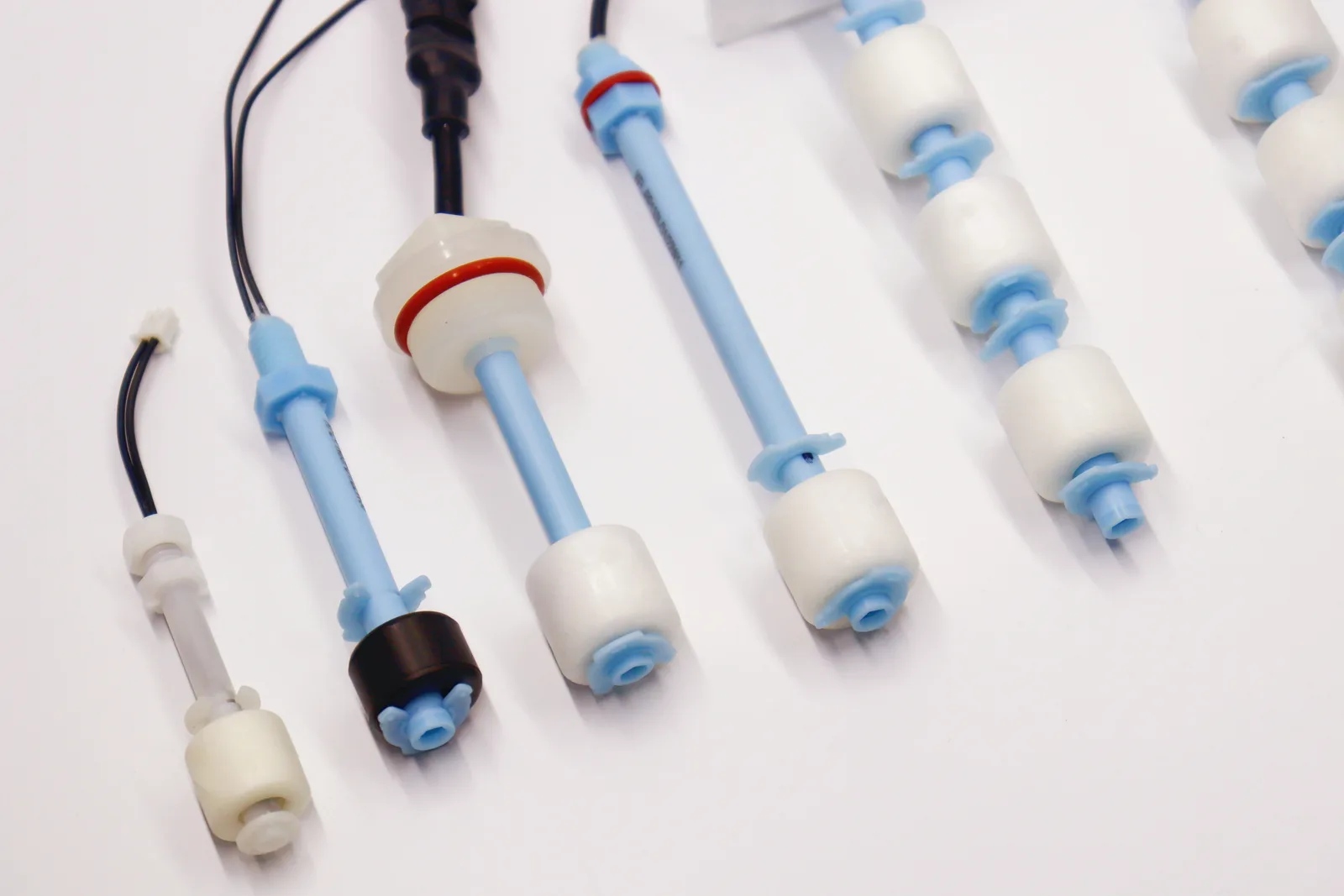
Select a float level switch by answering four questions: (1) Mounting: top/bottom (vertical multi-point) or side-wall (horizontal single-point)? (2) Material: 316L stainless steel for most liquids; PVDF for concentrated acids; PP for alkalis. (3) Switch points: 1–4 setpoints on one vertical guide rod. (4) Process rating: standard is 10 bar / 120°C. If continuous measurement is needed instead of switching, upgrade to a magnetostrictive sensor.
How Float Level Switches Work
A float level switch uses a permanent magnet sealed inside a buoyant float. The float slides along a stainless steel or PVDF guide tube. When the liquid level rises, the float rises with it. At the setpoint position, the magnetic field of the float actuates a hermetically sealed reed switch inside the guide tube, opening or closing the electrical circuit without any mechanical contact between the float and the switching element.
This contactless switching principle means the reed switch is isolated from the process fluid — there are no seal failures possible at the switch point. The only wetted component is the float and guide tube material, making material selection the most critical engineering decision in float switch specification.
Vertical vs Horizontal Float Switches
| Parameter | Vertical Float Switch | Horizontal Float Switch |
|---|---|---|
| Mounting | Top or bottom tank nozzle | Side-wall tank nozzle |
| Switch points | 1–4 on one sensor body | 1 per switch |
| Measurement range | 50–6,000 mm | Single point only |
| Best for | Pump control, multi-level alarm, limited side-wall access | Simple high or low alarm, compact installation |
| Typical output | SPST / SPDT reed switch per point; NPN/PNP available | SPST reed switch or microswitch |
| Installation | Single tank penetration for all switch points | One nozzle per switch level required |
Material Selection Guide
The wetted materials (float and guide tube/body) must be chemically compatible with the process liquid at the operating temperature and pressure. Use this guide for initial material selection — always verify with a full chemical compatibility chart for your specific liquid concentration and temperature.
| Material | Best for | Temperature Limit | Avoid |
|---|---|---|---|
| 316L Stainless Steel | Water, oils, cooling fluids, mild acids (pH 4–10), food & beverage | 120°C (standard) / 150°C (HT) | Chlorides >200 ppm, concentrated HCl/HF |
| PVDF | Concentrated acids (HCl, HF, H₂SO₄), chlorine, solvents, aggressive chemicals | 80°C | Strong alkalis, ketones, esters |
| PP (Polypropylene) | Alkalis, weak acids, wastewater, general chemical service | 60°C | Aromatic hydrocarbons, oxidising acids |
| PTFE-coated 316L | Most aggressive chemical applications | 100°C | Physical abrasion that damages coating |
Float Switch vs Magnetostrictive: Which Level Technology?
├── Yes → Float level switch ✓
└── No → Need continuous 4–20 mA output
├── Short range < 300 mm → Optical or float switch + analog encoder
└── Any range → Magnetostrictive level sensor ✓
Multiple setpoints needed?
├── 1–4 points → Multi-point vertical float switch ✓
└── 5+ points or graduated reading → Magnetostrictive sensor ✓
Liquid is foam-heavy or turbulent?
├── Yes → Float switch with stilling tube + time delay relay ✓
└── Severe foam → Guided wave radar or magnetostrictive
How to Size a Float Level Switch: 5 Key Parameters
Provide these five parameters when ordering to ensure correct sensor specification:
- Tank height and switch point positions: Measure from the tank bottom to each alarm setpoint in mm.
- Process connection: Thread size (G1/2", G3/4", G1", G1¼", flange DN25/DN50) and position (top, bottom, or side).
- Wetted materials: Float material and guide tube material based on liquid compatibility table above.
- Process conditions: Maximum operating temperature (°C) and pressure (bar).
- Output signal: Reed switch (SPST/SPDT), NPN open-collector, PNP open-collector, or analog transmitter.
Common Applications and Configurations
| Application | Configuration | Material | Switch Points |
|---|---|---|---|
| Water tank pump control | Vertical, top-mount | 316L SS | 2 (pump-on / pump-off) |
| CDU coolant expansion tank alarm | Vertical, top-mount | 316L SS | 2 (low alarm / low-low shutdown) |
| Chemical dosing tank | Vertical, top-mount | PVDF | 3 (high / low / low-low) |
| Oil reservoir level | Vertical, top-mount | 316L SS | 2 (high / low) |
| Wastewater sump pump | Vertical, bottom-mount or horizontal | PP | 2 (pump-on / pump-off) |
| Battery coolant tank (EV) | Vertical, top-mount | 316L SS or PVDF | 3 (high / low / low-low) |
Frequently Asked Questions
A float level switch is a liquid level detection device that uses a buoyant float mounted on a guide rod. As the liquid level changes, the float moves with it. A permanent magnet inside the float actuates a reed switch sealed inside the guide tube, providing a discrete on/off signal when the liquid reaches the switch setpoint.
A vertical float switch mounts from the top or bottom of the tank and can have 1–4 switch points on one sensor body. A horizontal float switch mounts through the side wall for single-point alarms. Use vertical for multi-point control with one tank penetration; use horizontal for simple side-wall single-point mounting.
316L stainless steel for water, oils, and most industrial liquids. PVDF for concentrated acids, chlorine, and aggressive solvents. PP for alkalis and wastewater. PTFE-coated for the most aggressive chemical applications. Always verify chemical compatibility at your operating temperature and concentration.
A vertical float switch guide rod can accommodate 1 to 4 reed switches at different positions, providing high-high, high, low, and low-low levels in a single tank penetration. For more than 4 setpoints or continuous level output, a magnetostrictive sensor is the better choice.
Standard 316L stainless steel float switches are rated to 120°C and 10 bar. High-temperature versions reach 150°C and 40 bar. PVDF float switches are limited to 80°C. Rated pressure decreases as temperature increases — verify the combined rating from the datasheet for your specific operating conditions.
A float switch uses a mechanical float buoyed by the liquid — it works on any liquid denser than the float. An optical sensor uses infrared light refraction — faster response, no moving parts, but affected by colored, opaque, or film-forming liquids. Float switches are more universally applicable; optical sensors suit clean, transparent liquids in tight spaces.
Float switches can experience false triggering in foaming or turbulent liquids. Solutions: install a stilling tube around the guide rod to dampen wave action, or add a 5–30 second time delay to the relay output to ignore transient float movements. For severe turbulence, consider guided wave radar or magnetostrictive sensors with built-in wave-filtering algorithms.