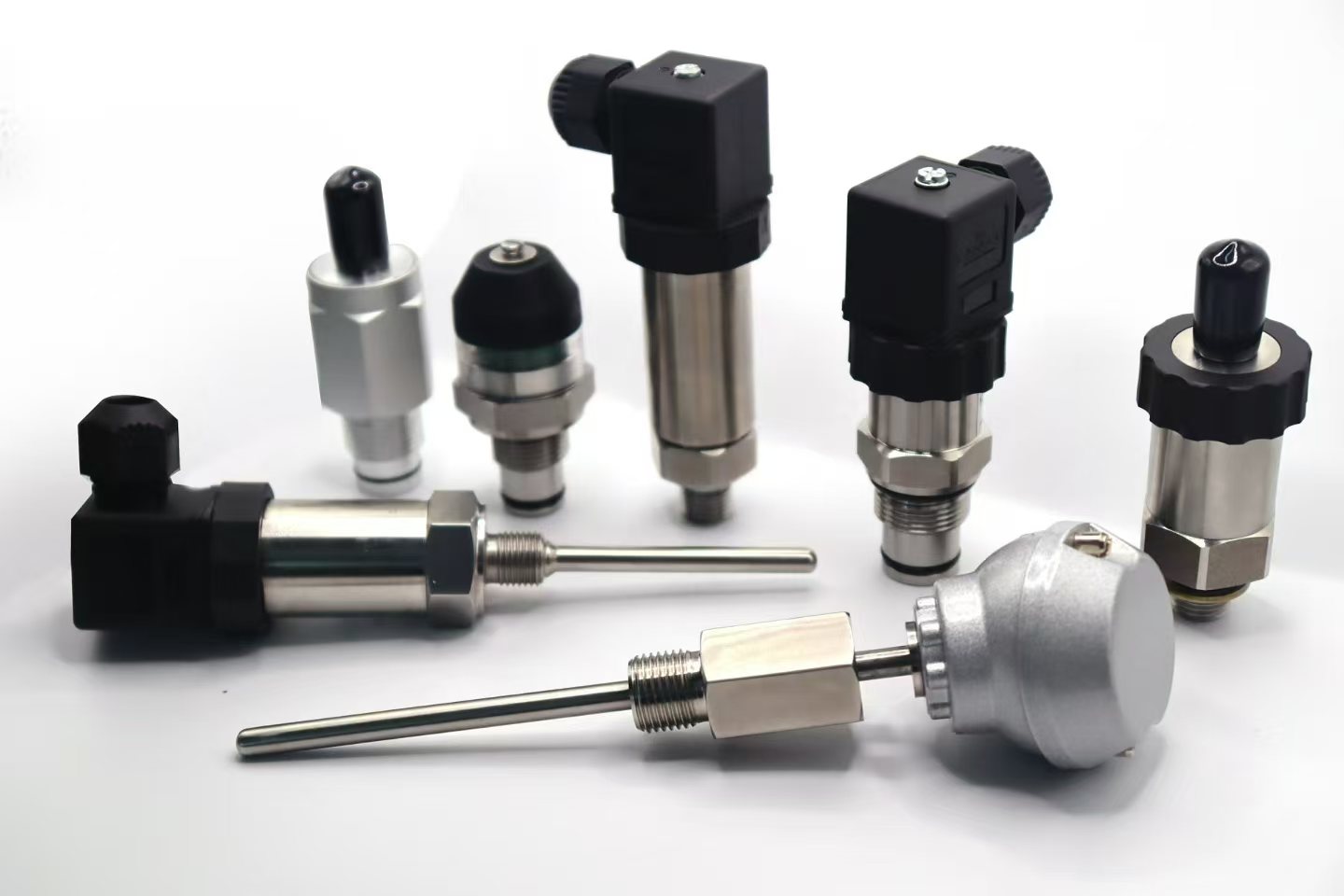
316L stainless steel is 316 stainless with the carbon limited to 0.030%. Chromium (16–18%) gives the passive film, nickel (10–14%) keeps the structure austenitic and tough, and molybdenum (2–3%) is what separates it from 304: it makes the film far more resistant to chlorides. Sensor makers use 316L for diaphragms, probes and process connections because those parts touch the process medium, are often welded, and must not corrode or drift over years of service.
What is 316L stainless steel made of?
316L is defined by its chemistry. The limits below are taken from ASTM A240 (plate, sheet and strip); the international designation system is ISO 15510, where 316L corresponds to X2CrNiMo17-12-2 (EN 1.4404). The comparison with 304 and standard 316 shows which element does which job.
| Element (wt %) | 304 (S30400) | 316 (S31600) | 316L (S31603) | What it does in a sensor |
|---|---|---|---|---|
| Carbon (C), max | 0.07 | 0.08 | 0.030 | Low carbon keeps welded diaphragms and probes free of intergranular corrosion |
| Chromium (Cr) | 17.5–19.5 | 16.0–18.0 | 16.0–18.0 | Forms the Cr₂O₃ passive film that makes the steel "stainless" |
| Nickel (Ni) | 8.0–10.5 | 10.0–14.0 | 10.0–14.0 | Stabilizes the austenitic structure: tough, ductile, essentially non-magnetic when annealed |
| Molybdenum (Mo) | — | 2.00–3.00 | 2.00–3.00 | Raises resistance to pitting and crevice corrosion in chloride media |
| Nitrogen (N), max | 0.10 | 0.10 | 0.10 | Small contribution to strength and pitting resistance |
Source: ASTM A240 composition limits. Mn ≤2.00%, Si ≤0.75%, P ≤0.045%, S ≤0.030% apply to all three grades. Always check the mill certificate of the actual heat.
Why do sensor manufacturers use 316L for wetted parts?
Because the wetted parts of a sensor — the diaphragm of a pressure transmitter, the probe of a submersible level transmitter, the float of a level switch — are in permanent contact with the process medium, and any corrosion changes the measurement before it causes a leak. 316L combines three properties that matter for that job:
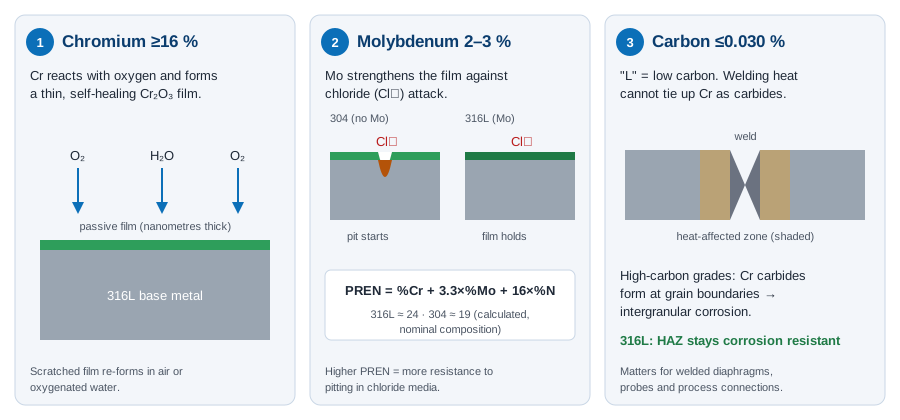
- Passive film from chromium. With at least 16% Cr, the surface forms a chromium-oxide layer only nanometres thick that re-forms by itself in air or oxygenated water after a scratch.
- Chloride resistance from molybdenum. Tap water, cooling water, wastewater and many cleaning solutions contain chlorides. Molybdenum makes the passive film much harder for chloride ions to break locally, so pits do not start as easily as on 304.
- Weldability from low carbon. Diaphragms, probe caps and process connections are usually welded. Heating standard-carbon steel through roughly 450–850 °C lets chromium carbides form at grain boundaries (sensitization), leaving chromium-depleted zones that corrode. At ≤0.030% carbon there is too little carbon for this to happen in normal welding.
Two secondary benefits matter for instruments: annealed 316L is essentially non-magnetic, so it does not disturb magnetic sensing principles, and its high nickel content gives good toughness for thin, repeatedly flexed diaphragms.
How is the pitting resistance of 316L calculated?
Pitting resistance is compared with the Pitting Resistance Equivalent Number (PREN), an empirical index widely used alongside laboratory tests such as ASTM G48 (ferric chloride pitting and crevice tests):
PREN = %Cr + 3.3 × %Mo + 16 × %N
Worked example (calculated value, nominal composition, not a test result):
- 316L with 17.0% Cr, 2.1% Mo, 0.05% N → 17.0 + 3.3 × 2.1 + 16 × 0.05 = 17.0 + 6.9 + 0.8 = 24.7
- 304 with 18.0% Cr, 0% Mo, 0.05% N → 18.0 + 0 + 0.8 = 18.8
The roughly six-point gap comes almost entirely from molybdenum. A higher PREN means better resistance to pitting in chloride water, but PREN is only a ranking tool: temperature, chloride concentration, pH, oxygen and crevices decide the real outcome.
316L vs 316 vs 304: which should a sensor use?
| Situation | Suitable grade | Reason |
|---|---|---|
| Wetted diaphragm or probe in water, wastewater, cooling water | 316L | Chloride resistance from Mo; welds stay resistant |
| Food, beverage or pharmaceutical process (CIP) | 316L, polished | Cleanable, weldable surface; hygienic connections |
| Housing inside a hydraulic cylinder (clean oil, no chlorides) | 304 can be adequate | Mineral hydraulic oil is not corrosive to 304 |
| Welded part where 316 is specified | 316L | Same corrosion resistance plus weld safety; plate and bar are often dual-certified 316/316L |
| Strong acids (HCl, H₂SO₄, HNO₃) or NaOH >30% | Not 316L — Hastelloy C or PVDF | Passive film is attacked; diaphragm fails early |
SEGMENsensor follows the same logic: in-cylinder magnetostrictive position sensors (SGM-PF10, PF20, PR40, PR50) use 304 stainless housings because they sit in hydraulic oil, while every product that touches water or process liquid uses 316L wetted parts.
Where does 316L stainless steel reach its limits?
316L is not a universal material. It is a poor choice for hydrochloric acid, hot concentrated sulfuric acid and strong caustic, and warm, concentrated chloride brines can cause pitting, crevice corrosion or chloride stress-corrosion cracking. Stagnant seawater in tight crevices (under gaskets, in threads) is a known risk. In those cases specify an alternative wetted material and tell the sensor supplier the exact medium, concentration and temperature.
Which SEGMENsensor sensors use 316L?
| Product | 316L part | Published parameters | Alternative materials |
|---|---|---|---|
| 4–20 mA pressure transmitter | Diaphragm and housing | 0–0.1 to 0–400 bar, ±0.25% FS (±0.1% FS high-accuracy), IP67; standard 316L for pH 4–10, water, oil, hydraulic fluids, fuels | Hastelloy C or PVDF-coated flush diaphragm; hygienic 316L flush diaphragm with tri-clamp or DIN 11851, Ra ≤0.8 µm |
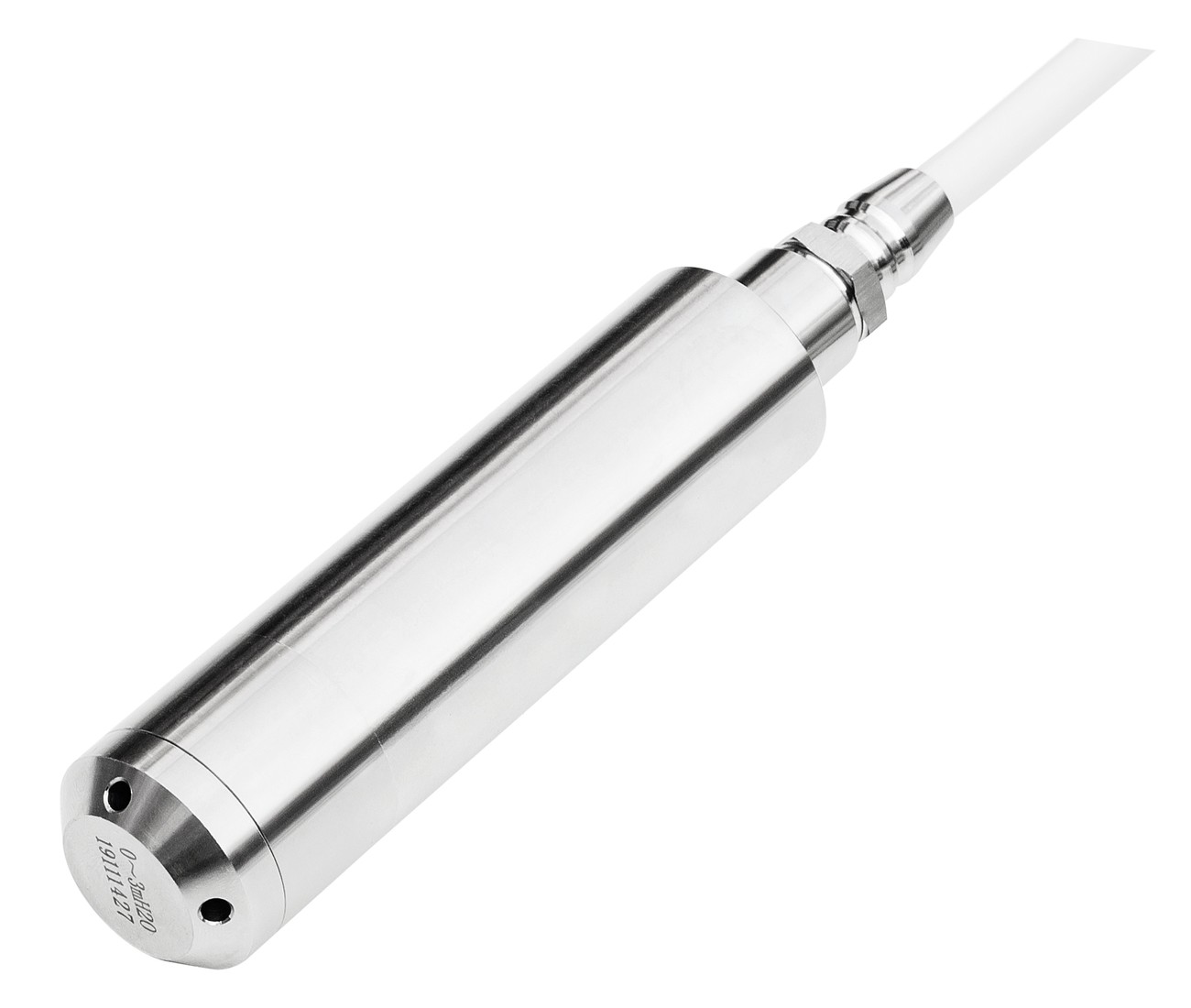
| Submersible level transmitter | Probe | 4–20 mA, ±0.1% FS standard, IP68 | PTFE cable for chemical media |
| Float level switch | Float | 316L float −20 °C to +120 °C, IP68, reed switch output | PP or PVDF float |
Material is one part of a specification; enclosure rating is another — see IP67 vs IP68 vs IP69K. To size a range after choosing the material, use the pressure unit converter or the hydrostatic level calculator, and for range and output choices read the 4–20 mA pressure transmitter selection guide. If a stainless target is being detected by an inductive sensor, note that sensing distance depends on target material — see proximity sensor sensing distance.
Not sure if 316L suits your medium?
Send the medium, concentration, temperature and pressure range. Our engineers confirm the wetted material before quotation. Qualification samples 1–5 pcs in 5–7 working days · reply within 24 hours.
Frequently Asked Questions
L means low carbon. 316L is limited to 0.030% carbon, compared with 0.08% for standard 316. The lower carbon prevents chromium carbides from forming at grain boundaries during welding, so the weld heat-affected zone keeps its corrosion resistance.
For parts that touch water or process liquids, yes. 316L contains 2–3% molybdenum, which 304 does not, so it resists chloride pitting much better (PREN about 24 versus about 19, calculated). For housings in clean hydraulic oil, 304 can be adequate.
In the annealed condition 316L is austenitic and essentially non-magnetic. Heavy cold working or welding can make it slightly magnetic, but much less so than ferritic or martensitic stainless steels.
316L handles flowing seawater and splash zones far better than 304, but stagnant seawater, warm brine and tight crevices can still cause pitting or crevice corrosion. Tell the supplier the chloride level and temperature so the wetted material can be confirmed per project.
For strong acids such as H₂SO₄, HCl and HNO₃, or strong alkalis such as NaOH above 30%. SEGMENsensor then specifies a Hastelloy C diaphragm or a PVDF-coated flush diaphragm; standard 316L is used for water, oil, hydraulic fluids, fuels and media of pH 4–10.
Give the medium and its concentration, process temperature, pressure range, any cleaning chemicals, and whether a hygienic connection is required. SEGMENsensor engineers confirm the material and model and reply within 24 hours; qualification samples are 1–5 pcs in 5–7 working days, and production lead time is confirmed with the quotation.
Last updated · SEGMENsensor Engineering Team