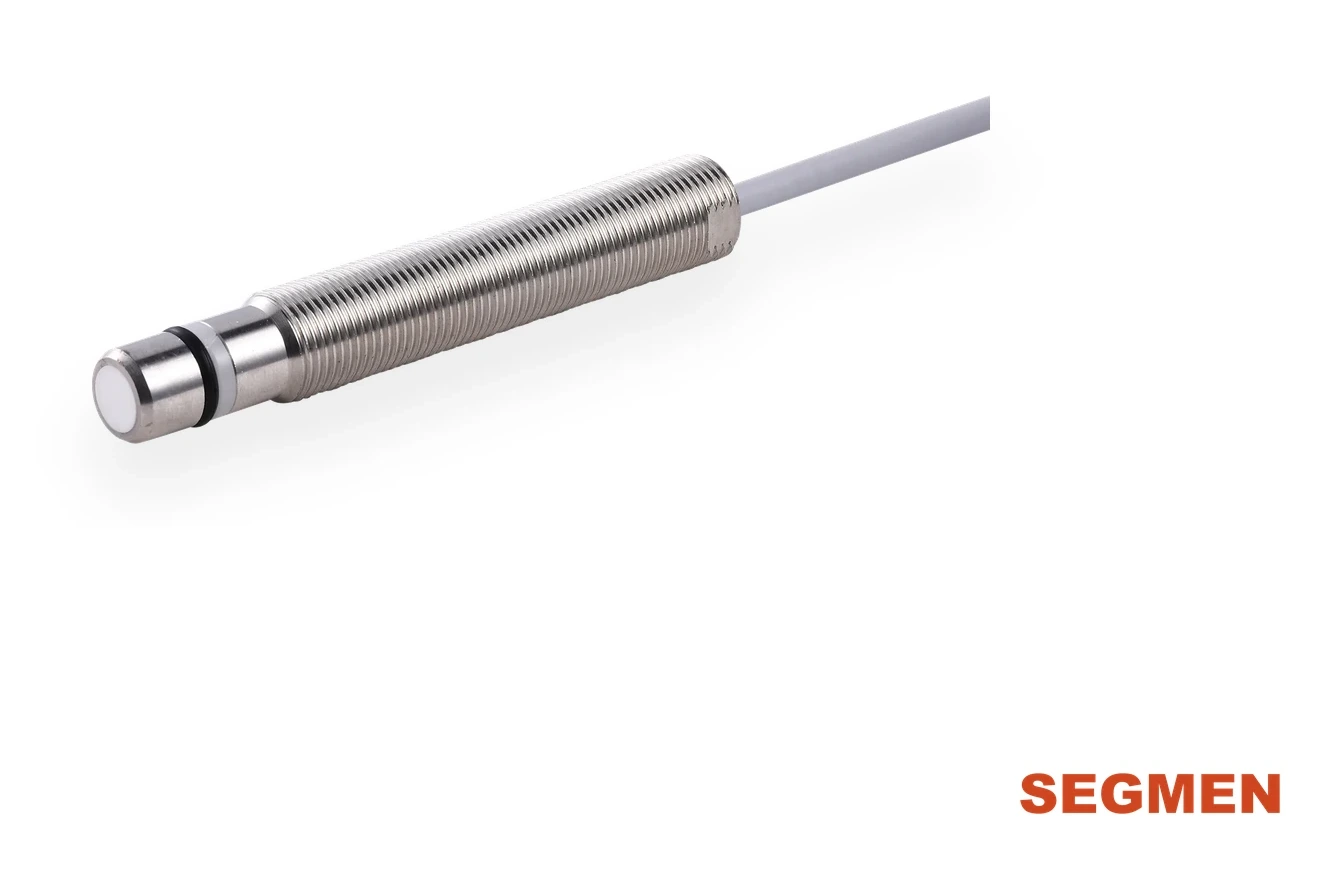
IP67 means dust-tight and protected against temporary immersion (1 m, 30 minutes). IP68 means dust-tight and protected against continuous immersion at a depth and time the manufacturer specifies. IP69K means dust-tight and protected against high-pressure, high-temperature washdown jets. Choose by exposure: submersion calls for IP68, hot pressure-washing calls for IP69K, and a sensor exposed to both needs both codes.
What do the two digits of an IP code mean?
The first digit rates protection against solid objects and dust; the second rates protection against water. The values that matter for industrial sensors are:
| Digit | Meaning | Test in short |
|---|---|---|
| First digit 5 (IP5X) | Dust-protected: some dust may enter, not enough to impair operation | Dust chamber |
| First digit 6 (IP6X) | Dust-tight: no dust ingress | Dust chamber with vacuum inside the enclosure, up to 8 h |
| Second digit 5 (IPX5) | Water jets | 6.3 mm nozzle, 12.5 L/min, from 3 m |
| Second digit 6 (IPX6) | Powerful water jets | 12.5 mm nozzle, 100 L/min, from 3 m |
| Second digit 7 (IPX7) | Temporary immersion | 1 m depth, 30 min |
| Second digit 8 (IPX8) | Continuous immersion | Depth and duration stated by the manufacturer, more severe than IPX7 |
| Second digit 9K (IPX9K) | High-pressure, high-temperature jets | 80 °C water, 80–100 bar, 100–150 mm, four angles |
Digits 0–8 are specified in IEC 60529 — Degrees of protection provided by enclosures (IP Code) ↗. The suffix “K” and the 9K jet test come from ISO 20653 — Road vehicles: degrees of protection (IP code) ↗, which replaced the German DIN 40050-9 and is also used for industrial washdown equipment.
IP67 vs IP68 vs IP69K: how do the tests compare?
| Rating | Standard | Water exposure | What it does not prove | Typical sensor use |
|---|---|---|---|---|
| IP67 | IEC 60529 | Immersion 1 m for 30 min | Long-term submersion; jets | Machines, outdoor installations, occasional flooding |
| IP68 | IEC 60529 | Continuous immersion, depth and time stated by the manufacturer | Jets, unless also marked IPX5/IPX6/IPX9K | Submersible level transmitters, sumps, wells, tanks |
| IP69K | ISO 20653 | 80 °C water at 80–100 bar from 100–150 mm | Immersion, unless also marked IPX7/IPX8 | Equipment cleaned with hot pressure washers |
Is IP69K better than IP68?
No — they test different things. IP68 proves that water does not get in under long, static immersion; IP69K proves that water does not get in under a short, hot, high-energy jet. A seal that resists one may fail the other, which is why IEC 60529 treats ratings above IPX6 as non-cumulative and why sensors for washdown areas are often marked with two codes, for example IP67/IP69K.
Which IP rating does a sensor need?
Start from the worst water exposure at the mounting point, then check the cable or connector as well as the housing: the code applies to the complete assembly, and a connector reaches its rating only when it is mated with a sealed counterpart.
| Exposure at the sensor | Rating to specify | Check as well |
|---|---|---|
| Splashes, rain, condensation | IP67 | Cable entry and connector sealing |
| Pit or channel that floods now and then | IP67 (IP68 if water can stand for hours) | Expected depth and duration |
| Permanent submersion in a tank, well or sump | IP68 with stated depth ≥ maximum liquid depth | Vented cable for gauge measurement, cable material vs medium |
| Cleaning with hot pressure washers | IP69K | Add IP67/IP68 if the sensor can also be submerged |
| Sensing face inside a hydraulic cylinder | IP code is not the deciding value | Rated pressure of the sensing face (bar) |
Worked example: what pressure does submersion put on the seal?
Static water pressure on a submerged sensor is p = ρ × g × h. Calculated values (not test data):
- IPX7 test depth 1 m: p = 1000 kg/m³ × 9.81 m/s² × 1 m ≈ 9.8 kPa ≈ 0.1 bar.
- A level transmitter at the bottom of a 3 m tank: p ≈ 29.4 kPa ≈ 0.29 bar — about three times the IPX7 test, and permanent. It needs IP68 stated for at least 3 m.
- A sensor in a hydraulic cylinder at 500 bar sees roughly 1700 times the 3 m tank pressure. No IP test covers this; a pressure-rated sensing face does.
The 80–100 bar of the IP69K test is the water pressure at the nozzle, not a static pressure on the housing, so IP69K is not a pressure rating either. Convert between bar, kPa and psi with the pressure unit converter.
Not sure which protection rating your application needs?
Tell us where the sensor is mounted, how it is cleaned and whether it can be submerged. We will propose a sensor and sealing concept. OEM volume supply · qualification samples of 1–5 pcs in 5–7 working days · production lead time confirmed with the quotation · reply within 24 hours.
What IP ratings do SEGMENsensor sensors have?
| SEGMENsensor product | Published protection | Note |
|---|---|---|
| High-pressure inductive proximity sensor (M8 / M12) | IP67 and IP69K | Rated 500 bar, ceramic sensing face; -25 °C to +70 °C |
| Inductive proximity sensors | IP67 (per model) | M8 / M12 / M18 / M30 housings |
| Photoelectric sensors | IP67 (barrel and rectangular); IP50 (slot types) | M12 / M18 / M30 and rectangular housings |
| Submersible level transmitter | IP68, permanent submersion | 316L stainless steel probe, vented cable |
| Liquid level sensors | IP67 or IP68 (per model) | IP68 for submersible types |
The protection code of each model is on its data sheet; for a project we confirm it in the quotation. For hydraulic applications read hydraulic cylinder proximity sensors for high pressure and hot oil; for submerged level measurement read why a submersible level sensor needs a vent tube; for sensor families see types of proximity sensors.
Frequently Asked Questions
Both are dust-tight. IP67 is tested by immersion at 1 m for 30 minutes. IP68 means continuous immersion under conditions the manufacturer states, which must be more severe than IP67, so always read the stated depth and duration.
The K marks the special test conditions defined for road vehicles, first in DIN 40050-9 and now in ISO 20653. IPX9K uses 80 °C water at 80–100 bar and 14–16 L/min from 100–150 mm, for 30 seconds at each of four angles.
An IP68 product is normally also suitable for IPX7 immersion, but water ratings above IPX6 are not cumulative: IP68 does not prove resistance to water jets or IP69K washdown. A product that passed several tests carries several codes, such as IP67/IP69K.
Not necessarily. IP69K covers short, hot, high-pressure jets, not immersion. If the sensor can also be submerged, specify IP67 or IP68 as well.
No. The 80–100 bar in the IP69K test is the nozzle pressure of a cleaning jet. A sensor whose face sits in hydraulic oil needs a rated operating pressure, such as the 500 bar of SEGMENsensor M8 and M12 high-pressure inductive sensors.
Most SEGMENsensor proximity and photoelectric sensors are IP67, M8 and M12 high-pressure inductive sensors are IP67 and IP69K, and submersible level transmitters are IP68 for permanent submersion. Qualification samples of 1–5 pcs ship in 5–7 working days, quotations are FOB China, and we reply within 24 hours.