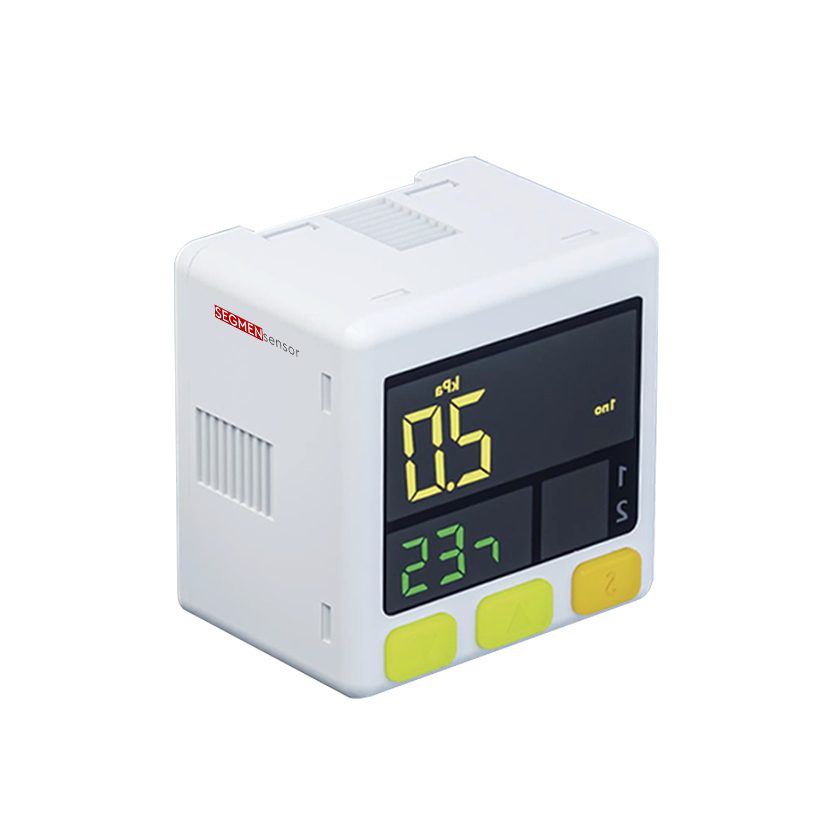
Gauge pressure (bar(g), psig) is pressure above the local atmosphere, so a vented sensor reads 0 when open to air. Absolute pressure (bar(a), psia) is measured from a perfect vacuum. Sealed gauge is measured from a fixed reference — typically about 1.013 bar — sealed inside the sensor, so it needs no vent but ignores weather and altitude changes.
What reference does each pressure type use?
Every pressure sensor measures the force on a diaphragm. The value it reports depends on what pressure sits on the other side of that diaphragm — the reference. There are three common choices:
- Absolute (A) — the back of the diaphragm faces a sealed vacuum. The reading starts at true zero and includes the atmosphere. Units: bar(a), kPa(a), psia.
- Vented gauge (G) — the back of the diaphragm is open to the surrounding air through a vent hole, a breathable membrane or a vent tube in the cable. The atmosphere cancels out, so the reading is the pressure above ambient. Units: bar(g), psig.
- Sealed gauge (S, SG) — the back of the diaphragm is closed off at a fixed pressure, normally close to one standard atmosphere. It reads 0 at that reference pressure, not at the actual ambient pressure. It is sometimes marked “psis” or “bar(s)”.
The SI definition of the pascal and the value of the standard atmosphere (1 atm = 101.325 kPa) are given in NIST Special Publication 811; the same sea-level value is the basis of the ISO 2533 standard atmosphere.
How do you convert between gauge, absolute and sealed gauge?
All three are linked by two simple equations, where Patm is the actual local atmospheric pressure and Pref is the pressure sealed inside the sensor:
| Conversion | Formula |
|---|---|
| Gauge → absolute | Pabs = Pgauge + Patm |
| Sealed gauge reading | Psealed = Pabs − Pref |
| Sealed gauge vs true gauge | Psealed = Pgauge + (Patm − Pref) |
The term (Patm − Pref) is zero only when the local atmosphere happens to equal the sealed reference. Everywhere else it is a fixed offset in the reading. Use our free pressure unit converter to move between bar, psi, kPa and MPa.
Worked example: sealed gauge sensor at 1,500 m altitude
- The sensor is sealed at 1.013 bar (one standard atmosphere).
- Installed at 1,500 m, the standard atmosphere is about 0.846 bar.
- Offset = Patm − Pref = 0.846 − 1.013 = −0.167 bar.
- A line at a true 10.000 bar(g) is read as about 9.833 bar — 1.7% FS low on a 0–10 bar range.
- A vented gauge sensor at the same place reads 10.000 bar(g); an absolute sensor reads 10.846 bar(a).
How much does altitude change the reading?
The table uses the standard atmosphere model (ISO 2533). Real weather moves sea-level pressure up or down by a few tens of millibar on top of these values.
| Altitude | Standard atmosphere | Same in psi | Sealed gauge offset (ref. 1.013 bar) |
|---|---|---|---|
| 0 m (sea level) | 1.013 bar | 14.70 psi | 0 mbar |
| 500 m | 0.955 bar | 13.85 psi | about −59 mbar |
| 1,000 m | 0.899 bar | 13.04 psi | about −115 mbar |
| 1,500 m | 0.846 bar | 12.26 psi | about −168 mbar |
| 2,000 m | 0.795 bar | 11.53 psi | about −218 mbar |
| 3,000 m | 0.701 bar | 10.17 psi | about −312 mbar |
Gauge vs absolute vs sealed gauge: comparison table
| Criterion | Vented gauge | Absolute | Sealed gauge |
|---|---|---|---|
| Reference | Local atmosphere | Perfect vacuum | Fixed pressure sealed at manufacture |
| Reads open to air (sea level) | 0 | ≈ 1.013 bar(a) | ≈ 0 |
| Follows weather and altitude | Yes — cancels them out | Includes them in the value | No — they appear as an offset |
| Needs a vent path | Yes (hole, membrane or vent tube) | No | No |
| Can read below atmosphere | Yes, as negative gauge | Yes, always positive | Yes, as negative values |
| Best fit | Low and medium ranges, tank level, pumps, compressed air | Vacuum, gas density, barometric, altitude-independent readings | High ranges, wet or wash-down locations where a vent could let in water |
When should you use sealed gauge instead of vented gauge?
Use sealed gauge when the range is high enough that the atmospheric offset is negligible and a vent would be a liability. On a 0–400 bar hydraulic line a 30 mbar weather swing is 0.0075% FS — far below a ±0.25% FS accuracy class — and a sealed reference keeps water, oil mist and wash-down spray out of the sensor. On a 0–1 bar range the same swing is 3% FS, so vented gauge or absolute is the right choice.
| Full-scale range | 30 mbar weather swing | 168 mbar offset (1,500 m) |
|---|---|---|
| 0–1 bar | 3% FS | 16.8% FS |
| 0–10 bar | 0.3% FS | 1.68% FS |
| 0–100 bar | 0.03% FS | 0.168% FS |
| 0–400 bar | 0.0075% FS | 0.042% FS |
A sealed reference volume also follows the gas law: at constant volume its pressure rises with absolute temperature. Without compensation, warming an air-filled reference from 20 °C to 30 °C raises it by about 3.4%, roughly 35 mbar. That is another reason sealed gauge is reserved for higher ranges.
Why do submersible level sensors use vented gauge?
Hydrostatic level is calculated from the pressure of the liquid column above the sensor, and 1 m of water is only about 98 mbar. Atmospheric changes of tens of millibar would show up as several centimetres of false level, so a submersible level transmitter uses a vent tube inside its cable to keep the back of the diaphragm at true atmosphere. See our submersible level transmitters and the hydrostatic level calculator.
Not sure which reference to specify?
Send us the medium, range, installation altitude and whether the sensor can breathe to atmosphere. We will confirm gauge, absolute or differential for your application. MOQ 1 pc · samples in 5–7 working days · production 3–5 weeks · reply within 24 hours.
Which pressure references does SEGMENsensor offer?
SEGMENsensor pressure transmitters are built in gauge, absolute and differential configurations from 0–0.1 bar to 0–400 bar, with ±0.25% FS standard accuracy or ±0.1% FS on the high-accuracy version, and 4-20 mA 2-wire, 0-10 V or RS485 output. For a sealed or wash-down installation, state the reference you need in your enquiry and our engineers will confirm the configuration. For gauge vs absolute vs differential selection in more depth, read Gauge vs Absolute vs Differential Pressure Transmitter; for output types see Pressure Transducer vs Pressure Transmitter. Performance terms such as accuracy and hysteresis are defined in IEC 60770-1.
Frequently Asked Questions
Sealed gauge pressure is measured against a fixed reference pressure, usually close to one standard atmosphere (1.013 bar), that is sealed inside the sensor during manufacture. It reads like gauge pressure but does not follow changes in local atmospheric pressure caused by weather or altitude.
No. psig is pressure above the actual local atmosphere, measured by a vented sensor. Sealed gauge, sometimes written psis, is pressure above a fixed sealed reference. The two agree only when the local atmosphere equals the sealed reference pressure.
Add the local atmospheric pressure: psia = psig + Patm. At sea level under standard conditions Patm is about 14.7 psi, so 20 psig is about 34.7 psia. At altitude use the lower local value, for example about 12.3 psi at 1,500 m.
When the atmospheric offset is small against the range. A 30 mbar weather swing is 0.0075% of a 0–400 bar range but 3% of a 0–1 bar range. Sealed gauge suits high-pressure hydraulics; low ranges and level measurement need vented gauge or absolute.
It turns into an unintended sealed gauge sensor. The trapped air no longer follows the atmosphere and expands or contracts with temperature, so the zero drifts. Keep vent holes, membranes and cable vent tubes open and dry.
SEGMENsensor pressure transmitters cover 0–0.1 bar to 0–400 bar in gauge, absolute and differential configurations at ±0.25% FS or ±0.1% FS. MOQ is 1 piece, samples ship in 5–7 working days, production takes 3–5 weeks and quotations are FOB China, with a reply within 24 hours.