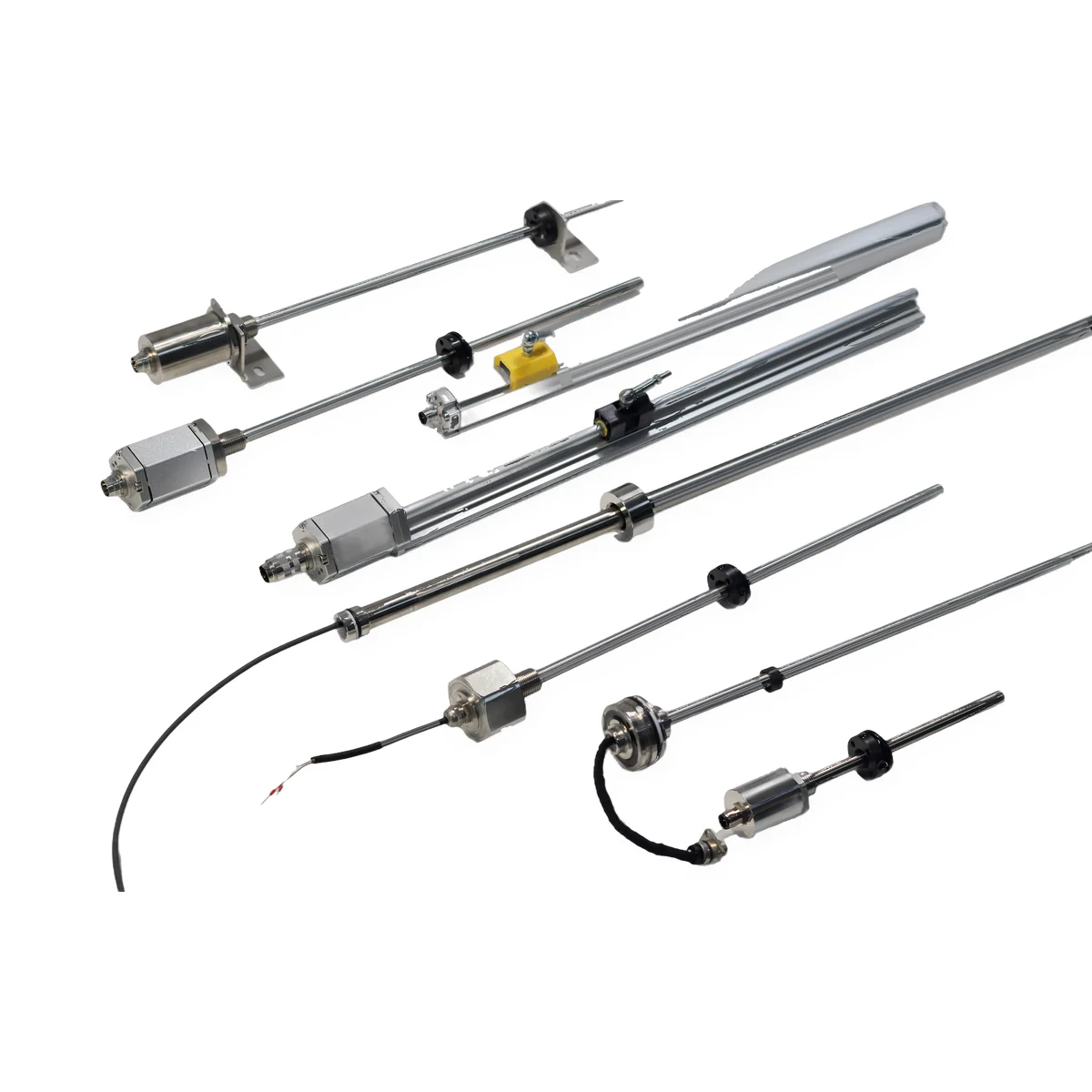
A null zone is the inactive length at the head (mounting) end of a linear position sensor, and a dead zone is the inactive length at the far end. Inside either zone the position magnet produces no valid reading, so the stroke you need must fit entirely between them. When you size a sensor, add both zones to the measuring range to get the rod or profile length, and make sure the magnet never travels into them.
What are the null zone and dead zone on a linear position sensor?
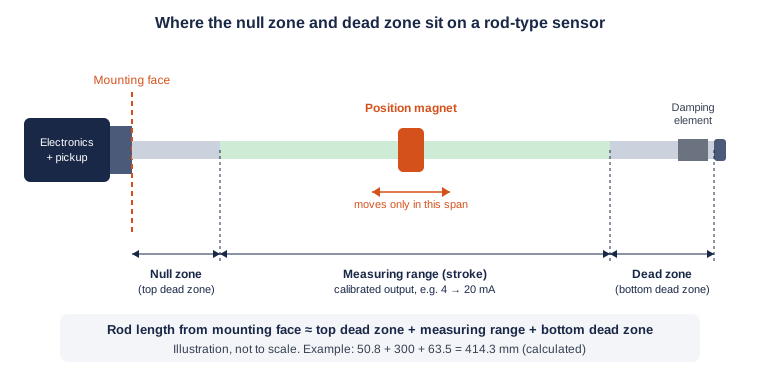
They are the two unmeasured lengths at either end of the sensing element. On a rod-type magnetostrictive sensor the null zone runs from the mounting face (thread or flange face) to the first point of the measuring range, and the dead zone runs from the last point of the measuring range to the rod tip. Datasheets also call them the top dead zone and bottom dead zone, or the head and tip inactive zones.
| Term | Also called | Where it is | Why it exists |
|---|---|---|---|
| Null zone | Top dead zone, head inactive zone | Mounting face → start of measuring range | Space for the pickup and the transition from the head; the electronics also need a short settling time after each interrogation pulse before a return signal can be read |
| Measuring range | Stroke, electrical stroke | Between the two zones | The calibrated span: output runs from its start value to its end value (for example 4 to 20 mA) |
| Dead zone | Bottom dead zone, damping zone, tip inactive zone | End of measuring range → rod or profile end | Houses the damping element that absorbs the wave so it does not reflect back as a false echo |
Why does a magnetostrictive sensor have a null zone and a dead zone?
Both zones come from how the sensor measures. The electronics send a current pulse down a ferromagnetic waveguide; where the position magnet sits, the Wiedemann effect twists the waveguide and launches a torsional wave that travels back to the pickup in the head. Position is the travel time multiplied by the wave speed, about 2,800 m/s in sensor waveguides.
- Head end (null zone): the pickup, the mounting thread or flange and the transition into the rod occupy length that cannot be measured. A magnet very close to the pickup would return its signal while the electronics are still settling from the current pulse, so the measuring range starts a defined distance away.
- Tip end (dead zone): the wave that runs away from the head must be absorbed, otherwise it reflects from the end and returns as a second, false echo. A damping element at the tip does this, and the magnet cannot be measured over it.
- Result: the calibrated measuring range is the waveguide length minus both zones. The datasheet value for each zone is what the factory guarantees, not just the physical minimum.
The step-by-step measurement is explained in how a magnetostrictive position sensor works.
How do you calculate the rod length from the null zone and dead zone?
Add the three lengths. For rod-type sensors the reference is the mounting face; for profile types it is the end of the profile housing. Always check the result against the dimension drawing of your part number.
Lrod ≈ Ztop + R + Zbottom
Ztop = null zone (top dead zone), R = measuring range, Zbottom = dead zone (bottom dead zone)
Worked example: hydraulic cylinder with 285 mm mechanical stroke
- Choose a measuring range at least as long as the mechanical stroke. SGM-PR40 ranges are ordered in 5 mm steps, so a 285 mm stroke can use R = 285 mm; rounding up to 300 mm leaves margin at both ends.
- Take the published zones for SGM-PR40: Ztop = 50.8 mm, Zbottom = 63.5 mm.
- Lrod ≈ 50.8 + 300 + 63.5 = 414.3 mm from the mounting face (calculated).
- Check the cylinder: the bore in the piston rod must accept this rod length, and at full retraction the magnet must sit at or beyond 50.8 mm from the mounting face, not inside the null zone. Cylinder ports for metric mounting threads such as the M18×1.5 thread are commonly specified to ISO 6149-1; confirm the port form against the sensor drawing.
The same logic applies to level: an SE-LX20 level transmitter with a 1,500 mm measuring range needs a probe of about 100 + 1,500 + 36 = 1,636 mm (calculated, with the bottom dead zone of the chosen float confirmed at order).
What are typical null zone and dead zone lengths?
They depend on the housing and the damping design, so read them from the datasheet of the exact series. The table lists the series standard values published on SEGMENsensor product pages, read from the dimension drawings.
| Series | Type | Top dead zone / null zone (mm) | Bottom dead zone (mm) | Dead-zone options |
|---|---|---|---|---|
| SGM-PR40 | Compact rod | 50.8 | 63.5 | Z9 customer-specified |
| SGM-PR50 | Miniature rod | 27.5 | 36 | Z9 customer-specified |
| SE-PR30 | Intrinsically safe rod | 36 | 58 | Z9 customer-specified |
| SGM-PF20 | Compact embedded | 30 | 36.5 or 63.5 | Standard 30 + 36.5; Z1 30 + 63.5 |
| SGM-PE10 | Profile | 12 | 66 | Z1, Z9 |
| SGM-PE20 | Slim profile | 73 | 73 | Z9 customer-specified |
| SGM-LC10 | Corrosion-resistant level | 24 | 30 | Z9 customer-specified |
| SE-LX20 | Explosion-proof level | 100 | 36 (varies with float) | Quoted on request |
What goes wrong when the null zone or dead zone is ignored?
| Symptom | Likely cause | Fix |
|---|---|---|
| Output stops changing or jumps at full retraction | Magnet enters the null zone at the head end | Move the magnet seat or order a sensor whose measuring range starts closer (custom top dead zone) |
| Output unstable or fault near full extension | Magnet reaches the damping zone at the tip | Order a longer measuring range so the full stroke ends before the dead zone |
| Sensor rod hits the bottom of the piston-rod bore | Rod length calculated from the stroke only, without both zones | Recalculate Lrod = Ztop + R + Zbottom and check the bore depth |
| Tank never reads empty or full | Float cannot reach the lowest or highest level inside the measuring range | Choose the probe length so both levels fall inside the measuring range |
To convert the analogue output back into position across the measuring range, use the 4–20 mA calculator. For in-cylinder mounting, see the SGM-PR10 in-cylinder position sensor and the full magnetostrictive sensor range.
Need a sensor with a specific null zone or dead zone?
Send the mechanical stroke, the space available at both ends, the output your controller needs and the mounting. Our engineers will propose the series and zone option. Qualification samples of 1–5 pcs in 5–7 working days · production lead time and MOQ confirmed with the quotation · FOB China · 100% T/T in advance · reply within 24 hours.
Frequently Asked Questions
Yes. Null zone and top dead zone are two names for the same inactive length at the head end, between the mounting face and the start of the measuring range. SEGMENsensor datasheets use the terms top dead zone and bottom dead zone; the bottom one is what many engineers simply call the dead zone.
The reading is outside the calibrated measuring range, so the output is not specified there and must not be used for control. Depending on the electronics the output may clamp, hold or report an error, so design the mechanics so that the magnet never leaves the measuring range.
Because the far end of the waveguide carries a damping element that absorbs the torsional wave so it does not reflect back as a false echo. A magnet placed over the damping element cannot produce a clean, measurable pulse.
Add the top dead zone, the measuring range and the bottom dead zone. For an SGM-PR40 with a 300 mm range: 50.8 + 300 + 63.5 = 414.3 mm from the mounting face (calculated). Always check the result against the dimension drawing of your part number.
On several SEGMENsensor series, yes: option Z9 orders customer-specified dead zones, SGM-PF20 offers 30 + 36.5 mm or 30 + 63.5 mm, and SGM-PE10 lists option Z1 for short dead zones. Custom dead zones are quoted on request.
Yes. On the SE-LX20 the published top dead zone is 100 mm and the bottom dead zone is 36 mm, which varies with the float. Level cannot be read while the float is inside either zone, so the tank's highest and lowest levels must lie inside the measuring range.