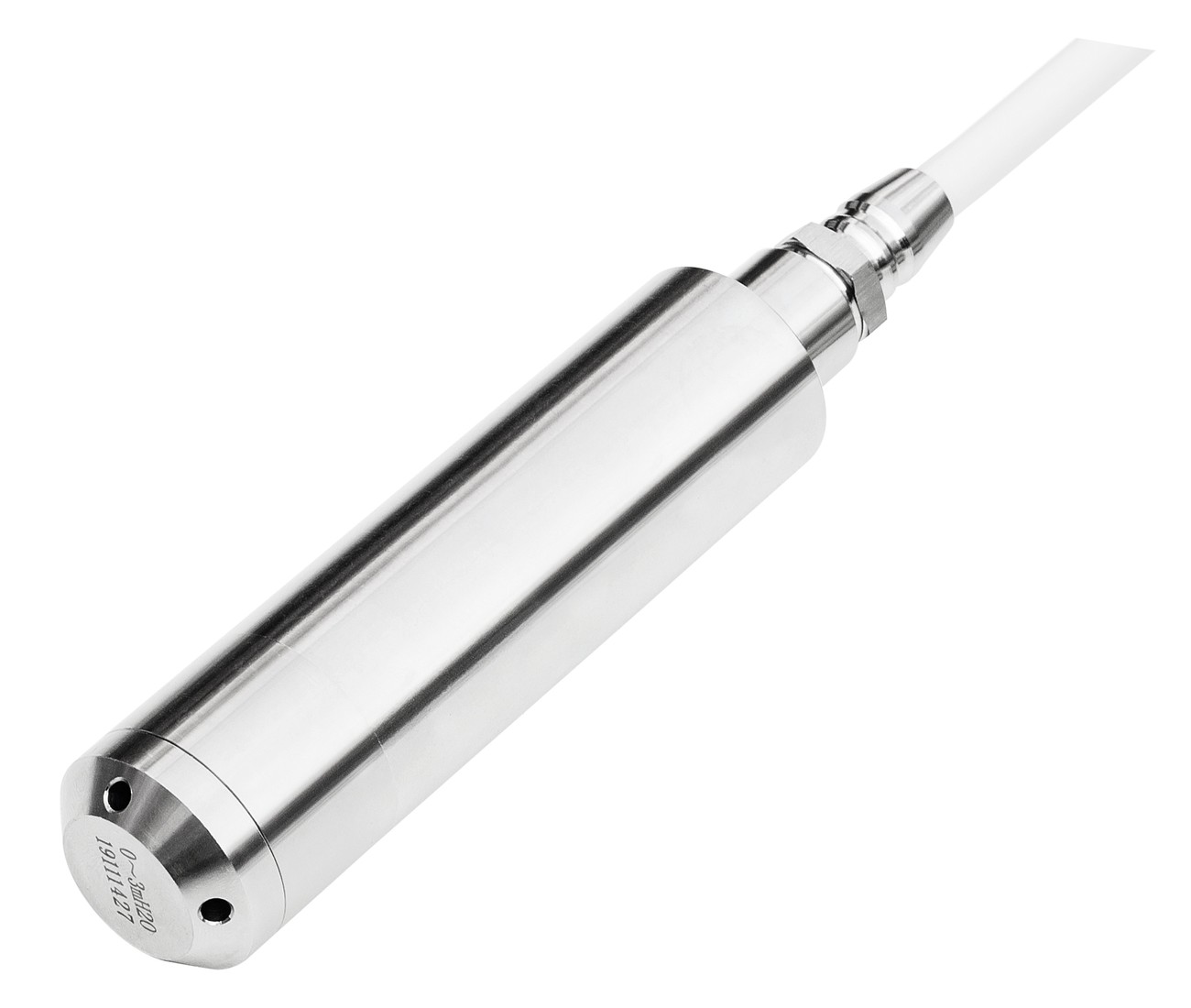
A level transmitter measures liquid level continuously and sends it as a standard signal, most often 4–20 mA, to a PLC, controller or display. It differs from a level switch, which only signals high or low points. The main types are hydrostatic, magnetostrictive, float, ultrasonic, radar and capacitive. See SEGMENsensor liquid level sensors for each type.
This guide is for design engineers, OEM equipment builders and plant engineers who need to specify a level transmitter for a tank, well, sump or process vessel. It defines the term, explains how the signal works, compares the six common measuring principles and gives a step-by-step selection method. SEGMENsensor figures come from our submersible level transmitter, magnetostrictive level transmitter and SEU ultrasonic level sensor pages and datasheets.
What Is a Level Transmitter?
A level transmitter is a level sensor with built-in electronics that turns a continuous level measurement into a standard output signal for a control system. The sensing element detects something that changes with level, such as pressure, the position of a float or the travel time of an echo, and the transmitter converts that into 4–20 mA, 0–10 V or a digital value such as RS485 Modbus.
Three points describe what a level transmitter does:
- It measures continuously. The output follows the level across the whole range, not just at fixed points.
- It outputs a standard signal. 4–20 mA is the most common, because the same two wires carry power and signal and a broken wire reads 0 mA, which the controller can detect as a fault.
- It is scaled to a range. The installer or factory sets which level is 4 mA (0 %) and which is 20 mA (100 %).
How it works in three steps
- The sensing element detects a physical value that changes with level: pressure at the bottom, a float position or an echo time from the top.
- The electronics convert that value into a level and compensate for effects such as temperature.
- The output stage scales the level to the calibrated range and sends 4–20 mA, 0–10 V or RS485 to the PLC.
Level Sensor vs Level Transmitter vs Level Switch: What Is the Difference?
A level transmitter is a type of level sensor that gives a continuous, scaled signal; a level switch is a level sensor that only changes state at set points. "Level sensor" is the general term that covers both.
| Device | What it reports | Typical output | Typical use |
|---|---|---|---|
| Level switch (for example a float switch) | High or low at one or more fixed points | Relay or reed contact, NPN/PNP | Pump start/stop, overflow and dry-run alarms |
| Level transmitter | Continuous level across the full range | 4–20 mA, 0–10 V, RS485 Modbus, 4–20 mA + HART | Inventory, process control, remote monitoring |
| Level indicator | Local reading only | Display or gauge, sometimes with a transmitter inside | Local checks by operators |
For a detailed comparison of when two alarm points are enough and when you need a full signal, read float switch vs level transmitter.
What Are the Main Types of Level Transmitter?
There are six common level transmitter principles: hydrostatic (submersible), magnetostrictive, float, ultrasonic, radar and capacitive or RF admittance. They differ in whether they touch the liquid, what they need to know about the liquid, and how they cope with foam, vapour, coating and tank shape.
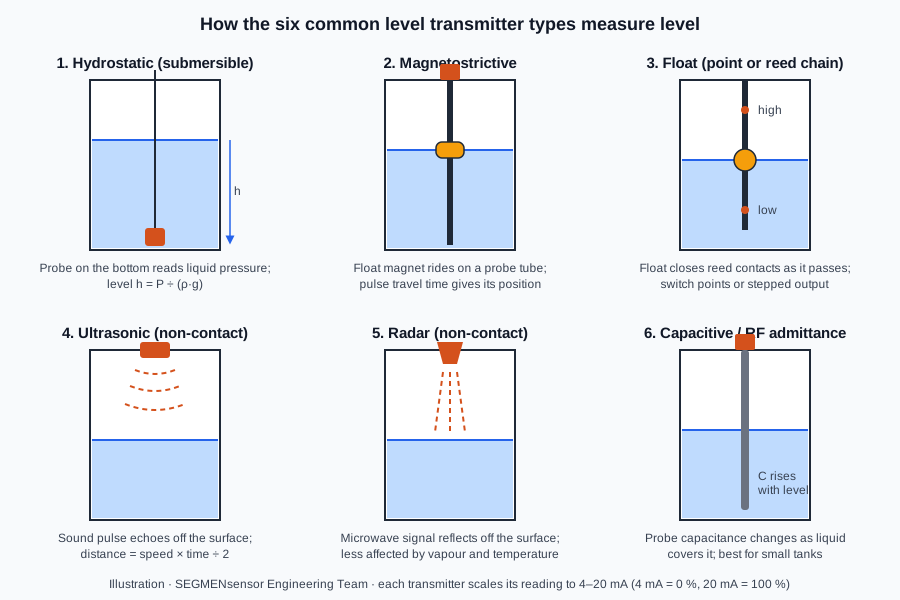
| Type | Measures | Contact with liquid | Good fit | Watch out for | SEGMENsensor option |
|---|---|---|---|---|---|
| Hydrostatic (submersible) | Pressure of the liquid column | Yes, probe at the bottom | Wells, boreholes, water and wastewater tanks, deep tanks | Level reading depends on liquid density; needs a vented cable for open tanks | Submersible level transmitter, 0–0.5 to 0–200 m water column, ±0.1% FS |
| Magnetostrictive | Position of a magnetic float on a probe | Yes, float and probe | Fuel, oil, chemical and process tanks needing high resolution | Float must suit the liquid density and the tank opening | SGM-LS10, SGM-LK10, SGM-LC10, SE-LX series, 25–8000 mm |
| Float (reed chain or switch) | Float position, as switch points or steps | Yes | Simple tanks, pump control, alarms | Stepped or switch output, moving parts in the liquid | Float switches, -40 to +120 °C (+150 °C version) |
| Ultrasonic | Echo time of a sound pulse from the surface | No | Water, wastewater, chemicals in open or closed tanks | Blind zone under the sensor; foam, heavy vapour and obstructions | SEU, 0.25–15 m, ±0.3% FS, 25 cm blind zone |
| Radar | Reflection time of a microwave signal | No | Vapour, high temperature or pressure in process vessels | Higher cost than ultrasonic; mounting and nozzle design matter | Principle only; not in the SEGMENsensor range |
| Capacitive / RF admittance | Change in probe capacitance as the liquid covers it | Yes, probe | Small tanks, viscous liquids and oils, compact machines | Reading depends on the liquid's dielectric constant; calibrate per medium | SGL-RF10, 50–1000 mm |
For a deeper look at the magnetostrictive principle, read how a magnetostrictive level transmitter works.
What Is a Hydrostatic Level Transmitter?
A hydrostatic level transmitter measures level from the pressure of the liquid above the sensor, using h = P ÷ (ρ·g). The submersible version hangs on its cable near the bottom of the tank or well; for water (ρ ≈ 1000 kg/m³) each metre of depth adds about 9.81 kPa. A 0–5 m range in water therefore reads about 49 kPa (0.49 bar) at full scale (calculated value).
The vent tube inside the cable connects the back of the sensing diaphragm to the atmosphere, so changes in air pressure cancel out. Without it, a 10 mbar weather change would read as about 102 mm of water (calculated value). Because the reading depends on density, a hydrostatic transmitter calibrated for water reads differently in a liquid with a different density, so specify the medium at order. You can check ranges and signals with our hydrostatic level calculator, or watch how a submersible level transmitter works.
How Does a 4–20 mA Level Transmitter Signal Work?
A 4–20 mA level transmitter sends 4 mA at the bottom of its calibrated range and 20 mA at the top, changing linearly in between. Level = (I − 4) ÷ 16 × span. On a 0–5 m range:
| Current | % of range | Level on a 0–5 m range (calculated) |
|---|---|---|
| 4 mA | 0 % | 0 m |
| 8 mA | 25 % | 1.25 m |
| 12 mA | 50 % | 2.5 m |
| 16 mA | 75 % | 3.75 m |
| 20 mA | 100 % | 5 m |
A reading of 0 mA means an open circuit, not an empty tank, which is the main reason the live zero of 4 mA is used. Digital outputs such as RS485 Modbus suit multi-drop networks, and 2-wire 4–20 mA + HART lets technicians set parameters with a HART handheld communicator on SEGMENsensor magnetostrictive level transmitters.
How Do You Choose a Level Transmitter?
Choose a level transmitter by working through the liquid, the tank, the range, the environment and the signal, in that order:
- Liquid. Note the medium, density, viscosity, temperature, and whether it coats surfaces, foams or gives off vapour. Coating favours non-contact or RF admittance; foam and vapour make ultrasonic harder.
- Tank or well. Note depth, open or closed, top openings, internal obstructions and agitators. Deep wells and boreholes favour submersible probes; long tanks with a top opening suit magnetostrictive probes.
- Range and accuracy. State the measuring span and the accuracy you actually need. Inventory and custody of fuel usually need finer resolution than a pump-control sump.
- Environment and approvals. Note ambient temperature, IP rating, and whether the area is hazardous. ATEX/IECEx versions are options on selected series; confirm the marking at order.
- Signal and supply. Match the controller input: 4–20 mA, 0–10 V, RS485 Modbus or 4–20 mA + HART, and the available supply voltage.
- Installation details. Process connection, cable length, cable material and mounting position.
SEGMENsensor Level Transmitters: Published Specifications
| Series | Principle | Range | Accuracy | Output | Protection / temperature |
|---|---|---|---|---|---|
| Submersible level transmitter | Hydrostatic, 316L probe | 0–0.5 to 0–200 m water column | ±0.1% FS standard | 4–20 mA or 0–10 V, 12–36 V DC | IP68, -20 to +80 °C |
| SGM-LS10 | Magnetostrictive, stainless rod | 25–8000 mm | ±0.005 mm repeatability | 4–20 mA, 0–10 V, RS485 Modbus | IP68, -40 to +85 °C |
| SE-LX10 / SE-LX20 / SE-LX30 | Magnetostrictive, flameproof | 200–8000 mm | Per datasheet | 4–20 mA, 0–10 V or RS485; 2-wire 4–20 mA + HART | IP67, -40 to +85 °C (+250 °C high-temperature version) |
| SEU | Ultrasonic, non-contact | 0.25–15 m | ±0.3% FS | 4–20 mA + 2 relays, 12–36 V DC | IP67, -20 to +70 °C |
| SGL-RF10 | RF admittance | 50–1000 mm | ±2% FS (water) | 0.5–4.5 V DC or RS485 Modbus, 9–36 V DC | IP65 |
Download the one-page datasheet (PDF)
Ranges, accuracy classes, outputs, supply voltage, process connections, materials, temperature limits and dimensions. No registration required.
Download datasheet (PDF) Download datasheet (PDF) – SE-LX10 magnetostrictive levelMore documents: level sensor downloads (per-series datasheets)
Not sure which principle suits your tank? Request an engineering review: send the medium, tank depth, temperature and the signal your controller reads, and an application engineer replies within 24 hours. Qualification samples of 1–5 pcs ship in 5–7 working days; production lead time and MOQ are confirmed with the quotation.
Where Are Level Transmitters Used?
Level transmitters are used wherever a controller needs to know how much liquid is in a vessel, not only whether it is full or empty. Typical applications, evaluated per project:
- Water and wastewater: wells, boreholes, lift stations and reservoirs, usually with submersible or ultrasonic transmitters.
- Fuel, oil and chemical storage: inventory and leak monitoring with magnetostrictive probes, which report float position without density compensation.
- Equipment coolant and hydraulic tanks: compact submersible, magnetostrictive or RF admittance sensors built into OEM machines.
- Process vessels in hazardous areas: flameproof magnetostrictive transmitters such as the SE-LX series, with the approval confirmed at order.
Factory Supply for OEM Equipment Builders
SEGMENsensor has manufactured level, pressure and position sensors in Shenzhen since 2019, with an engineering team bringing 20+ years of sensor experience and 200+ OEM customers in 30+ countries. Ranges, cable lengths, connectors and outputs are built to each project. Quotes are FOB China with 100% T/T in advance and a 12-month warranty.
FAQ
A level transmitter is an instrument that measures liquid level continuously and converts it into a standard signal, usually 4–20 mA, where 4 mA is 0 % and 20 mA is 100 % of the calibrated range. A PLC, controller or display reads that signal to show or control the level.
Level sensor is the general term. A level transmitter is a level sensor that outputs a continuous, scaled signal such as 4–20 mA, 0–10 V or RS485. A level switch is a level sensor that only changes state at set points, such as high and low alarms.
Use level = (I − 4) ÷ 16 × span. On a 0–5 m range, 12 mA is 50 % of the range, or 2.5 m (calculated value). A reading of 0 mA indicates an open circuit rather than an empty tank.
A hydrostatic level transmitter calculates level from the pressure of the liquid above the sensor, using h = P ÷ (ρ·g). For water, each metre adds about 9.81 kPa. SEGMENsensor submersible versions cover 0–0.5 to 0–200 m water column with ±0.1% FS standard accuracy and a vented cable.
Start from the liquid and the tank. Submersible hydrostatic suits wells and deep water tanks; magnetostrictive suits fuel, oil and chemical tanks that need fine resolution over 25–8000 mm; ultrasonic suits non-contact measurement up to 15 m; RF admittance suits small tanks with viscous liquids.
Qualification samples of 1–5 pcs ship in 5–7 working days. Production lead time and MOQ are confirmed with the quotation, based on your annual volume, and every inquiry is answered within 24 hours.
References
- IEC 60381-1 — Analogue signals for process control systems: direct current signals (4–20 mA) ↗
- IEC 60770-1 — Transmitters for use in industrial-process control systems ↗
- NIST — SI units (pascal and other units used in hydrostatic level calculations) ↗
Related reading: Float switch vs level transmitter · How a magnetostrictive level transmitter works · Liquid level sensors · Water level sensor for tanks · Last updated by the SEGMENsensor Engineering Team.