SEU Ultrasonic Level Sensor — Non-Contact 4-20 mA Level Transmitter, 0.25–15 m
The SEGMENsensor SEU series is a top-mounted ultrasonic level sensor and transmitter for tanks, sumps and process vessels. It measures from 0.25 m to 15 m without touching the liquid, with ±0.3% FS accuracy, a 4-20 mA output plus two relays, IP67 protection and an optional LCD. Built in Shenzhen for OEM equipment makers and system integrators.
The SEGMENsensor SEU is a non-contact ultrasonic level sensor that mounts on top of a tank, times the echo of a sound pulse from the liquid surface and converts the distance into a 4-20 mA level signal. It covers 0.25–15 m with ±0.3% FS accuracy and adds two relay outputs for high and low alarms.
The measuring range is 0.25 m to 15 m, with a 25 cm blind zone directly below the sensor face.
Accuracy is ±0.3% FS, which is ±15 mm on a 5 m span (calculated value).
Outputs are 4-20 mA plus two relays, powered from 12–36 V DC.
Protection is IP67, operating temperature is −20 °C to +70 °C, and the sensor face is ABS or 316L.
Process connections are G¾, G1 or flanged; an LCD is optional; CE and RoHS apply.
Last updated · SEGMENsensor Engineering Team
What is an ultrasonic level transmitter?
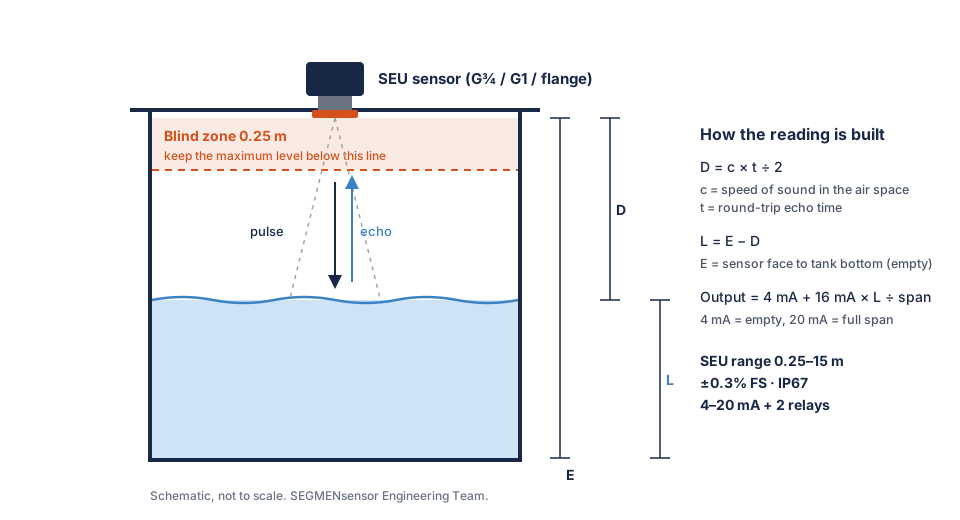
An ultrasonic level transmitter is a non-contact instrument that measures liquid level from above. The transducer sends a short sound pulse down to the surface and times the echo: distance D = c × t ÷ 2, where c is the speed of sound in the air space and t is the round-trip time. Subtracting D from the empty distance E (sensor face to tank bottom) gives the level, which the SEU outputs as 4-20 mA. Because nothing touches the liquid, there are no floats to stick and no probe to coat — the reason ultrasonic is chosen for wastewater, chemicals and coolant reservoirs.
Specifications
SEU Ultrasonic Level Sensor Specifications
Values from the SEGMENsensor liquid level sensor datasheet (v1.0, 2026-09). Configurations outside this table are confirmed per project.
Parameter
SEU series
Measuring principle
Ultrasonic pulse-echo (time of flight), non-contact
Measurement
Continuous level
Measuring range
0.25–15 m
Blind zone
25 cm below the sensor face
Accuracy
±0.3% FS
Output
4-20 mA + 2 relays
Supply
12–36 V DC
Display
LCD (optional)
Operating temperature
−20 °C to +70 °C
Protection
IP67
Sensor face material
ABS or 316L
Process connection
G¾, G1 or flanged
Certifications
CE, RoHS
Samples
From 1 pc for qualification; volume per project
Download the liquid level sensor datasheet (PDF)
One page covering the SEU ultrasonic sensor alongside the SFL float switch, SLS submersible transmitter and CDU coolant level sensor: principle, range, accuracy, output, supply, temperature, protection, materials and process connection. No registration required.
How do you size an ultrasonic level sensor for your tank?
Size it from the empty distance E and the blind zone: the highest level you can measure is E − 0.25 m, so the sensor face must sit at least 0.25 m above the maximum liquid level.
Fig. 1 — The SEU measures the air gap D and reports level L = E − D. Liquid inside the 0.25 m blind zone cannot be measured.
Worked example: 3 m tall water tank
The sensor face is mounted 3.0 m above the tank bottom, so E = 3.0 m. With the 0.25 m blind zone, the highest measurable level is 3.0 − 0.25 = 2.75 m. If the tank fills to 2.9 m, raise the sensor on a stand-off or nozzle so its face is at least 3.15 m above the bottom. Then set the span so 4 mA is the empty tank and 20 mA is the maximum working level. These are calculated values for planning; confirm the mounting height and nozzle dimensions with our engineers before ordering.
What ±0.3% FS means in millimetres
Span (full scale)
±0.3% FS
Typical use
2 m
±6 mm
Coolant reservoirs, dosing and day tanks
5 m
±15 mm
Water tanks, lift-station wet wells
10 m
±30 mm
Storage tanks, reservoirs
15 m
±45 mm
Tall silos and open basins at the top of the range
Calculated as 0.3% × span; not measured values.
Scaling the 4-20 mA output to level
Level = (I − 4 mA) ÷ 16 mA × span. On a 0–5 m span, 4 mA is empty, 8 mA is 1.25 m, 12 mA is 2.5 m, 16 mA is 3.75 m and 20 mA is 5 m. Use the 4–20 mA calculator to check other spans, and the loop resistance calculator for long cable runs on the 12–36 V DC supply.
Why the air temperature matters
The speed of sound in air rises by about 0.6 m/s per °C (roughly 343 m/s at 20 °C), so any ultrasonic sensor must correct for the temperature of the air space to keep its distance reading accurate. Give the expected air-space temperature range in your RFQ — the SEU operates from −20 °C to +70 °C — and we check it against the configuration.
Selection
When should you choose ultrasonic level measurement?
Choose ultrasonic when the liquid must not be touched and the air space above it is clear. Choose a submersible or magnetostrictive transmitter when dense foam, vapour or pressure gets in the way of the sound pulse.
Mount it vertically on the tank roof, with the sensor face pointing straight down at the liquid, at least 0.25 m above the maximum level and clear of anything that reflects the pulse.
⬇️
Face square to the surface
Install the SEU vertically so the pulse hits the liquid at a right angle; a tilted face sends the echo away from the transducer.
↔️
Clear of walls and inlets
Keep the sound path away from the tank wall, ladders, agitators and the fill stream, which create false echoes and surface turbulence.
📏
Respect the blind zone
The maximum liquid level must stay at least 0.25 m below the sensor face. Use a stand-off or nozzle to gain height if needed.
🔩
Pick the connection
Choose G¾, G1 or a flange to suit the tank roof. Tell us the nozzle length and inner diameter so we can review the mounting.
🔌
Wire the loop and relays
Connect the 12–36 V DC supply and the 4-20 mA signal to the PLC analog input; use the two relays for high and low alarms or pump control.
🧪
Name the medium
State the liquid and its vapours in the RFQ: we confirm whether the ABS or the 316L sensor face suits the tank atmosphere.
Applications
Typical SEU ultrasonic level sensor applications
Typical applications, evaluated per project from your medium, tank geometry and output requirement.
♻️
Wastewater sumps and lift stations
Non-contact level and pump-control relays in wet wells, where floats and probes foul with solids and grease.
⚗️
Chemical storage tanks
Level without wetted probes in corrosive liquids; the 316L sensor face is available where ABS does not suit the vapours.
🌊
Water tanks and reservoirs
Building water tanks, cooling-tower make-up and rainwater storage up to 15 m, with 4-20 mA to SCADA or BMS.
❄️
Coolant reservoirs
Non-contact level in CNC sumps and liquid-cooling reservoirs; for small CDU tanks up to 1.2 m see the CDU and BESS coolant level guide.
🏭
OEM equipment
Washers, dosing skids and treatment packages that need a level signal and two alarm relays in one top-mounted unit.
🌾
Open basins and ponds
Level in open basins and irrigation ponds, mounted on a bracket above the water surface.
FAQ
SEU Ultrasonic Level Sensor — Frequently Asked Questions
Answers for engineers specifying non-contact level measurement.
What is the measuring range and blind zone of the SEU ultrasonic level sensor?
The SEU measures from 0.25 m to 15 m. The first 25 cm below the sensor face is a blind zone, so the maximum liquid level must stay at least 0.25 m below the face; mount the sensor on a stand-off if the tank fills higher.
How accurate is an ultrasonic level transmitter?
The SEU is specified at ±0.3% FS. On a 5 m span that is ±15 mm, and on a 15 m span ±45 mm (calculated values). Accuracy in service also depends on a clear sound path, a calm surface and correct temperature compensation of the air space.
Can an ultrasonic level sensor measure liquids with foam?
Dense foam absorbs the sound pulse and weakens the echo, so ultrasonic is not the right choice for heavily foaming liquids. For those, a submersible hydrostatic transmitter or a magnetostrictive level transmitter measures below the foam. Light, thin foam is evaluated per project.
What outputs does the SEU have?
The SEU provides a 4-20 mA level output plus two relays, from a 12–36 V DC supply. The relays are typically used for high and low alarms or pump start and stop. An LCD is optional; other output options are confirmed per project.
Which process connections are available?
The SEU is supplied with a G¾ or G1 thread or a flange. Send the nozzle length and inner diameter with your RFQ so our engineers can confirm the mounting before samples ship.
What certifications does the SEU ultrasonic level sensor have?
The SEU is CE and RoHS compliant and rated IP67 to IEC 60529. Certificate copies are available on request with your quotation.
Specify an SEU ultrasonic level sensor for your OEM project
Send the tank height, maximum level, medium, connection and output — our engineers reply within 24 hours. Qualification samples of 1–5 pcs ship in 5–7 days.