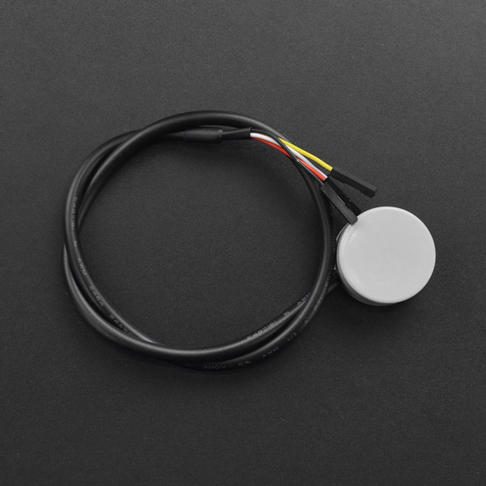
A coolant level sensor for a liquid-cooled BESS container or a data center CDU monitors the reservoir that feeds the pump. SEGMENsensor supplies a non-contact ultrasonic sensor (25–1200 mm, 4-20 mA + two relay alarms, IP67), float level switches for point alarms, and hydrostatic transmitters for large tanks, from 10 pieces with samples in 5–7 days.
Liquid cooling has moved from a niche into the default design for two fast-growing systems: battery energy storage containers, where cells are cooled by a water-glycol loop, and AI or high-density server racks, where a coolant distribution unit (CDU) circulates dielectric coolant or treated water to cold plates. Both loops share a weak point. The reservoir or expansion tank is the only place where a slow leak, evaporation or an air pocket shows up before the pump cavitates or a cold plate runs dry. This guide explains what the level sensor in that reservoir has to do, which sensing technology suits each loop, and how the published specifications of SEGMENsensor liquid level sensors map onto the requirement. For the complete CDU sensor set including flow and pressure, see the CDU liquid-cooling sensor guide.
Why Coolant Level Is the First Alarm in a Liquid-Cooling Loop
A closed cooling loop is designed to hold a fixed volume. Any change in reservoir level is therefore information: a falling level means coolant is leaving the loop through a fitting, a quick-disconnect or a permeable hose; a rising level in a system with a heat exchanger can mean facility water is crossing into the secondary loop. Temperature and flow sensors report the consequence of a leak only after the cooling capacity has already dropped. The level sensor reports the cause, usually hours or days earlier.
Three functions are expected from the reservoir level sensor in both BESS and CDU designs:
- Low-level pump protection. A relay contact or a switch output wired into the pump interlock so the pump cannot run dry.
- Continuous level trend. A 4-20 mA or RS-485 signal to the battery management system (BMS), PLC or rack management controller, so that slow loss can be trended and a top-up scheduled before an alarm.
- High-level or overflow alarm. A second contact for thermal expansion overfill or for facility-water ingress across the heat exchanger.
Three Sensing Technologies for a Coolant Reservoir
The reservoir in a CDU is usually a small polymer tank with a sight window; the expansion tank in a BESS container is larger and often stainless steel or HDPE. The coolant itself may be deionised water, a propylene-glycol or ethylene-glycol mixture, or a dielectric fluid. Each combination favours a different sensing method.
| Technology | How it measures | Best fit | Output |
|---|---|---|---|
| Ultrasonic, non-contact | Top-mounted transducer measures the echo time to the coolant surface; no wetted parts | CDU reservoirs with dielectric coolant or DI water; polymer tanks (HDPE, polycarbonate, acrylic window) | 4-20 mA continuous + 2× relay alarm |
| Magnetic float switch | A float carrying a magnet operates a reed contact or microswitch at one or more fixed points | BESS expansion tanks and any loop that only needs low/high alarms; water-glycol with PP, PVDF or 316L wetted parts | Relay / SSR contact; multi-float versions with 4-20 mA |
| Submersible hydrostatic transmitter | Pressure of the coolant column above the sensor, converted linearly to level | Large buffer or storage tanks at container or plant level, 0.5 m and deeper | 4-20 mA / 0-10 V / RS-485 Modbus |
| Magnetostrictive level transmitter | Float position read along a rigid probe, 25–8000 mm | Tall storage tanks where high-resolution continuous level and optional temperature are required | 4-20 mA / RS485 / SSI |
For most CDU reservoirs the ultrasonic sensor is the natural choice because nothing metallic touches the coolant, which matters for dielectric fluids and for deionised water that must stay low in conductivity. For BESS containers the float switch is often sufficient, since the control system needs a hard low-level interlock more than a continuous reading; a multi-float rod adds a 4-20 mA signal where the BMS wants a trend. Tank-farm and plant-level coolant storage is covered by the magnetostrictive level transmitter or a submersible transmitter.
Coolant Level Monitoring in Liquid-Cooled BESS Containers

A liquid-cooled battery container typically runs a water-glycol loop through cold plates under each battery module, with a chiller and an expansion tank mounted in the thermal management compartment. The loop operates at modest pressure and at coolant temperatures from below freezing in winter storage to the chiller return temperature. The level sensor sits on the expansion tank and has to tolerate the glycol mixture, outdoor ambient swings and container vibration during transport.
The SEGMENsensor float level switch family is specified for this duty: reed-chain or microswitch operation, PP, PVDF or SUS 316L wetted materials for glycol compatibility, an operating temperature range of −40 °C to +120 °C (high-temperature version to 150 °C), IP67 or IP68 protection, and side-entry, top-entry or flanged mounting. A two-point float switch gives the BMS a low-level interlock and a high-level alarm from a single tank penetration. Where the site operator wants to trend coolant loss across a fleet of containers, the multi-float version with a 4-20 mA output feeds the same BMS analogue input as the pressure and temperature transmitters.
Because BESS containers are shipped as complete units, the sensor should be ordered with the final cable length, connector and gland so that no rework is needed at the integration line. SEGMENsensor builds these variants to order at the same MOQ of 10 pieces.
Coolant Level Monitoring in Data Center CDUs

Data centers are among the most energy-intensive building types, and the U.S. Department of Energy describes them as consuming many times the energy per floor area of a typical office building in its overview of Data Centers and Servers ↗. Direct liquid cooling is one of the main responses to that load. The CDU that serves a row or a rack contains a pump, a heat exchanger and a small reservoir, and the reservoir level is the primary indication that the secondary loop is intact.
The SEGMENsensor CDU coolant level sensor is a top-mounted ultrasonic sensor with no metal parts in contact with the fluid. It is compatible with dielectric coolant, deionised water and PAG or PGW mixtures, and with the HDPE, polycarbonate and acrylic-window tanks used in CDU chassis. The sensing range of 25–1200 mm covers reservoirs from a 1U in-rack CDU to a row-level unit, with ±1 mm accuracy over ranges up to 300 mm. Output is 4-20 mA continuous plus two relay alarms for low and high level, so the rack management controller receives a trend and the pump interlock receives a hard contact from the same device. The operating temperature of −10 °C to +60 °C matches the CDU environment, and the DC 12–24 V supply is taken from the CDU control board.
Specification Summary
All figures below are taken from the SEGMENsensor liquid level sensor product page. The ultrasonic column applies to the CDU coolant level sensor; the float column applies to the standard magnetic float level switch used on BESS expansion tanks.
| Parameter | Ultrasonic coolant level sensor (CDU) | Magnetic float level switch (BESS) |
|---|---|---|
| Measurement principle | Ultrasonic, non-contact | Magnetic float, reed chain or microswitch |
| Sensing range | 25 mm – 1200 mm | Tank depth up to 10 m (multi-float rod) |
| Accuracy | ±1 mm (≤300 mm range) | Switch point (N/A) |
| Output | 4-20 mA + 2× relay alarm | Relay / SSR; 4-20 mA on multi-float versions |
| Media | Dielectric coolant, DI water, PAG, PGW | Water-glycol, water, oils (per wetted material) |
| Wetted / housing material | No wetted parts; housing suits HDPE, polycarbonate, acrylic tanks | PP / PVDF / SUS 316L |
| Mounting | Top-mount, G¾ thread or custom bracket | Side entry / top entry / flanged |
| Operating temperature | −10 °C to +60 °C | −40 °C to +120 °C (HT version to 150 °C) |
| Supply voltage | DC 12–24 V | Switch contact; DC 12–36 V or AC 230 V on powered versions |
| Protection rating | IP67 | IP67 / IP68 |
| Hazardous area | Safe area | ATEX II 2G option |
| Certifications | CE, RoHS; ISO 9001:2015 factory | CE, RoHS; ISO 9001:2015 factory |
| OEM MOQ / lead time | 10 pcs · samples (1–5 pcs) in 5–7 days · production in 3–5 weeks · reply within 24 hours | |
Protection ratings quoted above follow the IP code defined in IEC 60529 — Degrees of protection provided by enclosures (IP Code) ↗. IP67 covers the condensation and wash-down exposure inside a CDU chassis; IP68 is specified for float switches that may be fully submerged in a BESS expansion tank.
Download the one-page datasheet (PDF)
The liquid level sensor datasheet lists the float switch, submersible, ultrasonic and CDU coolant level sensor variants with ranges, outputs, materials, temperature limits, IP ratings, dimensions and the ordering code. No registration required.
Need a coolant level sensor specified for your BESS or CDU loop?
Send tank height, coolant type, mounting and quantity to our engineers. MOQ 10 pcs · samples in 5–7 days · reply within 24 hours.
Integration: Outputs, Alarms and Wiring
The continuous level signal is a 2-wire 4-20 mA loop of the type defined in IEC 60381-1 — Analogue signals for process control systems, Part 1: Direct current signals ↗, so it connects to any BMS, PLC or rack controller analogue input without a converter. The live zero at 4 mA lets the controller distinguish an empty reservoir from a broken sensor cable. Where the controller network is serial, the RS-485 Modbus RTU option carries level and alarm status on one bus with the flow and pressure transmitters. Wiring practice for 2-wire and 3-wire loops is covered in how to wire a 4-20 mA transmitter; the same rules apply to level transmitters.
Relay alarms should be wired fail-safe: use the normally-closed contact for the low-level pump interlock so that a lost supply to the sensor also stops the pump. Set the low-level point above the pump suction with margin for tilt during BESS container transport and for the sloshing that occurs when a rack-level CDU is wheeled into position.
Selection Checklist
- Reservoir: internal height (or depth), material (HDPE, polycarbonate, stainless steel), and the available mounting position (top, side or flange).
- Coolant: deionised water, glycol type and concentration, or dielectric fluid; operating and storage temperature.
- Function: continuous level (4-20 mA / RS-485), point alarms (relay), or both; number of switch points.
- Interface: supply voltage available on the control board, cable length, connector or gland type.
- Environment: IP rating required, vibration during transport, ATEX zone if the container is classified.
- Quantity: sample count now and expected annual volume, plus destination and Incoterm (EXW, FOB Shenzhen, CIF, DDP).
OEM Supply for BESS and CDU Integrators
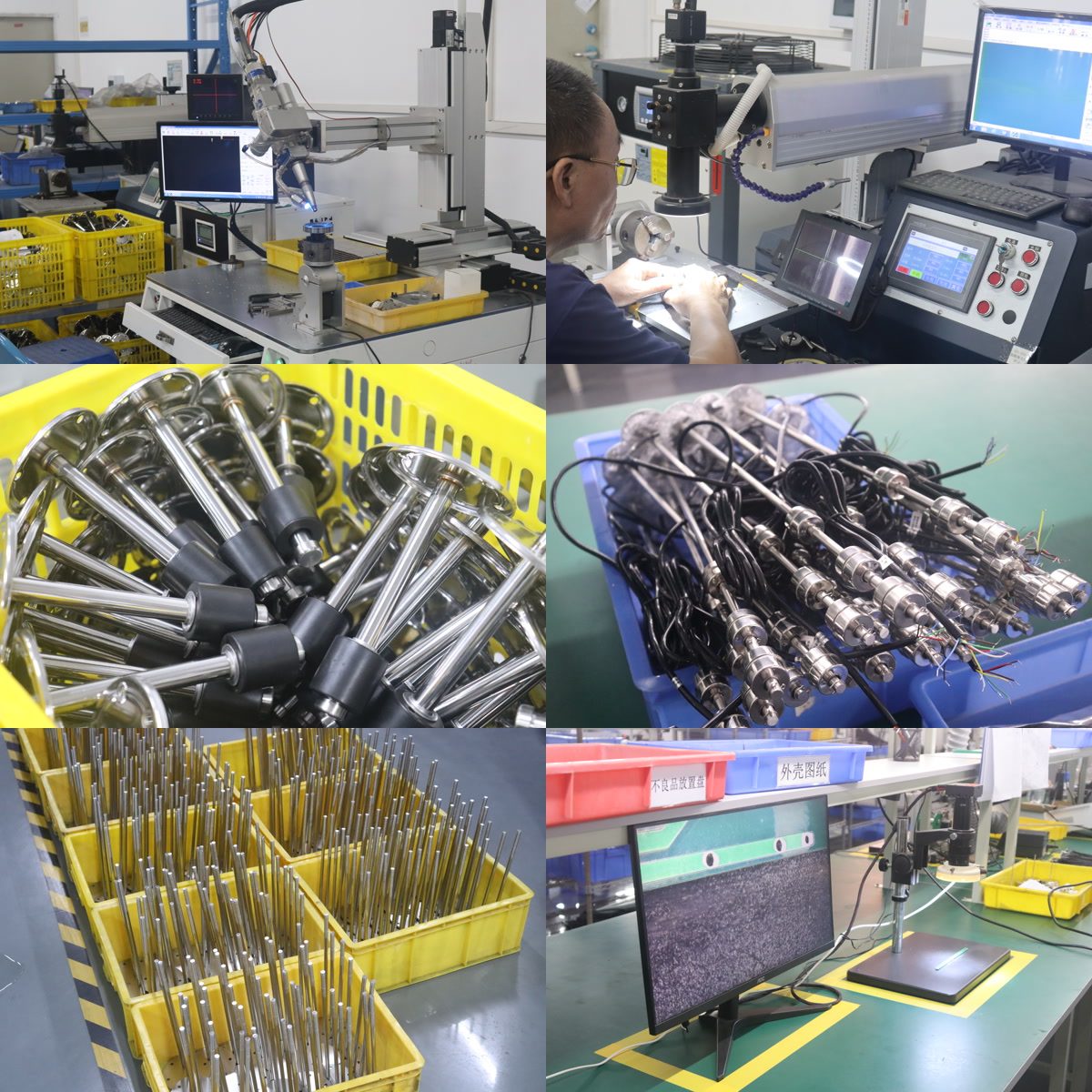
Segmen Industrial Development Co., Ltd. was founded in Shenzhen in 2019; its engineering team brings more than 20 years of sensor experience and supplies 200+ OEM customers in 30+ countries. Coolant level sensors are built to order on an ISO 9001:2015 production line, so the sample that passes qualification on your CDU or container prototype is the same configuration that ships in the series order. Custom brackets, cable lengths and connectors are available for rack and container integration, and private-label documentation can be supplied for the integrator's own manual.
Frequently Asked Questions
A non-contact ultrasonic level sensor mounted on top of the reservoir. Nothing touches the dielectric coolant or deionised water, the 25–1200 mm range covers typical CDU tanks, and the 4-20 mA output plus two relay alarms connect directly to the rack management controller.
Yes. Float level switches with PP, PVDF or 316L stainless steel wetted parts and the ultrasonic non-contact sensor are both compatible with water-glycol mixtures used in liquid-cooled battery containers. State the glycol type and concentration on the enquiry so the wetted material is confirmed.
Continuous 4-20 mA (2-wire) or 0-10 V for level, RS-485 Modbus RTU on request, and relay contacts for low-level and high-level alarms. Float switches provide a direct relay or solid-state switch output for pump interlocks.
The CDU ultrasonic coolant level sensor is rated −10 °C to +60 °C on the coolant side, matching the CDU environment. Float level switches cover −40 °C to +120 °C as standard, with a high-temperature version up to 150 °C for hot-side loops.
MOQ 10 pieces, samples of 1–5 pieces shipped in 5–7 days, production orders in 3–5 weeks, and every enquiry answered within 24 hours. Custom brackets, cable lengths and connectors are available for rack and container integration. The factory is ISO 9001:2015 certified and sensors carry CE and RoHS.
Related reading: Liquid level sensors — product page · CDU liquid-cooling sensor guide (level, flow, pressure) · Float level switch selection guide · How to choose a liquid level sensor
Last updated: 23 September 2026. Specifications reflect the SEGMENsensor product page at the date of publication; contact us for the current datasheet revision.