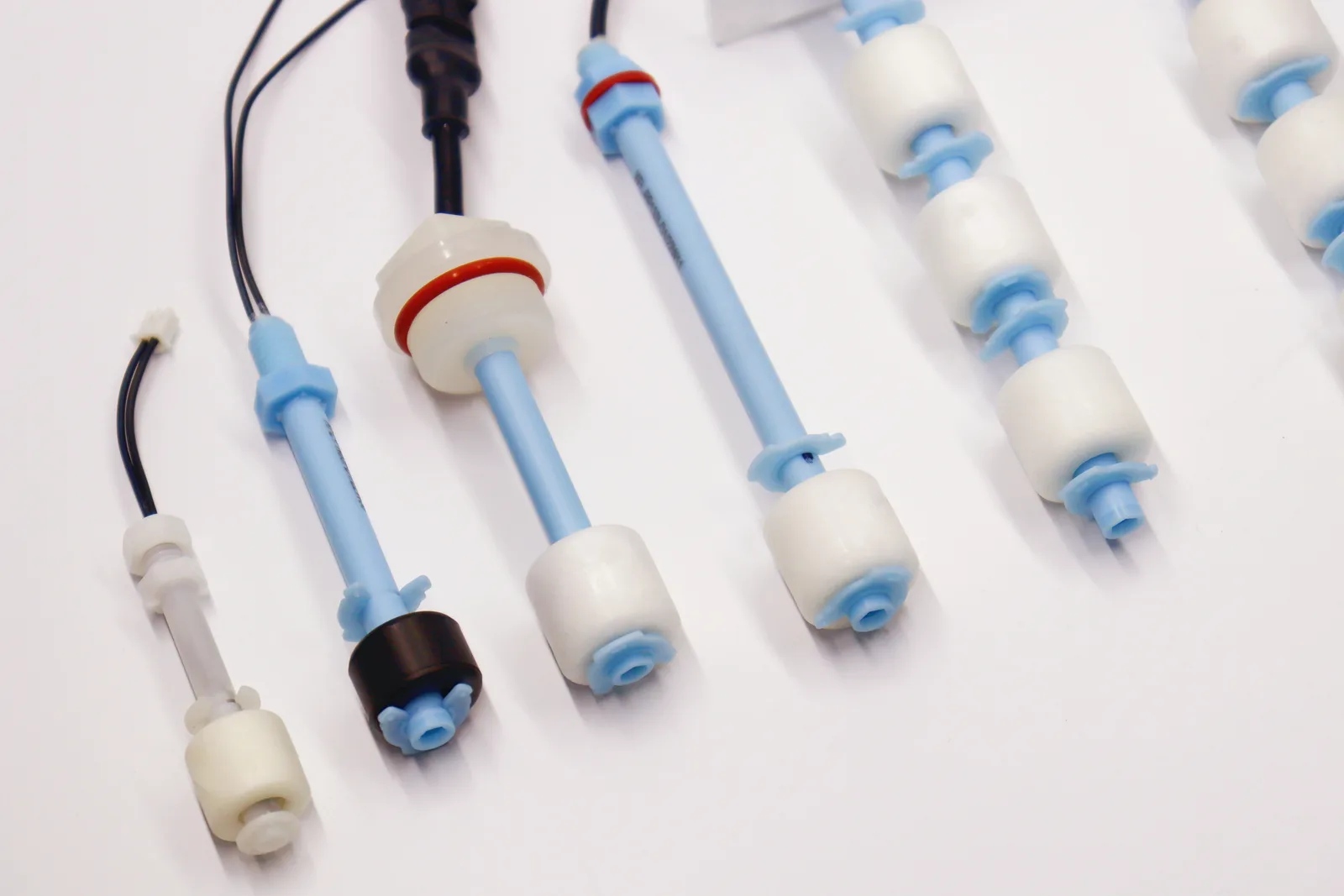
Choose a liquid level sensor by answering four questions: (1) Point or continuous? A float switch gives on/off alarms; the rest give a continuous reading. (2) Contact or non-contact? Ultrasonic is non-contact; float, hydrostatic and magnetostrictive touch the liquid. (3) Accuracy? Magnetostrictive is the most accurate (±0.05% FS); hydrostatic and ultrasonic are ±0.1–0.25% FS. (4) Media? Density changes, foam, coating, and interface layers each rule some technologies in or out. Use the comparison table below to match your tank to the right sensor.
The 5 Main Liquid Level Measurement Technologies
Almost every industrial liquid level application is served by one of five sensing principles. Each measures the surface of a liquid a different way, and each has a clear sweet spot. Understanding how they work is the fastest route to the right specification.
1. Float Level Switch (point level)
A buoyant float with an internal magnet rides on the liquid surface along a guide rod; at a fixed setpoint the magnet trips a sealed reed switch, giving a discrete on/off signal. Simple, low-cost, and reliable for high/low alarms and pump control, but it only measures fixed points — not a continuous reading. See our float level switch page.
2. Hydrostatic / Submersible Pressure (continuous)
A submersible level transmitter sits at the bottom of the vessel and measures the pressure of the liquid column above it (P = ρgh), converting it to a 4-20 mA level signal. Excellent for wells, sumps, and open tanks — but the reading depends on liquid density, so density changes (temperature, concentration) introduce error.
3. Ultrasonic (non-contact, continuous)
A sensor mounted at the top of the tank fires an ultrasonic pulse at the liquid surface and times the echo. Nothing touches the liquid, which suits corrosive or coating media. Foam, heavy vapor, steep surfaces, and narrow tanks with obstructions degrade the echo, and a fixed dead-band near the sensor limits the top of the range.
4. Magnetostrictive (continuous, high accuracy)
A magnetic float rides a magnetostrictive waveguide probe; a current pulse and the float's field generate a torsional strain wave whose travel time gives absolute position to 0.01 mm. This is the highest-accuracy continuous technology (±0.05% FS), and it uniquely offers oil-water interface and multi-point temperature measurement in one instrument. See our magnetostrictive level transmitter.
5. Capacitive (point or continuous)
Capacitive sensors detect the change in dielectric constant as liquid rises around a probe. They handle conductive and non-conductive liquids, powders, and interfaces, and have no moving parts — but they require calibration to the medium and can be sensitive to coating build-up on the probe.
Liquid Level Sensor Comparison Table
| Technology | Type | Typical accuracy | Contact | Best for | Watch out for |
|---|---|---|---|---|---|
| Float switch | Point | Setpoint ±few mm | Yes | High/low alarms, pump control | Foam, turbulence; no continuous reading |
| Hydrostatic / submersible | Continuous | ±0.1–0.25% FS | Yes | Wells, sumps, open tanks | Density changes; sediment on diaphragm |
| Ultrasonic | Continuous | ±0.25% FS | No | Corrosive/coating media, non-contact | Foam, vapor, dead-band, obstructions |
| Magnetostrictive | Continuous | ±0.05% FS | Yes | High-accuracy gauging, interface, inventory | Higher cost; float sizing per density |
| Capacitive | Point / continuous | ±1% FS | Yes | Interfaces, powders, mixed media | Coating build-up; needs calibration |
How to Decide: A Simple Selection Path
├── Alarm/point only → Float level switch ✓
└── Continuous reading → next question
Can the sensor touch the liquid?
├── No (corrosive/coating) → Ultrasonic non-contact ✓
└── Yes → next question
How much accuracy do you need?
├── Standard (±0.1–0.25%) → Hydrostatic / submersible ✓
└── High accuracy, interface or temperature → Magnetostrictive ✓
Wetted Material Selection
For any contact technology, the wetted parts (probe, float, diaphragm) must be compatible with the liquid at operating temperature and concentration. Verify against a full chemical-compatibility chart before ordering.
| Material | Best for | Temperature limit | Avoid |
|---|---|---|---|
| 316L Stainless Steel | Water, oils, cooling fluids, mild acids (pH 4–10), food & beverage | 120°C (std) / 150°C (HT) | Chlorides >200 ppm, concentrated HCl/HF |
| PVDF | Concentrated acids, chlorine, solvents | 80°C | Strong alkalis, ketones, esters |
| PP (Polypropylene) | Alkalis, weak acids, wastewater | 60°C | Aromatic hydrocarbons, oxidising acids |
| PTFE-lined / coated | Most aggressive chemical service | 100°C | Physical abrasion of the lining |
Output Signal & Wiring
Match the sensor output to your controller. The most common industrial options:
- 4-20 mA (2-wire): the industrial standard for continuous level into PLC/DCS analog inputs; long-cable, noise-immune.
- RS485 / Modbus RTU: digital; carries level, interface and multi-point temperature over one cable — ideal for magnetostrictive.
- SSI / HART: absolute digital position (SSI) or 4-20 mA with digital overlay (HART) for high-accuracy gauging.
- Reed switch / NPN / PNP: discrete on/off outputs for float and point-level switches.
Frequently Asked Questions
Magnetostrictive level transmitters are the most accurate continuous technology, at ±0.05% of full scale with 0.01 mm resolution, because level is derived from a physical time-of-flight measurement that does not drift. Hydrostatic and ultrasonic sensors are typically ±0.1–0.25% FS. For custody-style tank gauging and inventory, magnetostrictive is the reference choice.
Point level detection tells you only whether the liquid is above or below a fixed point — used for high/low alarms and pump on/off (e.g. a float switch). Continuous level measurement reports the exact level across the full range as a 4-20 mA or digital signal — used for inventory, dosing, and process control. Choose point level for simple alarms and continuous for measurement or control.
Hydrostatic (submersible) sensors read pressure, so a change in liquid density directly changes the reading and must be compensated. Magnetostrictive and ultrasonic sensors measure the physical surface position and are therefore largely density-independent. If your medium changes temperature or concentration significantly, prefer magnetostrictive (contact) or ultrasonic (non-contact).
Yes — a dual-float magnetostrictive level transmitter reports the total product level and the oil-water interface simultaneously, which is essential in separators and tank farms. Capacitive sensors can also detect interfaces. Float, hydrostatic, and ultrasonic sensors measure only the top surface.
Foam and turbulence disturb the surface that ultrasonic and float sensors rely on. Contact technologies inside a stilling tube perform better: a magnetostrictive probe or a float switch with a stilling well and time-delay relay will ride the true liquid surface. Ultrasonic struggles most with foam because foam absorbs the echo.
4-20 mA is the default for continuous level into a PLC/DCS. Choose RS485/Modbus when you need level plus interface plus multi-point temperature over one cable (common with magnetostrictive). SSI or HART suit high-accuracy absolute gauging. For point-level alarms, a reed switch or NPN/PNP output is used.
Yes. SEGMENsensor is a factory-direct OEM manufacturer in Shenzhen supplying float, submersible, ultrasonic, capacitive, and magnetostrictive level sensors with custom ranges, materials, process connections, outputs, and private labeling. MOQ is 10 pcs, with CE and RoHS documentation supplied. Send us your tank height, media, temperature, and output requirement for a specification and quote within 24 hours.