For an industrial water tank, use a float level switch when you only need high and low alarms or pump control, a submersible hydrostatic transmitter when you need a continuous 4-20 mA level in a well, sump or deep tank, and an ultrasonic sensor when the water must not be touched or contains debris that would foul a probe.
This guide is for OEM engineers and buyers specifying water level sensors for pump skids, water treatment units, cooling towers, rainwater and fire-water tanks, booster sets and wastewater sumps. Every figure for SEGMENsensor sensors comes from the published liquid level sensor, float level switch, submersible level transmitter and SEU ultrasonic level sensor pages; worked numbers are marked as calculated values.
What Types of Water Level Sensor Are Used in Industry?
Three technologies cover almost all industrial water applications: float switches for point detection, submersible hydrostatic transmitters for continuous level from the bottom of the tank, and ultrasonic sensors for continuous level from the top. Magnetostrictive level transmitters are a fourth option when a tank needs high-resolution gauging on a rigid probe.
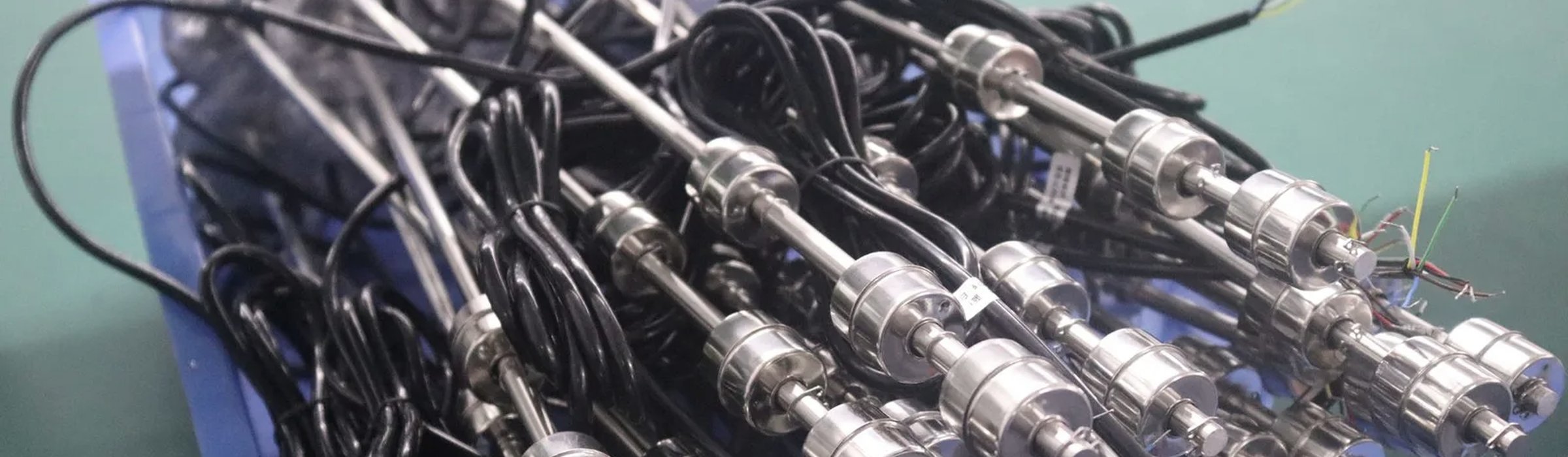
- Float level switch (point level). A magnet in the float operates a sealed reed switch in the stem as the water rises or falls. Switching needs no power, and one stem can carry several switch points for low, high and pump-control levels.
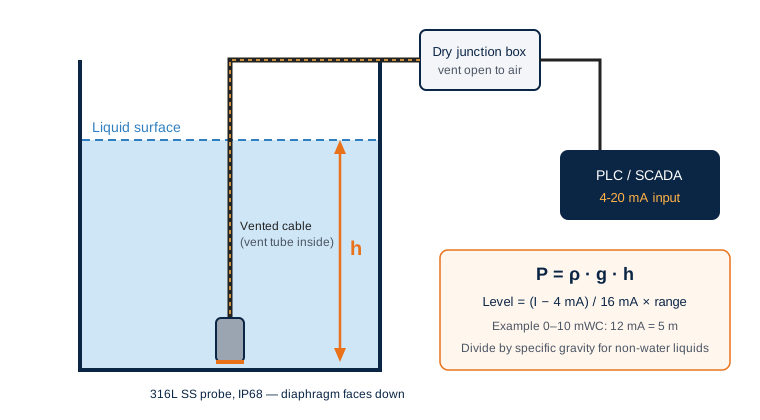
- Submersible hydrostatic transmitter (continuous). A sealed probe hangs at the bottom of the tank or well and measures the pressure of the water column above it. A vent tube in the cable keeps the back of the diaphragm at atmospheric pressure, so weather changes do not appear as false level. How it works in detail: hydrostatic level sensor principle.
- Ultrasonic sensor (continuous, non-contact). Mounted on the tank roof, it times the echo of a sound pulse from the water surface and converts the distance into level. Nothing touches the water, which suits dirty water, open sumps and tanks where probes would collect deposits.
- Magnetostrictive level transmitter (continuous). A float with a magnet rides on a rigid probe and its position is measured along the probe. SEGMENsensor magnetostrictive level sensors cover 25–8000 mm (SE-LX series 200–8000 mm); see the magnetostrictive level transmitter page.
Water Level Sensor Comparison: Float vs Submersible vs Ultrasonic
The table compares the three SEGMENsensor series most often used on water. Values are the published standard figures; options outside these ranges are confirmed per project.
| Parameter | SFL float switch | SLS submersible transmitter | SEU ultrasonic sensor |
|---|---|---|---|
| Measurement | Point level, 2–6 switch points per stem | Continuous, from the tank bottom | Continuous, non-contact from the top |
| Range | Fixed switch points on the stem | 0–0.5 mWC to 0–200 mWC | 0.25–15 m (25 cm blind zone) |
| Accuracy | ±5 mm actuation (±2 mm precision) | ±0.1% FS standard | ±0.3% FS |
| Output | SPDT reed contact, 10 A / 250 V AC or 0.5 A / 100 V DC | 4-20 mA or 0-10 V; RS-485 Modbus optional | 4-20 mA + 2 relays |
| Supply | None needed for switching | 12–36 V DC | 12–36 V DC |
| Temperature | -20 to +85 °C (PP); -20 to +120 °C (316L) | -20 to +80 °C | -20 to +70 °C |
| Wetted material / protection | PP, 316L or PVDF float | 316L probe, IP68 permanent submersion | ABS or 316L sensor face, IP67 |
| Connection | 3/4" NPT standard | Suspended on vented cable (5 m standard) or G1/2" | G¾, G1 or flange |
| Best for | High/low alarms, pump start/stop, dry-run protection | Wells, boreholes, sumps, deep tanks | Open sumps, dirty water, tanks where probes foul |
Protection ratings follow the IP code defined in IEC 60529 ↗; IP68 on the SLS probe is specified for permanent submersion.
Download the one-page datasheet (PDF)
Ranges, outputs, supply voltage, temperature limits, materials, IP ratings and ordering codes for SFL, SLS and SEU level sensors. No registration required.
More documents: liquid level sensor downloads
How Do You Choose a Water Level Sensor for a Tank?
Start from what the control system must do with the signal, then check depth, water quality and mounting. Five questions settle most specifications:
- Alarm or live reading? If the PLC or pump controller only needs to know "low", "high" or "start/stop", a float switch is the simplest choice. If operators or a BMS need the actual level or volume, use a continuous transmitter.
- How deep is the tank or well? Submersible transmitters suit deep wells and boreholes because only the cable gets longer; the range goes up to 0–200 mWC. Ultrasonic sensors cover up to 15 m but need a clear path from the roof to the surface.
- Can the sensor touch the water? For clean water any type works. For water with solids, fibres or deposits, a non-contact ultrasonic sensor avoids fouling; for potable or process water, check the wetted material (316L, PP or PVDF) against your requirements.
- What is in the tank above the water? Foam, condensation, internal ladders or pipes can disturb an ultrasonic echo; a submersible probe in a stilling pipe is unaffected by these.
- What signal and supply does the controller accept? 4-20 mA two-wire loops on 12–36 V DC are the most common; relay contacts and RS-485 are available depending on the series.
A more general method for other liquids is in how to choose a liquid level sensor, and the trade-off between keeping floats or moving to a transmitter is covered in float switch vs level transmitter.
How Do You Size the Range of a Submersible Water Level Sensor?
Choose a range slightly above the maximum water depth over the probe, because accuracy is stated as a percentage of full scale. Hydrostatic pressure is ρ·g·h, so for water (about 1000 kg/m³) each metre of depth adds about 9.81 kPa, or 0.098 bar.
| Worked example (calculated values) | Value |
|---|---|
| Maximum water depth above the probe | 8.5 m |
| Selected range | 0–10 mWC |
| Pressure at full scale | ≈ 98.1 kPa (0.98 bar) |
| ±0.1% FS on 10 m | ±10 mm |
| 4-20 mA scaling | 4 mA = 0 m, 12 mA = 5 m, 20 mA = 10 m |
| Level from current | Level = (I − 4 mA) ÷ 16 mA × 10 m |
For other depths or liquids with a different density, use the hydrostatic level calculator. The kilopascal and the standard acceleration of gravity used here are defined in the SI, summarised by NIST SI units ↗. If the reading drifts with the weather, the vent tube is usually blocked or wet; the fixes are in submersible level sensor vent tube.
Specifying water level sensors for an OEM product?
Send the water type and temperature, tank depth, point or continuous measurement, output and supply, connection, cable length and annual volume. We ship qualification samples (1–5 pcs) in 5–7 working days; production lead time and MOQ are confirmed with the quotation, and every inquiry is answered within 24 hours.
Typical Water Applications
The applications below are typical uses of each sensor type; the final selection is evaluated per project.
- Booster sets and pump skids: multi-point float switches for dry-run protection and pump start/stop, with a separate high-high float as an independent overflow alarm.
- Wells, boreholes and lift stations: submersible transmitters on long vented cable, giving a continuous 4-20 mA level to the pump controller.
- Cooling tower basins and make-up tanks: continuous level for make-up valve control, plus float switches for low-level alarms.
- Rainwater, fire-water and storage tanks: ultrasonic sensors on the roof for volume indication without entering the tank.
- Wastewater sumps: ultrasonic sensors where solids would foul a probe, or submersible probes in a stilling pipe where foam disturbs the echo.
Continuous transmitters for process control are commonly evaluated with the performance test methods of IEC 60770-1 ↗, which defines how accuracy, hysteresis and repeatability of industrial-process transmitters are assessed.
Factory Supply for OEM Water Equipment Builders
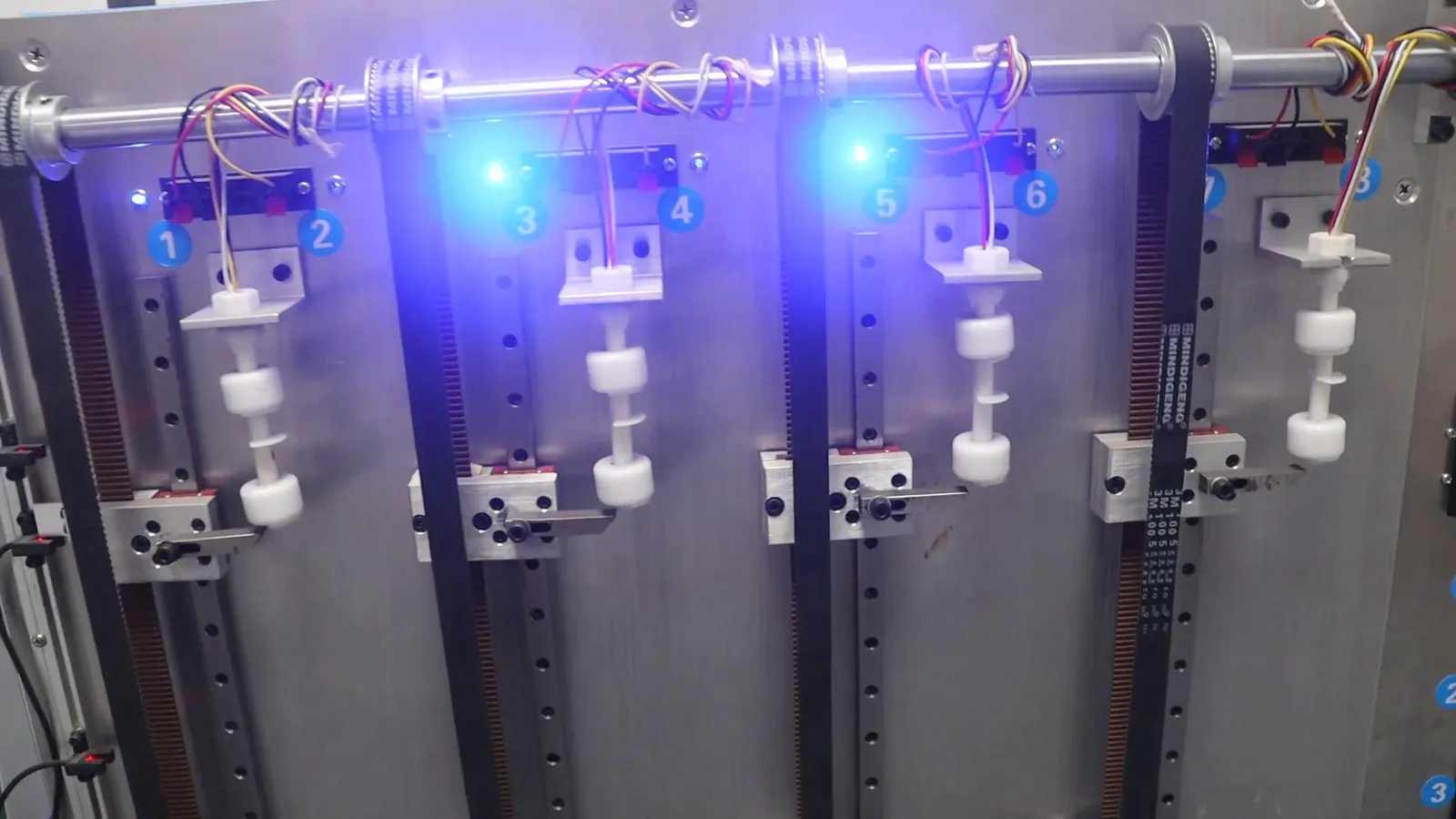
Segmen Industrial Development Co., Ltd. was founded in Shenzhen in 2019; its engineering team brings more than 20 years of sensor experience and supplies 200+ OEM customers in 30+ countries. Float switches are moulded, sealed and checked for switching function on a multi-station test rig before shipment. Quality is managed under ISO 9001:2015, and level sensors carry CE, RoHS 3 and UKCA, with ATEX/IECEx versions as an option on selected models. Wetted material, switch points, cable length, connector, output and private-label marking can be customised. Orders are quoted FOB China with 100% T/T in advance and a 12-month warranty.
FAQ
It depends on the signal you need. A float switch is best for high and low alarms or pump control, a submersible hydrostatic transmitter for a continuous 4-20 mA level in wells and deep tanks, and an ultrasonic sensor when the water must not be touched.
It measures the hydrostatic pressure of the water above the probe and converts it to depth. For water, each metre adds about 9.81 kPa (0.098 bar). A vent tube in the cable references the sensor to atmosphere so weather changes do not affect the reading.
Yes. The SEGMENsensor SEU ultrasonic sensor measures 0.25–15 m from the tank roof with ±0.3% FS accuracy and 4-20 mA plus two relay outputs. Keep the water surface at least 25 cm below the sensor face, which is the blind zone.
Most PLCs and pump controllers accept a two-wire 4-20 mA signal on 12–36 V DC, which is the standard for SEGMENsensor submersible and ultrasonic transmitters. Float switches give a dry SPDT contact, and RS-485 or 0-10 V are available depending on the series.
Qualification samples of 1–5 pcs ship in 5–7 working days. Production lead time and MOQ are confirmed with the quotation, based on your annual volume, and every inquiry is answered within 24 hours.
References
- IEC 60529 — Degrees of protection provided by enclosures (IP Code) ↗
- IEC 60770-1 — Transmitters for use in industrial-process control systems: methods for performance evaluation ↗
- NIST — SI units ↗
Related reading: Liquid level sensors · Submersible level transmitters · How to choose a liquid level sensor · Float switch vs level transmitter
Last updated: 1 November 2026. Specifications reflect SEGMENsensor product pages and datasheets at the time of writing; worked examples are calculated values, not measured limits.