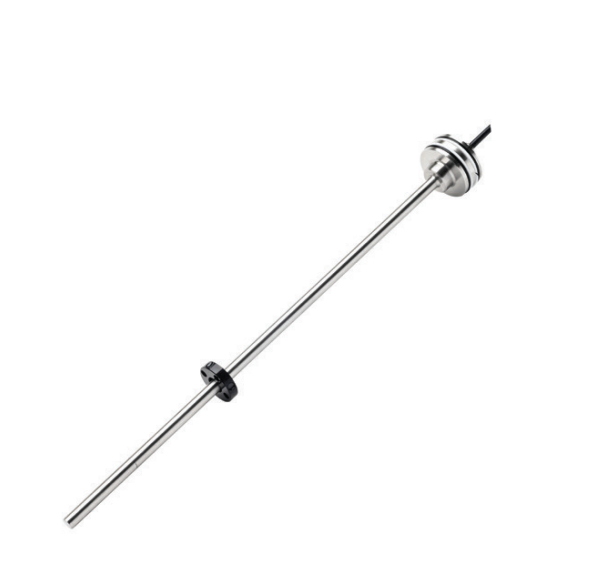
A hydraulic cylinder position sensor tells the controller where the piston is. Continuous sensors, typically magnetostrictive sensors built into the cylinder, report the exact rod position at every point of the stroke for closed-loop positioning. End-of-stroke sensors, typically high-pressure inductive proximity switches in the end caps, only confirm that the cylinder is fully retracted or fully extended.
This page is for hydraulic cylinder builders, mobile and industrial machine OEMs and system integrators deciding how much position information a cylinder needs. It explains what each sensor type measures, where it is installed and how to choose between them. Product figures come from the SEGMENsensor hydraulic cylinder magnetostrictive sensor and high-pressure inductive proximity sensor pages.
What Does a Hydraulic Cylinder Position Sensor Do?
It converts the mechanical position of the piston into an electrical signal the PLC, motion controller or vehicle ECU can use. A cylinder on its own only moves when oil flows; the sensor is what lets the control system know how far it has moved, when to slow down, when to stop and whether it has stayed where it was told to stay.
In practice the signal is used for four jobs:
- Positioning: stopping the rod at a set point, for example a press stroke, an injection-moulding clamp or a boom angle.
- Motion control: following a speed or position profile and synchronizing two or more cylinders on the same load.
- Interlocks and sequencing: confirming that a cylinder is fully in or fully out before the next step of the machine cycle starts.
- Condition monitoring: watching drift with the valve closed and stroke time under load, both early signs of seal wear (see how to check if a hydraulic cylinder is bypassing).
Continuous Position vs End-of-Stroke Detection
The two sensor types answer different questions: "where is the piston?" and "has the piston arrived?". The table compares them using published SEGMENsensor figures.
| Criterion | In-cylinder magnetostrictive (continuous) | High-pressure proximity switch (end of stroke) |
|---|---|---|
| What it reports | Absolute rod position at every point of the stroke | On/off signal at one defined end position per switch |
| Measuring range / sensing point | 25–8000 mm stroke (SGM-PF20, SGM-PR40, SGM-PR50: 25–4000 mm) | Fixed point set by the mounting position in the end cap |
| Pressure rating | Pressure tube 35 MPa (350 bar) continuous, 70 MPa peak | M8 and M12: 500 bar; M18 hydraulic-cylinder type: 250, 350, 500, 800 and 1000 bar grades |
| Output | 4-20 mA, 0-10 V, RS485 Modbus RTU, SSI standard; CAN and other interfaces confirmed per model | PNP or NPN switching output |
| Speed | Update time 1 ms for 1–2 m strokes, below 10 ms on longer strokes | Switching frequency 1 kHz |
| Accuracy | Non-linearity below ±0.01% FS | Repeatable switching point; no position value between the ends |
| Cylinder machining | Gun-drilled piston rod, ring magnet on the piston, threaded port in the cap end | Threaded, sealed bore through the end cap to the oil chamber |
| Supply | 24 V DC standard; 12 V on request | DC supply as listed on the series page |
| Protection | IP67 (SGM-PR10) or IP68 (SGM-PF10 and others) | IP67 / IP69K |
| Typical use | Closed-loop positioning, synchronization, drift monitoring | Interlocks, sequencing, stroke-time monitoring |
How Does an In-Cylinder Magnetostrictive Sensor Measure Position?
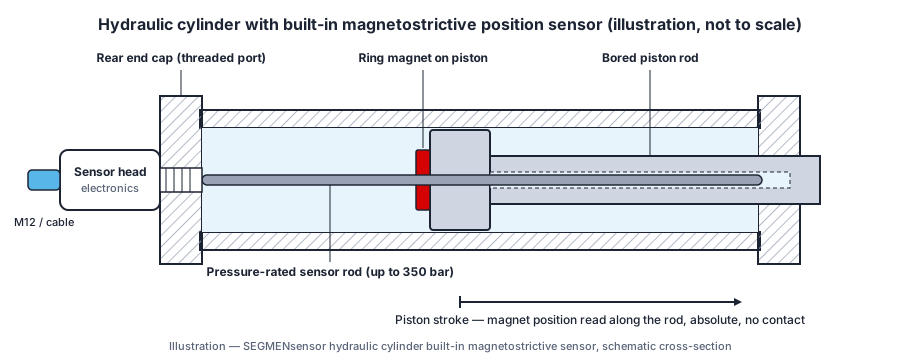
It times a mechanical wave along a waveguide. The electronics send a current pulse down the waveguide inside the pressure tube; where the pulse meets the field of the ring magnet on the piston, a torsional strain wave is created and travels back to the sensor head. The travel time is proportional to the distance, so the output is an absolute position that is available immediately after power-up. Because nothing touches the magnet, there is no wear on the measuring element. The full principle is explained in how a magnetostrictive position sensor works.
The sensor head sits outside the oil, while the pressure tube carries the full cylinder pressure. That is why the pressure rating of the tube (35 MPa continuous, 70 MPa peak on the SGM series) and the thread and seal of the mounting port matter as much as the electrical output.
Specifying sensors for a new cylinder design?
Send the bore, rod diameter, stroke, pressure, output and annual volume. We propose an SGM in-cylinder sensor, an SGI-HP end-position switch or both, and ship qualification samples (1–5 pcs) in 5–7 working days; production lead time and MOQ are confirmed with the quotation, and every inquiry is answered within 24 hours.
How Does an End-of-Stroke Proximity Sensor Work in a Cylinder?
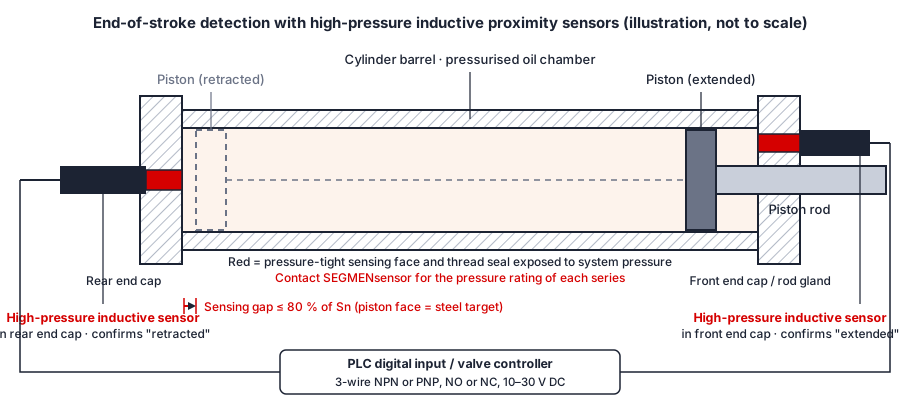
It detects metal at close range. An inductive proximity switch generates a high-frequency field at its sensing face; when the piston, the cushion spear or a target on the rod comes within the switching distance, eddy currents damp the field and the output switches. In a hydraulic cylinder the switch is screwed through the end cap, so its face sits in the pressurized oil. A standard switch is not built for that: the housing and face must be designed and tested for the cylinder pressure, which is why high-pressure series such as SGI-HP are used. Proximity switches are specified under IEC 60947-5-2 ↗.
One switch is needed per position. Most cylinders use two, one at each end, wired to PLC inputs. Mounting and sealing details are covered in end-of-stroke detection in hydraulic cylinders.
How Do You Choose a Hydraulic Cylinder Position Sensor? (Selection Guide)
- Define what the controller needs. Only "fully in / fully out" points to end-of-stroke switches. Intermediate stops, speed profiles, synchronization or drift alarms need continuous position.
- Check stroke and pressure. In-cylinder magnetostrictive sensors cover 25–8000 mm; the pressure tube is rated 35 MPa continuous and 70 MPa peak. For end-of-stroke switches, match the bar grade (500 bar for M8 and M12, up to 1000 bar for M18) to the peak pressure, not only the working pressure.
- Check oil temperature. Hot-oil applications need a series rated for the temperature. SEGMENsensor high-temperature inductive proximity sensors are rated up to +150 °C; a combination of the highest pressure grade and the highest temperature in one model is confirmed per project. See selecting proximity sensors for high pressure and hot oil.
- Match the output to the controller. Analog 4-20 mA or 0-10 V for simple PLC inputs, SSI or RS485 Modbus RTU for digital position, PNP or NPN for switch inputs. Confirm the supply: 24 V DC is standard for in-cylinder sensors, 12 V on request for mobile machines.
- Plan the cylinder machining. A built-in sensor needs a gun-drilled rod, a magnet seat on the piston and a cap-end port; a proximity switch needs a threaded, sealed bore in the end cap. Hydraulic port threads and sealing are commonly specified to ISO 6149-1 ↗.
- Check the environment. Outdoor and wash-down machines need the right connector and protection rating: IP67 or IP68 for in-cylinder sensors, IP67 / IP69K for SGI-HP switches. IP codes are defined in IEC 60529 ↗.
These sensors report position and end position for control and condition monitoring. They are standard components with no SIL or PL rating and do not replace a safety-rated function where the machine risk assessment requires one.
SEGMENsensor Sensors for Cylinder Position Feedback
| Sensor | Role in the cylinder | Published figures |
|---|---|---|
| SGM-PR10 in-cylinder magnetostrictive | Continuous absolute position | 25–8000 mm; non-linearity <±0.01% FS; 4-20 mA, 0-10 V, RS485 Modbus RTU, SSI; IP67 |
| SGM-PF10 in-cylinder magnetostrictive | Continuous absolute position | 25–8000 mm; non-linearity <±0.01% FS; IP68 |
| SGM-PF20, SGM-PR40, SGM-PR50 | Continuous absolute position, compact builds | 25–4000 mm; IP68 |
| SGM pressure tube | Part inside the bored rod | 35 MPa (350 bar) continuous, 70 MPa peak; 24 V DC standard, 12 V on request |
| SGI-HP high-pressure proximity sensor | End of stroke | M8 and M12 rated 500 bar; M18 in 250, 350, 500, 800 and 1000 bar grades; IP67 / IP69K; 1 kHz |
| High-temperature inductive proximity sensor | End of stroke near hot oil or hot machine parts | Rated up to +150 °C |
Download the one-page datasheet (PDF)
Ranges, outputs, supply voltage, pressure and temperature limits, IP rating, dimensions and ordering codes for the sensors above. No registration required.
More documents: magnetostrictive downloads · proximity sensor downloads
Factory Supply for Cylinder Builders
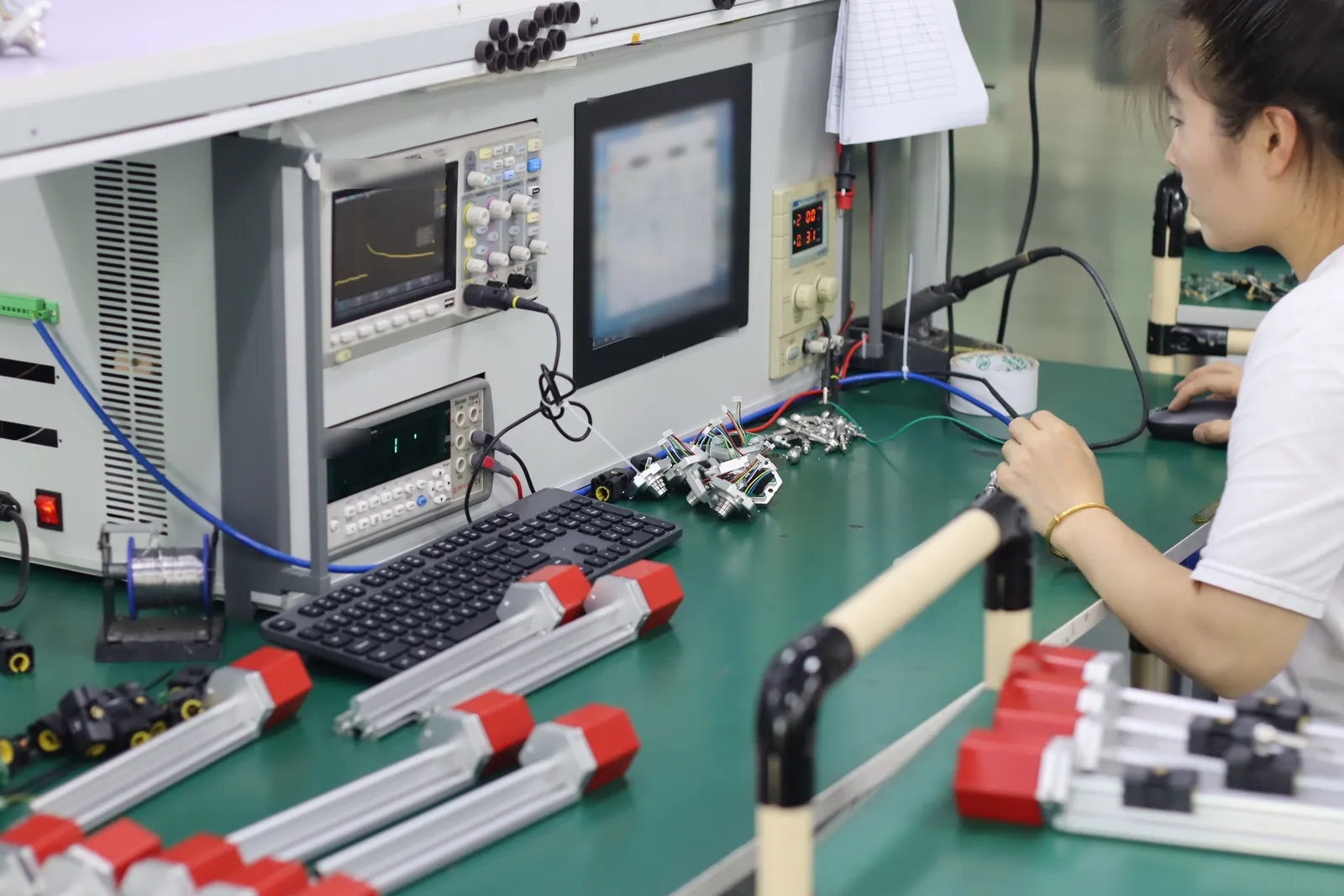
SEGMEN (Shenzhen) Industrial Development Co., Ltd. was founded in Shenzhen in 2019; its engineering team brings more than 20 years of sensor experience and supplies 200+ OEM customers in 30+ countries. Every magnetostrictive sensor is signal-tested before shipment. Quality is managed under ISO 9001:2015, and products carry CE, RoHS 3 and UKCA, with ATEX/IECEx options and UL on selected models. Orders are quoted FOB China with 100% T/T in advance and a 12-month warranty.
FAQ
General questions
It tells the machine controller where the piston and rod are. A continuous sensor reports the exact position along the whole stroke, while an end-of-stroke sensor only switches when the piston reaches a defined end position.
A continuous position sensor, such as an in-cylinder magnetostrictive sensor, outputs the absolute rod position at every point of the stroke. An end-of-stroke sensor, usually an inductive proximity switch in the end cap, gives an on/off signal only at the retracted or extended position.
An in-cylinder magnetostrictive sensor is screwed into the cap end, its pressure tube runs inside a gun-drilled piston rod and a ring magnet sits on the piston. A high-pressure proximity switch is screwed through the end cap so its face sits in the pressurized oil and detects the piston or cushion spear.
End-of-stroke switches are enough when the controller only needs to know that the cylinder is fully in or fully out. Choose continuous feedback when the cylinder must stop at intermediate positions, follow a motion profile, synchronize with another axis or report drift.
Yes. Many machines use an in-cylinder magnetostrictive sensor for closed-loop positioning and add end-position switches as an independent confirmation of the retracted or extended position.
Procurement Q&A
For continuous position, the SGM in-cylinder magnetostrictive series (SGM-PR10, SGM-PF10, SGM-PF20, SGM-PR40, SGM-PR50) measures 25–8000 mm with a pressure tube rated 35 MPa continuous. For end of stroke, SGI-HP high-pressure proximity sensors are rated 500 bar in M8 and M12, with M18 grades up to 1000 bar.
Send the bore and rod diameter, stroke, operating and peak pressure, oil temperature, output signal, supply voltage, connector or cable exit and annual volume. A written quotation follows within 24 hours on working days.
Qualification samples of 1–5 pcs ship in 5–7 working days. Production lead time and MOQ are confirmed with the quotation, based on your annual volume.
References
- IEC 60947-5-2 — Proximity switches ↗
- ISO 6149-1 — Hydraulic fluid power: connections for fluid power and general use, ports and stud ends ↗
- IEC 60529 — Degrees of protection provided by enclosures (IP code) ↗
Related reading: Hydraulic cylinder magnetostrictive sensors · High-pressure proximity sensors · How to check if a hydraulic cylinder is bypassing · LVDT vs magnetostrictive sensors
Last updated: 5 November 2026. Specifications reflect SEGMENsensor product pages and datasheets at the time of writing; combinations of stroke, pressure, temperature, output and connector are confirmed per project.