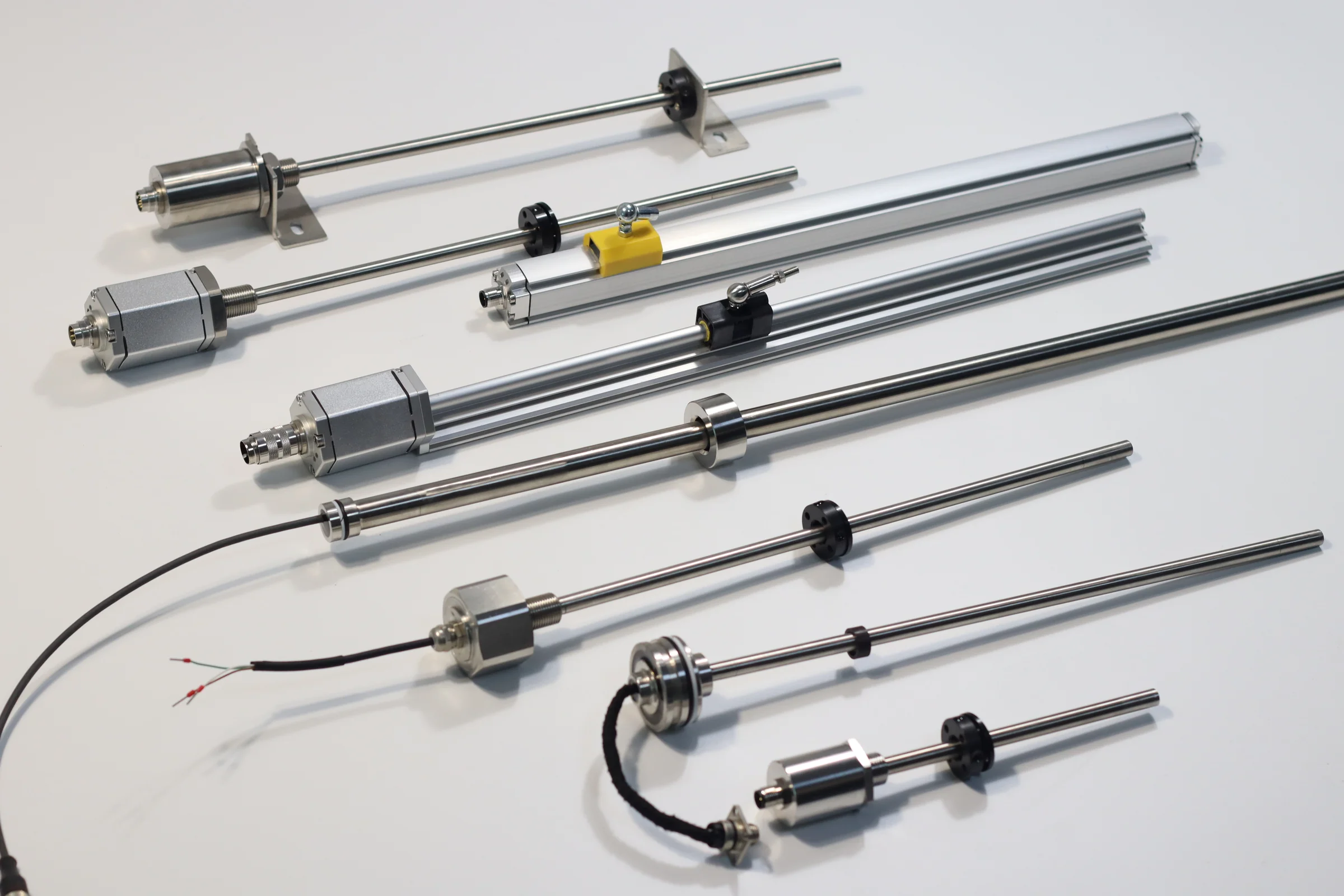
From 20 January 2027 machinery placed on the EU market must meet Regulation (EU) 2023/1230 instead of Directive 2006/42/EC. The machine manufacturer carries the obligation, but its technical file depends on component data. Ask each sensor supplier for the datasheet, CE and RoHS 3 declarations, test reports and a clear statement of whether the sensor is a safety component.
This guide is written for engineers and buyers at machine builders, hydraulic cylinder manufacturers and system integrators who sell into the EU. It does not restate the legal text. It explains where linear position sensors and proximity switches sit in a machine, what a sensor supplier can and cannot document, and how to prepare the component side of your technical file before the date of application. Product figures come from the SEGMENsensor magnetostrictive position sensor, LVDT displacement sensor and high-pressure inductive proximity sensor pages.
What Is Regulation (EU) 2023/1230?
It is the EU regulation that sets the health and safety requirements for machinery and related products placed on the EU market. The European Commission states that it was adopted on 14 June 2023 and "applies on a mandatory basis as of 20 January 2027". Because it is a regulation rather than a directive, it applies directly in every Member State without national transposition.
| Date | What happens | What it means for a machine OEM |
|---|---|---|
| 14 June 2023 | Regulation (EU) 2023/1230 adopted | Start reviewing machine designs, risk assessments and supplier documents |
| Until 19 January 2027 | Directive 2006/42/EC remains the current legislation | Machinery placed on the market follows the Directive; the EU declaration of conformity may also state conformity with the Regulation where applicable |
| 20 January 2027 | The Regulation applies on a mandatory basis | Machinery placed on the market from this date must meet the Regulation |
The Commission also notes that a corrigendum corrected a clerical error about the application dates in the original text, so always read the current consolidated version when you check a specific article.
Does the Machinery Regulation Apply to Sensors?
It applies to machinery and to related products, including safety components placed on the market independently. A standard position sensor or proximity switch that you build into a machine is a component of that machine: the machine manufacturer covers it in the risk assessment, the technical file and the EU declaration of conformity for the machine.
The answer changes only when a sensor is sold specifically to perform a safety function. SEGMENsensor magnetostrictive, LVDT and inductive proximity sensors are supplied as standard industrial components. They are not declared as safety components and carry no SIL or PL rating. If your risk assessment assigns a safety function, such as end-of-stroke protection that prevents a hazard, the machine builder selects a device rated for that function. Our sensors can still report position, end position or level for control and monitoring.
What Documents Should an OEM Ask a Sensor Supplier For?
Ask for documents that let you prove, inside your own technical file, which component you used and what it is rated for. The table lists what a machine builder typically needs and what SEGMENsensor supplies today.
| Document | Why the machine builder needs it | What SEGMENsensor supplies |
|---|---|---|
| Datasheet with ordering code | Identifies the exact model, supply, output, temperature and IP rating used in the design | One-page datasheet per product line (downloads below) |
| CE declaration of conformity | Shows the component's own conformity under the EU legislation that applies to it | Included with every order |
| RoHS 3 material certificate | Restricted-substance evidence under 2011/65/EU as amended by (EU) 2015/863 | Included with every order |
| Test report | Records functional test results for the shipped batch | Included with every order |
| ISO 9001:2015 scope certificate | Supplier quality-system evidence for your supplier approval | Included with every order |
| ATEX/IECEx certificate | Needed only when the machine works in a hazardous area | Supplied with explosion-protected versions, confirmed when ordering |
| Safety-component statement | Tells you whether the part is sold as a safety component | Written statement: standard component, no SIL or PL rating |
UKCA is available for the GB market and UL applies to selected models only. Other country approvals are not held as standard; they can be arranged for a project, with timing and conditions confirmed in the quotation.
Download the one-page datasheet (PDF)
Each datasheet lists ranges, outputs, supply voltage, temperature limits, IP rating, dimensions and the ordering code you need for the technical file. No registration required.
More documents: magnetostrictive · LVDT · proximity sensors
Where Do Position Sensors Sit in a Machine?
Position sensors usually tell the control system where an axis or a cylinder rod is, or confirm that it has reached an end position. The table shows the typical role of each SEGMENsensor line and the published figures you would record in the technical file.
| Sensor type | Typical role in a machine | Published figures |
|---|---|---|
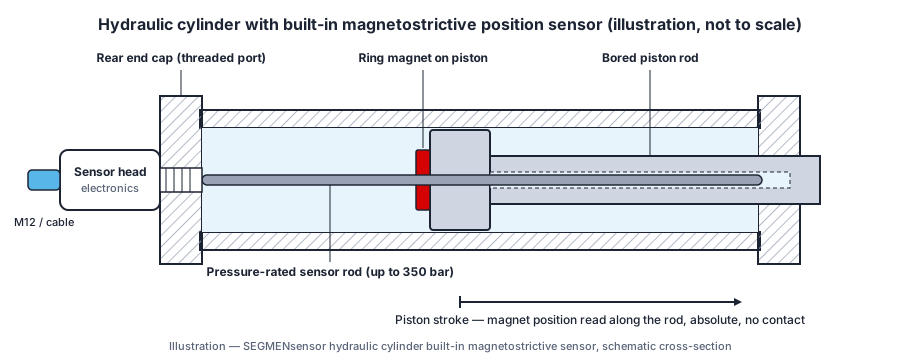
| Magnetostrictive position sensor (SGM / SE series) | Continuous absolute position of a cylinder rod or linear axis | 25–8000 mm; 4–20 mA, 0–10 V, RS485, SSI or CAN; non-linearity <±0.01% FS |
| LVDT displacement sensor | Short-stroke displacement, valve position, gauging | ±0.1% linearity; 4–20 mA, 0–10 V or RS485; IP67 |
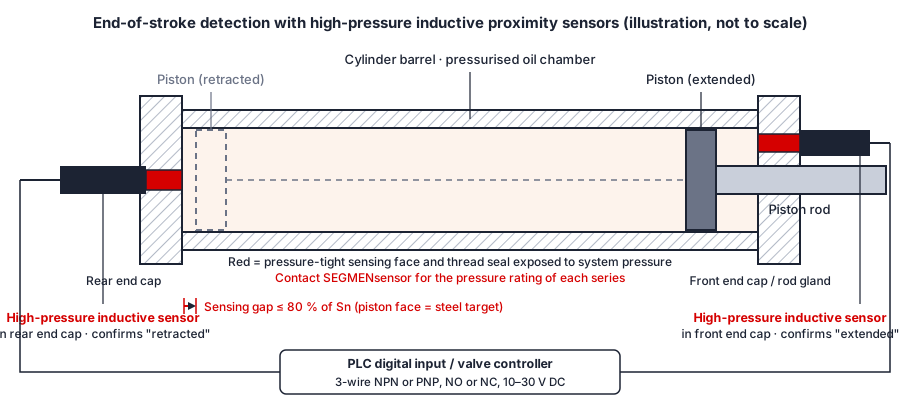
| High-pressure inductive proximity sensor (SGI-HP) | End-of-stroke detection inside hydraulic cylinders | M8/M12 rated 500 bar; M18 grades to 1000 bar; IP67/IP69K |
| High-temperature inductive proximity sensor (SGI-HT) | Position detection near hot oil, moulds or furnaces | Rated +120 °C or +150 °C; M8–M30; PTFE face |
Inductive proximity switches are specified under IEC 60947-5-2 ↗, and IP ratings follow IEC 60529 ↗. Record both on the component list so the assessor can trace each rating back to a standard. For how the in-cylinder sensor measures, see how a magnetostrictive position sensor works; for the IP codes, see IP67 vs IP68 vs IP69K.
Preparing a machine or cylinder for the 2027 deadline?
Send the sensor type, stroke, output and annual volume, and tell us which documents your technical file needs. Qualification samples 1–5 pcs in 5–7 working days · production lead time and MOQ confirmed with the quotation · reply within 24 hours.
How Should an OEM Prepare Before 20 January 2027?
Start with the machines you will place on the EU market after the date of application and work through the component list in this order:
- List every sensor in each machine with its exact ordering code from the datasheet.
- Mark the function of each sensor in the risk assessment: control, monitoring or safety function.
- Separate safety functions: where a function is safety-related, specify a device rated for it; standard sensors stay on control and monitoring duties.
- Collect the documents in the table above for every sensor and store them in the technical file.
- Check the environment ratings: IP code, temperature, pressure and, for hazardous areas, the ATEX/IECEx marking of the ordered version.
- Plan the instructions: the Commission states that the Regulation clarifies when instructions for use and the declaration of conformity can be provided in a digital format.
- Lock the supply: qualify the sensor with samples and agree the ordering code before release, so the documented part matches the shipped part.
Factory Supply and Documentation From SEGMENsensor
SEGMEN (Shenzhen) Industrial Development Co., Ltd. was founded in Shenzhen in 2019; its engineering team brings more than 20 years of sensor experience and supplies 200+ OEM customers in 30+ countries. Sensors are built under an ISO 9001:2015 quality system with a monthly capacity of 50,000 units. Certifications are listed on the About page: ISO 9001:2015, CE, RoHS 3 and UKCA, with ATEX/IECEx options and UL on selected models. Orders are quoted FOB China with 100% T/T in advance and a 12-month warranty.
FAQ
General questions
It is the EU regulation on machinery and related products adopted on 14 June 2023. It applies on a mandatory basis from 20 January 2027 and takes over from Machinery Directive 2006/42/EC, which remains the legislation for machinery placed on the market before that date.
It applies to machinery and related products, including safety components placed on the market independently. A standard position sensor built into a machine is a component, so the machine manufacturer covers it in the machine's risk assessment and conformity assessment.
No. SEGMENsensor magnetostrictive, LVDT and inductive proximity sensors are supplied as standard industrial components with no SIL or PL rating. If a machine function needs a safety-rated device, the machine builder selects one for that function.
Yes. The European Commission states that the regulation clarifies the conditions under which the instructions for use and the declaration of conformity can be provided in a digital format.
Review the risk assessment of each machine you will place on the EU market after that date, mark which sensors serve safety functions, and collect the datasheet, CE and RoHS 3 declarations and certificates for every sensor in the technical file.
Procurement Q&A
Each order includes the CE declaration of conformity, RoHS material certificates, test reports and the ISO 9001:2015 scope certificate. ATEX/IECEx certificates come with explosion-protected versions, and UL applies to selected models only.
Send the sensor type, stroke or sensing distance, output, supply voltage, connector, operating temperature and pressure, IP rating and annual volume. A written quotation follows within 24 hours on working days.
Send the nameplate or datasheet of the current sensor and the mounting drawing. We propose a matching SGM, SE or SGI model and ship 1–5 qualification samples in 5–7 working days so you can test fit and signal before release.
References
- European Commission – Machinery (Regulation (EU) 2023/1230) ↗
- IEC 60947-5-2 – Proximity switches ↗
- IEC 60529 – Degrees of protection (IP code) ↗
Related reading: Magnetostrictive position sensors · Hydraulic cylinder magnetostrictive sensors · LVDT displacement sensors · High-pressure proximity sensors · End-of-stroke detection in hydraulic cylinders
Last updated: 28 October 2026. This article explains supplier documentation for machine builders and is not legal advice; check the current text of Regulation (EU) 2023/1230 for your machine. Specifications reflect SEGMENsensor product pages and datasheets at the time of writing.