Both keep their properties at temperatures where PVC softens, so both are used on high-temperature sensors. Choose silicone where the cable must stay flexible or is routed in the cold; choose PTFE where oil, chemicals, weld spatter or abrasion reach the cable, or where a thin, non-stick jacket is needed. The sensor rating, not the cable, sets the upper limit.
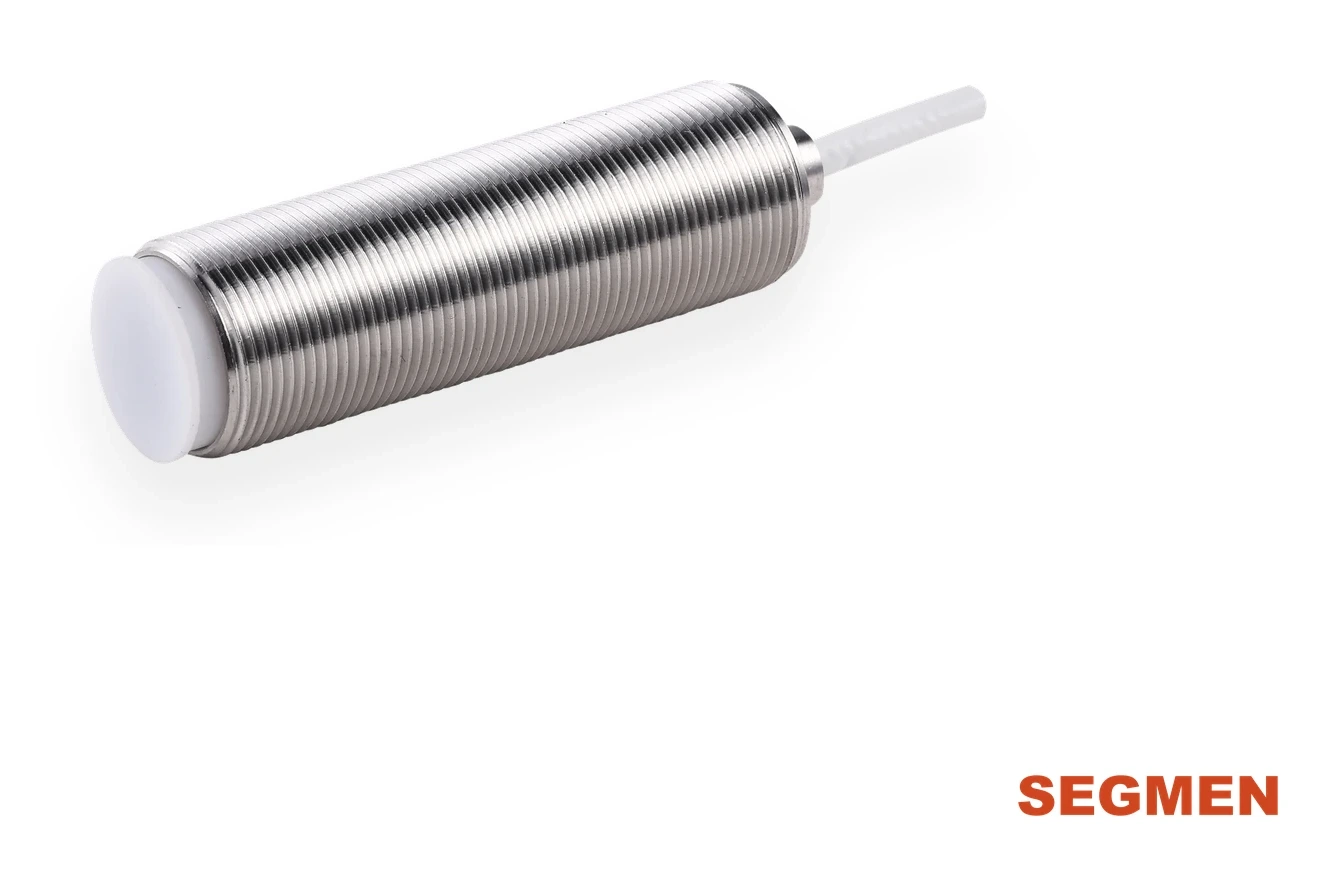
Product series: SGI-HT high-temperature inductive and SGC-HT high-temperature capacitive proximity sensors are supplied with silicone or PTFE cable.
When a proximity sensor fails in a hot machine, the cable is often the first part to go. A standard sensor has a PVC cable, and PVC softens with heat and becomes brittle in the cold. SEGMENsensor high-temperature sensors therefore come with silicone or PTFE cable. Both are "high-temperature cables", but they behave very differently when the cable moves, touches oil or is scraped along a machine frame. This guide explains the differences so you can specify the right one.
Why Standard PVC Cable Fails in the Heat
PVC is a thermoplastic: it softens as the temperature rises and hardens as it falls. In a hot zone the jacket becomes soft and deforms under clamps and bends; plasticisers migrate out over time and the jacket cracks. In the cold the jacket stiffens and cracks when it is bent. That is acceptable for the −25 °C to +70 °C range of a standard sensor, but not for a T120, T150 or T180 sensor. A cable rated below the sensor turns a high-temperature sensor back into a standard one.
PTFE vs Silicone at a Glance
| Property | PTFE (fluoropolymer) | Silicone rubber |
|---|---|---|
| Heat resistance | Very high; one of the highest among common cable insulations | High |
| Flexibility | Stiffer, thinner wall | Very flexible, soft; stays flexible in the cold |
| Behaviour in continuous motion | Limited flex life in repeated bending | Good for movement, but see abrasion |
| Abrasion and cut resistance | Good; hard, smooth surface | Lower; tears and abrades more easily |
| Oils, solvents, chemicals | Practically inert to most chemicals | Can swell in some oils and solvents |
| Surface | Non-stick: dirt and weld spatter do not adhere easily | Soft, can collect dirt |
| Under clamps | Can cold-flow under high clamping pressure | Compresses elastically |
| Typical use on sensors | Hot zones with oil, chemicals, spatter or abrasion; fixed routing | Hot zones where the cable is bent, moved or routed through cold areas |
General material characteristics; the rating of a specific cable is given in its datasheet.
The Sensor Sets the Temperature Limit, Not the Cable
Both materials are typically rated higher than the electronics inside a proximity sensor, so the upper limit of the complete product is the sensor rating: +120 °C, +150 °C or +180 °C for SEGMENsensor T120, T150 and T180 models. The temperature index of an insulation material is determined by long-term ageing tests, as described in IEC 60216-1 — Electrical insulating materials, thermal endurance properties ↗; this is why continuous ratings are lower than the short-term temperature a material can survive. Use the continuous rating when you compare cables.
Specify the Right Cable with Your Sensor
Tell us the temperature, movement and media along the cable route. We recommend silicone or PTFE and send the part number within 24 hours. MOQ 1 piece.
How to Choose for Your Installation
| Situation | Choose | Why |
|---|---|---|
| Cable moves with a door, carriage or tool | Silicone | Flexible, tolerates repeated bending |
| Hot zone with hydraulic oil or cutting fluid | PTFE | Chemically inert, does not swell |
| Welding, spatter or hot particles | PTFE | Non-stick surface resists spatter; for welding fields also see the weld-field immune series |
| Cable dragged over edges or frames | PTFE | Harder surface resists abrasion |
| Cable route passes through a cold area | Silicone | Stays flexible at low temperature |
| Cold store or outdoor, no heat | PUR (capacitive L models) | Oil-resistant and flexible in the cold |
Next to welding, the magnetic field is usually a bigger problem than the spatter; see the weld-field immune proximity sensors, which have a PTFE-coated brass housing and are immune to 150 mT welding fields.
Installation Tips for High-Temperature Cables
- Route the cable out of the hottest zone by the shortest path; the sensor rating does not help a cable that lies on a hot surface.
- Fix silicone cable with wide clamps so it is not cut; do not over-tighten clamps on PTFE cable.
- Where a PTFE cable must move, use a large bending radius and a loop rather than a tight bend.
- Keep the joint to the standard machine cable, or the M12 connector, outside the hot zone.
- Check the rating of any extension cable, connector and cable tie in the hot zone as well.
Frequently Asked Questions
Silicone and PTFE are the most common. SEGMENsensor high-temperature inductive and capacitive sensors are supplied with silicone or PTFE cable.
PTFE is stiffer, harder and chemically inert, with a non-stick surface. Silicone is soft and very flexible, also in the cold, but less resistant to abrasion and to some oils and solvents.
Silicone, because it tolerates repeated bending better. Use PTFE for fixed routing, or with a large bending radius if it must move.
No. The sensor rating (for example +150 °C for T150) is the limit for the complete product.
PUR stays flexible in the cold and resists oil and abrasion. SEGMENsensor capacitive L30 and L40 models use an oil-resistant PUR cable.
MOQ is 1 piece. Sample and production lead times are confirmed with your quotation, and every enquiry receives a written reply within 24 hours.
Related reading: High-temperature proximity sensor selection · High-temperature inductive proximity sensors · High-temperature capacitive proximity sensors · Weld-field immune proximity sensors
Last updated: 28 September 2026. Specifications reflect the SEGMENsensor product pages at the date of publication; datasheets and dimension drawings are sent on request.