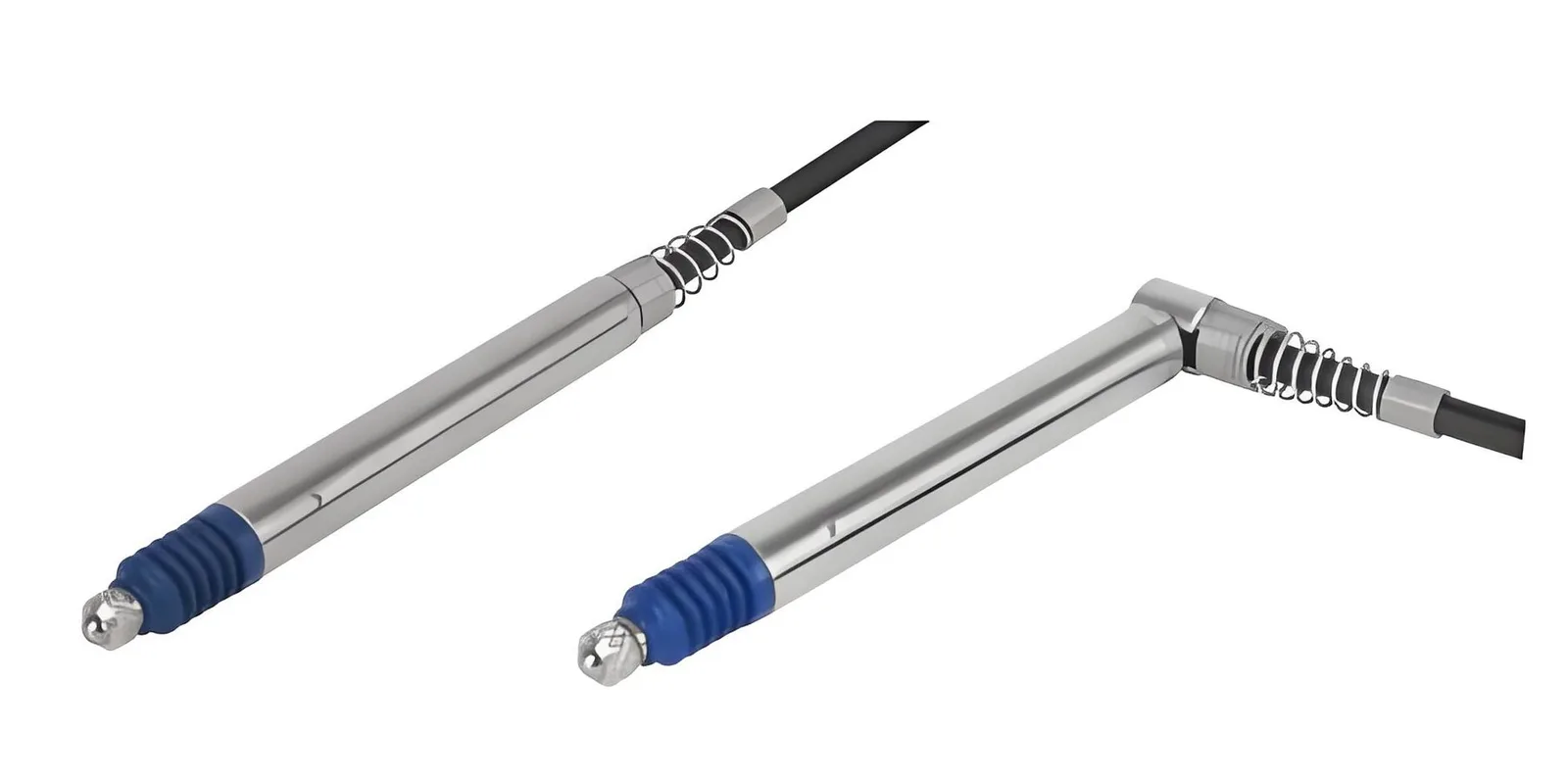
An LVDT (Linear Variable Differential Transformer) is a precision displacement sensor that converts linear position into a proportional voltage. A freely moving ferromagnetic core slides inside three coils — one primary and two differential secondaries. The output voltage is linearly proportional to core position, with infinite resolution, no mechanical contact, and no wear. Standard stroke range: ±0.5 mm to ±500 mm; accuracy: ±0.1–0.25% FS; temperature range: −55°C to +150°C.
What Does LVDT Stand For?
LVDT stands for Linear Variable Differential Transformer. Breaking down the name: "Linear" means it measures displacement along a straight line (as opposed to rotary sensors). "Variable" means the output changes with position. "Differential" means it uses two secondary coils wired in opposition to produce the output signal. "Transformer" describes the underlying electromagnetic induction principle — like a transformer, it uses coils and magnetic coupling, with no electrical contact between the primary and secondary circuits.
LVDT technology was developed in the 1940s and has since become one of the most widely used precision displacement measurement technologies in industrial and aerospace applications, valued for its combination of high accuracy, infinite mechanical life, and wide temperature range.
How an LVDT Sensor Works
Operating Principle — Step by Step
- Coil assembly: Three coils are wound on a hollow cylindrical former — one primary coil (P) at the center, flanked by two identical secondary coils (S1 and S2) wound in opposition to each other.
- AC excitation: An AC voltage (typically 1–10 kHz) is applied to the primary coil. This creates an alternating magnetic field in the core region.
- Free-floating core: A cylindrical ferromagnetic core slides freely inside the coil assembly without touching it, mechanically coupled to the object whose position is being measured.
- Differential coupling: At the electrical null (center) position, the core couples equally to S1 and S2. Since S1 and S2 are wound in opposition, their equal voltages cancel — output is zero.
- Linear output: As the core moves away from null, coupling to one secondary increases and to the other decreases. The differential output voltage is proportional to the core's displacement from null. Polarity indicates direction; amplitude indicates distance.
The most important engineering consequence of this principle: the core never makes contact with the coil body. There is a free air gap between core and coil throughout the full stroke. This means zero friction, zero mechanical wear, and theoretically unlimited cycle life — making LVDT the preferred choice for high-cycle fatigue testing, aerospace actuators, and any application where the sensor must outlast the machine it monitors.
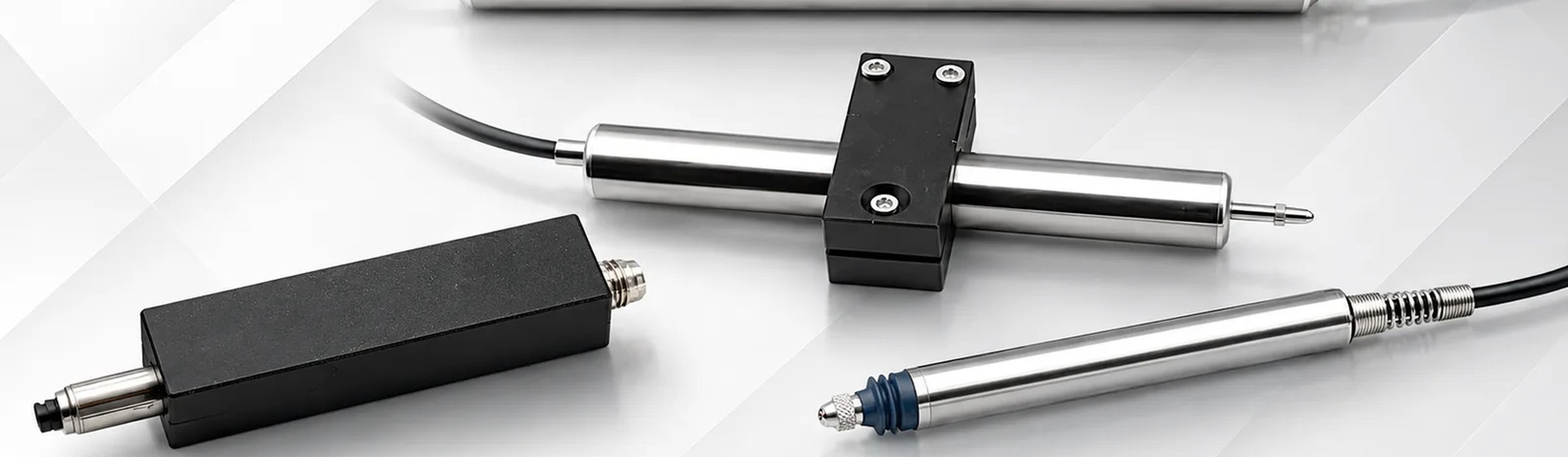
Key Specifications
Download the one-page LVDT datasheet (PDF)
The datasheet lists every stroke option from ±0.5 mm to ±500 mm, both linearity classes (±0.25% FS standard, ±0.1% FS optional), AC and DC output versions, supply voltage, operating temperature, IP rating, housing materials, dimensions and the ordering code. No registration required.
LVDT Output Types
The native output of an LVDT is an AC differential voltage — this requires a signal conditioner (demodulator/rectifier) to produce a usable DC output. SEGMENsensor LVDT sensors are available in three configurations:
| Configuration | Output | Wiring | Best For |
|---|---|---|---|
| AC LVDT (bare coil) | AC differential voltage (mV/V/mm) | 5-wire (P+, P−, S1+, S1−/S2+, S2−) | High-bandwidth test & measurement DAQ |
| DC-LVDT (conditioned) | 4–20 mA (2-wire loop-powered) | 2-wire | PLC/SCADA industrial measurement |
| DC-LVDT (conditioned) | 0–10 V or ±10 V | 3-wire | General industrial and test bench |
For new industrial installations, 4–20 mA loop-powered DC-LVDT is the most practical choice — it integrates directly with any PLC analog input, is immune to cable resistance variations over long cable runs, and requires no separate conditioner box in the field.
AC LVDT vs DC LVDT vs Spring-Loaded Gauging Probe
"LVDT" covers three physically different products. An AC LVDT is the bare coil-and-core transducer — it needs an external signal conditioner but gives the highest bandwidth. A DC LVDT has the oscillator, demodulator and output amplifier built into the housing, so it runs from 10–30 V DC and outputs 4–20 mA or 0–10 V directly. A spring-loaded gauging probe is an LVDT whose core is pushed against the workpiece by an internal spring, for dimensional inspection where the sensor tip must follow the surface. The figures below are taken from the SEGMENsensor LVDT product specification.
| Parameter | AC LVDT (bare coil) | DC LVDT (built-in conditioner) | Spring-loaded gauging probe |
|---|---|---|---|
| SEGMENsensor series | SDVG separate-core / SDVH, AC output version | SLT pen-type; SDVG / SDVH DC output version | SDVH (and SDVB) gauging probes |
| Stroke (full range) | ±0.5 mm to ±100 mm | ±2 mm to ±500 mm | ±0.5 / ±1 / ±2 / ±5 mm |
| Linearity | ±0.25% FS standard, ±0.1% FS on short-stroke probes | ±0.25% FS standard / ±0.1% FS optional | ±0.1% FS (ultra-high accuracy) |
| Repeatability | ±0.01% FS | ±0.01% FS | ±0.01% FS |
| Output signal | AC differential voltage (mV/V/mm), 5-wire | 4–20 mA (2-wire) / 0–10 V / ±10 V / RS485 Modbus | AC differential, or DC 0–10 V / 4–20 mA |
| Excitation / supply | 1–10 kHz, 1–5 Vrms from external conditioner | 10–30 V DC (built-in DC-DC converter) | 1–10 kHz (AC) or 10–30 V DC (DC version) |
| Core | Free-floating separate core, no contact with coil | Captive core in guided pen housing | Spring-returned core with ruby or carbide tip |
| Operating temperature | −40°C to +125°C | −40°C to +85°C (SLT) / +125°C (SDVG DC) | −40°C to +125°C |
| Protection / housing | IP67, 303 / 316L stainless steel | IP67, 303 stainless steel or aluminium alloy | IP67, 303 / 316L stainless steel |
| Typical use | High-bandwidth test rigs, DAQ, valve spool feedback | PLC / SCADA position measurement, press and actuator stroke | Gauging, dimensional inspection, surface profiling, CMM |
| OEM MOQ | 10 pcs | 10 pcs | 10 pcs |
Industrial Applications of LVDT Sensors
| Industry | Application | Why LVDT |
|---|---|---|
| Automotive | Engine test bench valve/piston stroke measurement | High vibration tolerance; high temperature; analog output for DAQ |
| Aerospace | Actuator position feedback, flight control surface | Non-contact; radiation tolerant; military-spec temperature range |
| Industrial automation | Hydraulic valve spool position, press ram position | High cycle life; short stroke; fast dynamic response |
| Materials testing | Tensile testing, fatigue testing, creep measurement | Sub-micron resolution; analog output synchronised to load cell |
| Civil/structural | Bridge deflection, building settlement monitoring | Long-term stability; weatherproof; no zero drift over years |
| Power generation | Turbine blade clearance, generator shaft displacement | High temperature; non-contact; no spark risk in generator housings |
| Medical devices | Patient positioning tables, surgical robots | No hysteresis; repeatable; MRI-compatible non-magnetic versions |
LVDT vs Other Displacement Sensors
Understanding when LVDT is the right choice requires comparing it to the alternatives:
| Technology | Contact? | Stroke | Max Temp | Absolute? | Cost |
|---|---|---|---|---|---|
| LVDT | No | ±0.5–±500 mm | +200°C (HT) | Relative | $$ |
| Magnetostrictive | No | 25–8000 mm | +85°C | Yes | $$ |
| Linear potentiometer | Yes (wiper) | 10–2,000 mm | +85°C | Relative | $ |
| Incremental encoder | No | Unlimited | +70°C | No | $–$$ |
| Optical (laser) | No | 0.01–100 mm | +50°C | Relative | $$$ |
The most common head-to-head choice is LVDT versus magnetostrictive: LVDT wins on short strokes, high temperature and bandwidth, while magnetostrictive gives an absolute position over strokes up to 8000 mm. Our detailed comparison — LVDT vs Magnetostrictive Sensor: Which to Choose — walks through stroke, accuracy, output and cost for both technologies. Full LVDT model data is on the LVDT displacement sensor product page.
Frequently Asked Questions
LVDT stands for Linear Variable Differential Transformer. It is an electromechanical transducer that converts linear displacement into a proportional electrical voltage. The name describes the operating principle: a transformer with two secondary coils wound in opposition (differential), where output voltage varies linearly with the position of a movable iron core.
An LVDT has three coils: one primary (center) and two secondary coils wound in opposition on either side. AC excitation applied to the primary induces voltage in both secondaries. A free-floating ferromagnetic core slides inside without contact. At the null position, secondary voltages cancel. As the core moves, the differential output voltage increases linearly with displacement — polarity indicates direction, magnitude indicates distance.
SEGMENsensor LVDT sensors are available from ±0.5 mm to ±500 mm stroke. Choose a stroke length where expected displacement is within 80% of full scale for best linearity. For strokes above ±500 mm, magnetostrictive sensors are typically the better choice.
AC LVDT: raw AC differential voltage (mV/V/mm), requires external signal conditioner. DC-LVDT with built-in conditioning: 4–20 mA (loop-powered, 2-wire), 0–10 V (3-wire), or ±10 V (bipolar). For industrial PLC/SCADA use, 4–20 mA is the most practical. For test-and-measurement DAQ, AC output with a phase-sensitive demodulator gives highest bandwidth.
LVDT linearity is the maximum deviation from a straight line between full-scale points, expressed as % FS. Typical values: ±0.1–0.25% FS. On a ±100 mm LVDT with ±0.1% FS linearity, worst-case positional error is ±0.1 mm anywhere in the range. Better linearity means more accurate position readings across the full stroke.
Yes. Standard LVDTs operate −55°C to +150°C; high-temperature versions to +250°C or beyond using ceramic insulation. The coil-and-core construction has no electronics in the measurement element — making it inherently suited to high temperature, vibration, and radiation. ATEX/IECEx versions are available for hazardous areas.
LVDT is non-contact — the core never touches the coil housing — giving theoretically infinite mechanical life with no friction or wear. A potentiometer uses a sliding wiper contact that wears over time. For precision measurement in long-life or harsh environments, LVDT is strongly preferred despite higher cost.
Automotive (engine testing, suspension measurement), aerospace (actuator feedback, flight control), industrial automation (hydraulic valve position, press control), materials testing (tensile/fatigue machines), civil engineering (structural health monitoring), and power generation (turbine clearance, generator shaft position).
Last updated: September 22, 2026 — added AC / DC / spring-loaded comparison table, product photos and datasheet download.